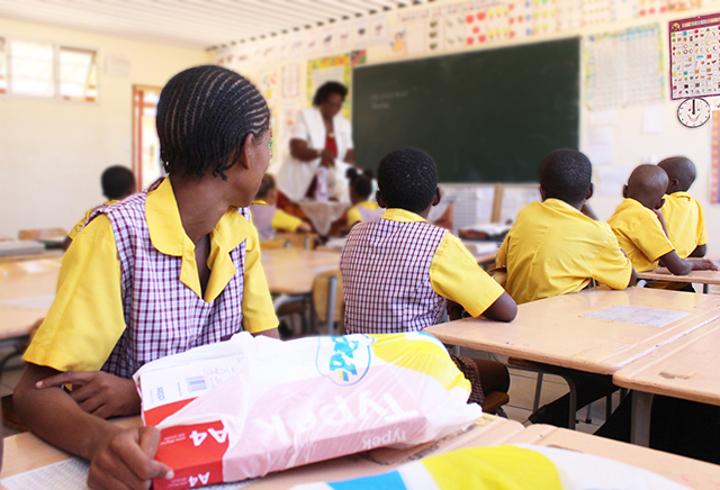
Africa-Press – Namibia. THE World Food Programme (WFP) says it needs N$71 million between now and August to feed 424 000 pupils countrywide.
The WFP country operational update report shows that pupils from 1 530 schools in 14 regions continuously benefit from the National School Feeding Programme’s fortified maize blend. The WFP launched the Home-Grown School Feeding Programme (HGSFP) in November 2021, which saw a total of 13 915 pupils benefit.
“The programme aims to provide diversified nutritious meals sourced locally from smallholder farmers. For countrywide reach, the government is in the process of expanding this programme to an additional 29 schools in seven regions,” stated the report.
WFP is also strengthening food systems through supporting smallholder farmers in the Zambezi region. The initiative is part of their integrated community-based food systems projects.
“These farmers have begun piloting barley production to support poultry farming at the Liselo youth poultry project and the Choi women poultry project. To date, 20 000 tomato seeds have been planted, while over 20 000 cabbage seedlings have been transplanted by the Kopano Farmers Group,” stated the report.
The harvest is earmarked for a readily available market in Namibia and Botswana. The WFP has also contracted the Roots agriculture project, a village-based model which combines intensive farming of livestock and permanent crops, as a service provider for technical expertise towards the upscaling of integrated food systems.
Roots agriculture will provide the service to projects at Stampriet, Tsumkwe and Berseba. “To date, Stampriet Primary School operates a chicken coop with a capacity of 1 000 broilers and 1 000 layers. To ensure a continuous supply of chicken to sustain the operation, 500 broiler chickens are due for learners’ consumption and market offtake in 35 days,” stated the WFP.
The report further explained that a variety of vegetables have also been planted using smart agriculture to ensure pupils’ balanced diets and nutrient requirements.
“WFP intends to use this school food systems model as a replica for other projects across Namibia in partnership with correctional facilities, communities, schools, and clinics,” the report stated.
For More News And Analysis About Namibia Follow Africa-Press