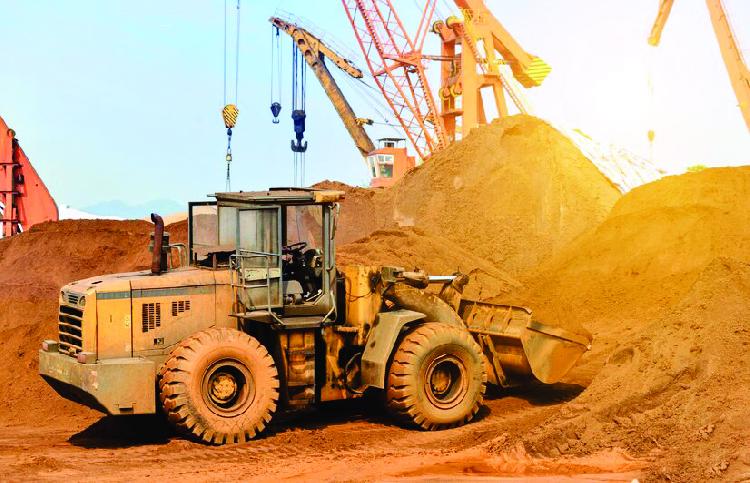
Africa-Press – Namibia. AUSTRALIAN mining company Paladin Energy Limited is seeking A$215 million (N$2,3 billion) to restart operations at its flagship Langer Heinrich uranium mine in the Namib Desert.
This would be raised through the sale of shares at A$0,72 (N$8,60) per share.
The offer opens on 7 April and closes on 26 April, but it is not all open to everybody.
The equity raise comprises a single tranche fully underwritten share placement to raise A$200 million and a non-underwritten share purchase plan to be offered to eligible Paladin shareholders in Australia or New Zealand to raise up to an additional A$15 million.
The company held an equity raising presentation last week, where management said the new dream is for Paladin to feature among the top 10 global uranium producers.
The restart of production at Langer Heinrich has been supported by a successful uranium marketing strategy, which included the company announcing a uranium sales tender award for an offer to supply uranium concentrates to a subsidiary of Duke Energy, a leading Fortune 150 North American power utility.
This is some 5% of the expected production.
Not all funds will go towards the restarting of the mine – restart mining capital is set at A$116 million (N$1,3 billion) and A$99 million (N$1,1 billion) would be spent on working capital and fees.
Langer Heinrich mine is 75% owned by Paladin Energy, while 25% is owned by China National Nuclear Corporation (CNNC).
Paladin sold a 25% stake in the mine to the CNNC for about N$2 billion in 2015, netting the company a healthy windfall, and recording a N$665 million profit – attributed to the sale of shares.
This sale also meant that 25% of production was to be sold to CNNC in an offtake agreement.
Although capital will be raised now, the commercial production target is in 2024, although the formal restart launch is set for July this year.
In the presentation, Paladin said restarting operations at Langer Heinrich would cost about US$87 million.
The mine still has a lifespan of 17 years, supported by ore reserves of 84 tonnes.
Paladin said it must still engage CNNC for funding to restart operations.
“With the strength of the company’s existing uranium sales offtake with CNNC combined with the recent successful tender award, and the continuing strong uranium market fundamentals, Paladin can now confidently work towards a formal commencement of the Langer Heinrich mine restart project,” said chief executive Ian Purdy.
“The extensive work streams we have conducted reinforce our confidence in Langer Heinrich as a low risk, robust, long-life operation that is poised to take advantage of the improving uranium market conditions and deliver sustainable value creation for all of our stakeholders,” he added.
Shares on the Namibian Stock Exchange on Monday were trading at N$8,75.
In January, The Namibian reported that uranium trading, exploring and mining companies were the best performing companies on the Namibian Stock Exchange last year and leading this pack was Paladin Energy whose share price was up 260%.
On the back of this spike was the possible return of uranium spot prices, which edged up to US$43 on long-term contracts.
Local active uranium mines such as Langer Heinrich, Orano’s Trekkopje mine, Etango mine and Valencia mine are still in care and maintenance, waiting for spot prices to reach at least US$55 per pound.
At that level, these mines, which have lower grade ore, are able to operate profitably.
Paladin Energy shares closed the year at N$10,16 after starting 2021 at just N$2,82.
During December last year, the Bank of Namibia indicated that the normal average international uranium spot price had increased by 12% to reach US$33,56 per pound.
In addition, the demand for nuclear energy as a clean and efficient power source has increased and that has pushed up prices, the bank said in its last quarterly update.
The central bank said if projected 10 years ahead from October 2021, uranium prices are expected to trend upwards as energy firms are set to phase down coal usage.
In addition, China plans to build up to 150 new nuclear reactors over the next 15 years, while Japan plans to put 30 reactors back to activity to meet emission goals.
“In this regard, Namibia is well positioned to benefit from sustained higher prices, as it has about four uranium mines,” the bank said.
For More News And Analysis About Namibia Follow Africa-Press