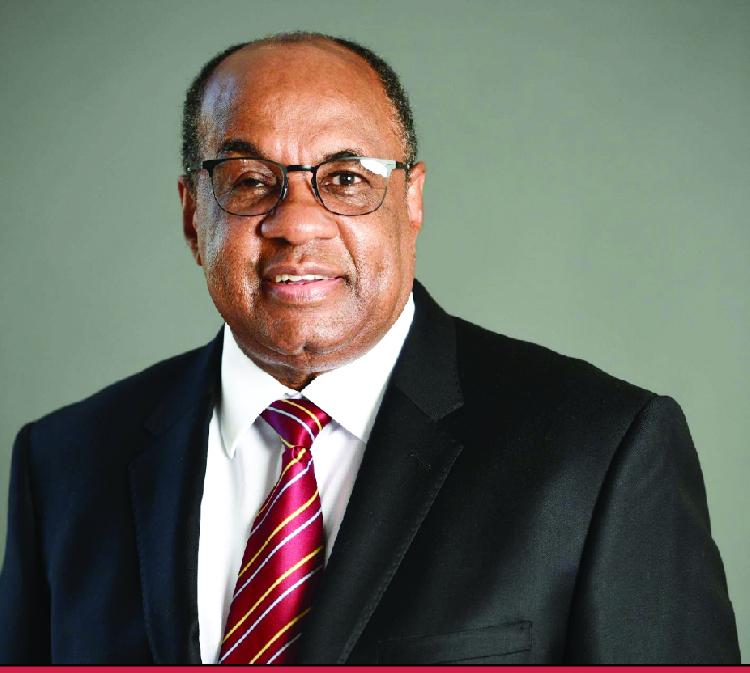
Africa-Press – Namibia. BANK of Namibia (BoN) governor Johannes !Gawaxab yesterday called on local commercial banks to consider reducing their lending rates – while he and his team increased the benchmark rate.
The benchmark interest rate was upped from 4% to 4,25%, while !Gawaxab said some members of the deciding committee were pushing for the rate to reach 4,5%.
Announcing the decision by the monetary policy committee, the governor said by increasing the repo rate, the bank was ensuring that the one-to-one Namibia dollar and South African rand is preserved, and it will allow the country to undertake its financial obligations.
This increase, however, appears to pay less attention to ever increasing prices of goods and services – and this increase will by no means make it easier for consumers.
But he said there is a solution – and it lies with commercial banks.
The governor said if only commercial banks would reduce the rate for loans, it would lessen the pressure on the consumers’ wallets which are under attack from price increases on all fronts – oil, food, transport and other household goods.
“I would like to appeal to the local commercial banks to seriously consider reducing the spread, to at least 3,5%,” he said.
This spread is the difference between the repo rate and the prime lending rate – the two rates, following yesterday’s increase, now stand at 4,25% and 8%, respectively.
“It is going to help consumers,” said !Gawaxab.
He added that Namibia has the highest spread between the prime lending rate and the repo rate.
“Botswana has a 200 basis points, same for Nigeria, while South Africa has a 350 basis points difference, reducing Namibia’s from its current 375 basis points would really help,” he said.
Namibian banks, despite the dip, are still recording multimillion-dollar profits.
At the end of 2021, these banks loaned out over N$104 billion through various schemes – and pocketed on average a profit of N$160 million every month.
In December last year, the banks made N$248 million in profit, the highest for the year, thus a reduction in the lending spread would still see the banks in a profitable state.
Analysts had predicted that the central bank was certainly going to increase the rates, while !Gawaxab said the rates will certainly increase, either gradually or at once.
Reacting to the increase, PSG Namibia’s Michelle Louw said the announcement was on par with expectations.
“The repo rate decisions do not only take into account the most recent inflation figures (of 4,5% y-o-y for February 2022 in Namibia), but more importantly, also consider future inflation expectations. We have seen further increases in Namibian fuel prices since February’s inflation figures were announced, for example. In order to keep future inflation contained, the repo rate was increased. It is worth remembering that the central bank has a mandate to promote price stability in the country,” she said.
Louw added that Namibia’s inflation is largely imported at this stage through higher global fuel and food prices, and is not significantly driven by local demand recoveries in general at this stage. In this regard, it is preferred that the repo rate was not hiked at a faster pace.
She further added that being consistent with the 25 basis point hikes in the repo rate, reduces the risk of larger increases in future.
Namibia’s repo rate is now on par with South Africa’s.
“Usually, it is preferred that Namibia has a slightly higher repo rate than its southern neighbour in order to mitigate the risk of capital flight. Higher interest rates are supposed to encourage savings which in turn should support economic growth,” she said.
Simonis Storm’s analyst Theo Klein said there is still more trouble to come, and consumer woes amid a troubled financial period are not over just yet.
“We maintain our view that BoN is likely to hike by another 75bps before the end of the year,” he said.
At the end of March, the country had a stock level of international reserves standing at N$40,8 billion, compared to N$43 billion at the end of February.
This balance is equal to 5,5 months of import cover, and has reduced over the month due to high international oil prices which skyrocketed the Namibian import bill for the month.
The next MPC meeting will be held on 13 and 14 June, and the announcement the day thereafter.
For More News And Analysis About Namibia Follow Africa-Press