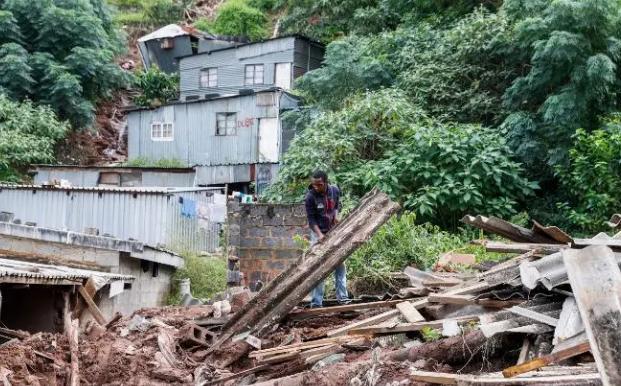
Africa-Press – Namibia. SOUTH Africa’s coastal province KwaZulu-Natal was hit by more rain over the weekend after the deadliest storm to hit the country in living memory killed nearly 400 people and left tens of thousands homeless.
The floods have damaged more than 13 500 houses and completely destroyed around 4 000. On Sunday, 27 people were still missing and 40 000 residents are left without shelter.
Floodwaters engulfed parts of Durban earlier in the week ripping apart roads, sweeping away homes and those trapped inside, and pulling down heavy cargo containers.
Clean water is scarce and authorities have promised to deploy water tankers. The government has announced one billion rand in emergency relief funding.
“Just as we thought it was safe to get out of (the Covid) disaster, we have another disaster, a natural disaster descending on our country,” President Cyril Ramaphosa said in a Good Friday speech.
More than 4 000 police have been deployed to affected areas to support relief efforts and maintain law and order. Emergency services were on high alert as weather forecasters predicted more rain over the Easter weekend.
“It’s already raining in some parts of KZN but it won’t be as hectic as it was in the past few days,” Puseletso Mofokeng, senior forecaster at the South Africa Weather Service, told the AFP news agency.
“But because of the soil being over-saturated with water, we can still get a lot of flooding,” he warned.
In an opinion piece, associate professor Hope Magidimisha-Chipungu of the University of KwaZulu-Natal said the floods wreaked havoc because people are forced to live in disaster-prone areas.
“The unavailability of suitable land for adequate housing is due to stunted progress in urban land reform. This, in turn, is crippling the capacity of local governments to provide adequate housing in areas that are not prone to disaster,” she said.
“A quarter of South Africa’s urban population is living in informal settlements. These are built wherever people find open spaces that are nearer to economic opportunities.
“They lack basic amenities and infrastructure, including proper roads and stormwater drainage systems. This leaves their residents most vulnerable to the effects of climate change and changing weather patterns, such as floods.”
She said Ethekwini’s geographic information system shows that some of the vacant land being encroached on by informal settlements falls under the 50- or 100-year flood lines.
“Living within areas demarcated as flood lines is not only illegal but also very dangerous.”
For More News And Analysis About Namibia Follow Africa-Press