Africa-Press – Namibia. Eveline de Klerk
Kuzeeko Tjitemisa
Steven Klukowski
WHILE celebrating May Day, politicians hailed the great strides made to improve the lives of workers in independent Namibia, and trade unionists pleaded for a more professional and responsive approach by labour officials. President Hage Geingob has said although Namibia has made significant progress as a country in guaranteeing safe working environments for workers, there is still much more to be done.
“As we march during the Fourth Industrial Revolution by embracing automation, robotics and the future of work, we will align our legislation with best practices globally to ensure that the interests of the workers are protected,” Geingob said in his Workers’ Day message on Sunday.
May Day, also known as Labour Day or Workers’ Day, falls on 1 May, and it is a public holiday in over 80 countries. Geingob urged workers and employers to reskill and retool for Namibia to become more competitive as the country prepares its workforce for the future of work.
Moreover, the president said the public and private sectors must work in partnership to include the youth in the economy by creating more employment opportunities. Geingob said he recognises the efforts of the country’s frontline workers, men and women in uniform, who during the Covid-19 pandemic risked their lives to save the lives of citizens.
“I also acknowledge all those whose efforts continue to advance the rights of workers and advocate for workers’ welfare,” Geingob said. He said, as we celebrate Workers’ Day, workers should forge ahead with renewed commitment and work together in building a fair, equitable and safe post-Covid 19 recovery for the citizens of the Namibian house.
Since independence, Geingob said, the government has been committed to the advancement of Namibian workers by putting in place several interventions to guarantee fairness, protect their safety and improve their working conditions. In addition to legislation that guarantees and protects workers’ rights, Geingob said during the outbreak of the Covid-19 pandemic, the government provided relief to employers to protect employees against the socio-economic scarring caused by the pandemic.
Swapo Party Youth League secretary for labour and justice Willem Amutenya in his May Day message acknowledged the determination and perseverance of the contract workers of the time, who organised themselves to fight for freedom and independence.
“They fought to win. It was their national unity and stamina which culminated in the formation of Swapo party as a national liberation movement,” he said.
“As we celebrate this Labour Day, we wish to honour and salute the spirit of all the workers, who are the founders of Swapo party. In so doing we call on all young professionals of Namibia to carry the torch forward under the umbrella of NUNW and Swapo party,” he said.
Amutenya further said the aim is genuine economic independence under which every worker is respected and works in a dignified environment. During a May Day celebration in Luderitz on Sunday, fisheries and marine resources minister Derek Klazen said the rights of workers are important and deserve utmost protection, hence their right to join a trade union of their choice is enshrined in the Constitution of Namibia and freedom of association.
“This talk is not just about joining any labour union or any formation claiming to represent workers, but this talk is about asking you to know and learn to trust your fate in the hands of only people with the necessary experience and tested leadership,” he said.
Klazen also encouraged employers to impress workers to make their choice and join the right trade unions as a means to ensure employees have the best bargaining and leverage powers when signing recognition agreements with various employers countrywide.
“Doing so is very important – not just to ensure that your demands are met but that labour relations in the country are improved for the better,” he said. He said he observed with great sadness how some workers are filled with false hope and vigour to partake in illegal strikes as advised by activist trade unions, resulting in the loss of jobs.
“You are also losing out on opportunities to care for and feed your families when taking part in such actions,” he warned. “The government and the ministry of fisheries remain open to peaceful and respectful mutually beneficial engagements, aimed at improving the livelihoods of the working class through job security promotion and compassion towards the plight of the working classes,” he assured.
In a statement, read on his behalf by his deputy Hafeni Ndemula in Luderitz, labour minister Utoni Nujoma said by celebrating Workers’ Day, the whole nation seeks innovative and effective ways to overcome the ravages of the Covid-19 pandemic. “I regret to say that not all employers view trade unions as a positive force in Namibia’s socio-economic development,” said Nujoma.
He also said too many workers are subjected to violence and harassment at work, including gender-based violence and sexual harassment. ‘’A large component of Namibian workers are trying to earn a livelihood without legal protection, a situation that must be reversed if we are to move forward as a nation,’’ he said, and called on workers to try to work together to achieve the economic and social justice they aspire for.
A retired fisherman, Johannes Weiss (72) said they used to work under harsh conditions during the apartheid era, but interventions such as trade unions today improved the livelihood of workers to a great extent. “Their rights are nowadays recognised and respected, whereby they are now entitled to benefits like pension and medical aid,” Weiss explained. Another female employee, who spoke under anonymity, said the celebration of May Day is important in the sense that the uninformed workers can be educated on their basic human rights according to the law and regulations in place at such platforms.
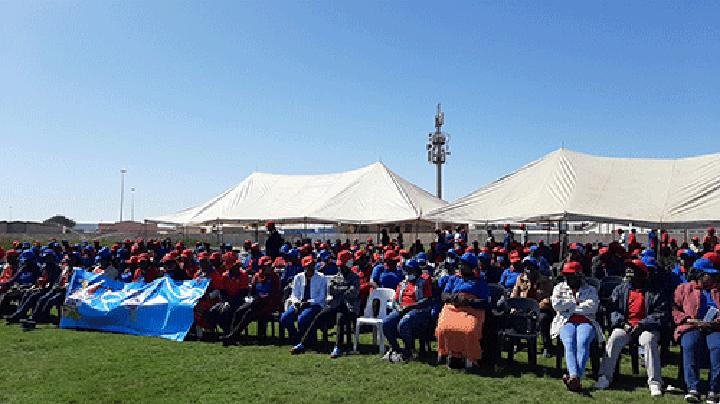
“Unfortunately, not all fellow workers have access to the internet to search for relevant websites; hence, this intervention can now make them aware of the stipulation in the Labour Act pertaining to their rights, she added. At an event marking May Day on Sunday in Kuisebmond, labour and health inspectors at the coast were accused of attending to personal matters and turning their offices into hair salons while workers are fighting unfair labour practices.
This was highlighted by unionists and workers affiliated with the Trade Union Congress of Namibia (Tucna). Reflecting on the day, Daniel Imbili added labour and health inspectors are failing the workers by not properly investigating unfair labour.
“Unions have identified companies that are exploiting workers but they remain silent on this matter. Imagine, we have workers who have been employed as casuals for the past nine years, yet the ministry is silent on this,” Imbili explained.
“They don’t even show up or visit companies to make sure the labour law is enforced,” Imbili said. Labour cases too costly Tucna president Paulus Hango said labour cases have become a burden to workers and unions, as cases continue to drag on for years. “In some instances, it costs N$500 000 to finalise a case. As a result, you have to spend just as much on legal fees and other expenses.
We also have to wait for three months before a hearing date has to be set. That is, we struggle with the ministry. A case that could have been finalised in three months will take you up to five years to be finalised,” Hango explained. Meanwhile, Immanuel Petrus from the Mining, Metal, Maritime and Construction Workers Union also shared the same sentiment, saying the labour ministry is not responsive to the needs of the workforce.
“They are, indeed, failing our workforce. We are not happy with their services. I can take a case today to the ministry but I will only get assistance three months later. Some companies are not complying with the Labour Act, yet the labour ministry fails to hold them accountable,” Petrus said.
For More News And Analysis About Namibia Follow Africa-Press