Africa-Press – Namibia. THE government, in collaboration with NamWater, is finalising preparations to start the public-private partnership procurement stage to construct another desalination plant at the coast.
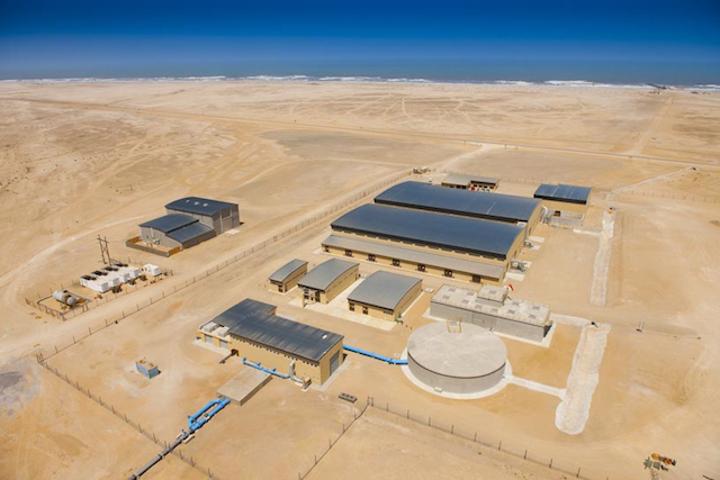
This is envisaged to be a modular desalination plant facility, which is scalable to further supply desalinated water to the central areas and also supply Botswana over time.
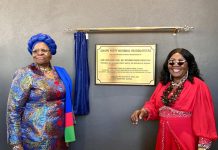
This was said by the minister of agriculture, water and land reform, Calle Schlettwein, when he inaugurated the N$100 million Rössing Uranium Water Reservoirs at Arandis in Erongo region last week.
“The unpredictable sulphur outbreaks in the ocean occasionally disrupt the desalination of sea water at the Orano plant, which is a crucial source of fresh water for the central west coast water region generally and Rössing mine specifically,” he said.
According to the minister, of the total demand for fresh water, roughly 50% is met from the Orano desalination plant.
“This temporary stoppage of supply from the desalination plant does not only put great strain on the security of water supply for the whole region – the community of coastal towns and other mines and industries, but understandably also on the mine’s production, as water is a key input utility in the mining operation.
“Up until now, the three NamWater reservoirs are used for supplying Arandis and Rössing Mine with fresh water and also for providing buffer capacity when there are disruptions of water supply from the desalination plant.
“At the same time, the same buffer capacity was reserved for Arandis town during periods when NamWater lacked sufficient water to supply capacity,” he said.
Under such conditions, when the reservoir levels drop, the mine had to cease operations; until such time that the reservoir level had recovered sufficiently to safely resume operations, the minister added.
“Such interruptions are unsustainable and often lead to Rössing Mine incurring significant production losses.
“To alleviate this problem, these reservoirs have been constructed to complement the storage capacity that is provided by NamWater reservoirs. This will enable the mine to continue with production for seven additional days during periods of extended water supply outages.”
It means that with the additional storage capacity, unforeseen extended water interruptions can be bridged and security of water supply is significantly improved for both the mine and the community of Arandis, Schlettwein added.
“It is thus pleasing to note that the mine is already reaping the returns from its investment, as it was able to sustain operations late last year when there was a planned maintenance shutdown at the Orano plant,” he said.
The minister added that the impact of investment of this nature on the sustainability and operations of Rössing Uranium Mine signifies the macro-criticality of secure water supply to enable and sustain investments, particularly in the mining sector.
He said the government, through NamWater, has been working continuously to rehabilitate and replace the coastal pipeline network, and develop new water schemes, like the Kuiseb scheme to increase capacity, which will ensure water supply security for all coastal communities.
Schlettwein was pleased to note that the construction was done by a local contractor, who was responsible for all the on-site construction activities, while 100 employees were contracted over the duration of the project.
“This investment aligns well with the national goals of achieving water supply security for industry and households,” said Schlettwein.
For More News And Analysis About Namibia Follow Africa-Press