Africa-Press – Namibia. WHEN Namibia University of Science and Technology (Nust) graduate Johannes Shiwombolo was retrenched after only three months on the job, he refused to allow his world to crumble.
“I started thinking of what to do next, because sitting idle at home was not an option for me,” he says.
With an honours degree in chemistry, Shiwombolo started researching chemicals, and it dawned on him that manufacturing cleaning materials would be ideal in the face of hepatitis E and Covid-19 outbreaks.
He started working from home in Okuryangava, and his first product was dishwashing liquid. “I had very little capital, but I decided to start working – even if it meant producing a single product. I worked from home because that was the most logical thing as I had no workshop,” he says.
Shiwombolo relocated to the government-owned Oshapaka Industrial Park in Windhoek’s Northern Industrial Area last month. The big challenge was the health hazard of handling chemicals in a residential space and the available space was not enough to handle large productions.
His breakthrough came in January last year when he won a pitching competition for the best idea at an entrepreneurship masterclass hosted by ML Foundation.
Shiwombolo scooped the top prize of N$10 000 sponsored by first lady Monica Geingos, which enabled him to buy more chemicals and equipment. Geingos commited to procure her household detergents from Shiwombolo’s business as a way of supporting the venture, he says.
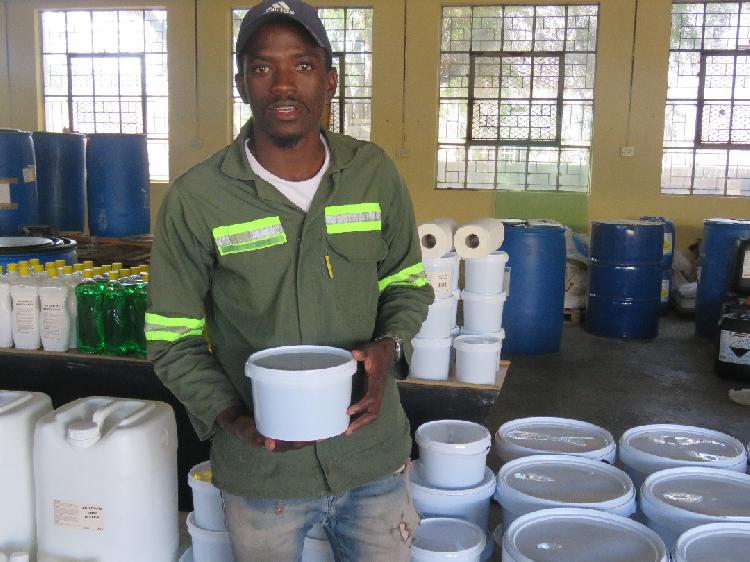
He now manufactures between eight and 10 products, including multipurpose surface cleaner, window cleaners, floor cleaners, thin and thick bleaches, toilet-bowl cleaners, dishwashing liquid and sanitisers.
The young entrepreneur says although he has supplied a few companies and a night clubs, as well as individuals with cleaning materials, he is canvassing for more customers.
“I plan to supply cleaning materials to government departments and tourism establishments,” he says.
Shiwombolo says limited working capital has hindered his marketing programme as he cannot print posters and other promotional material. “However, I use social media platforms to market my products,” he says. He currently has one employee, but will be employing more as the situation improves, he says.
Shiwombolo says he gets his raw materials, which include caustic soda, alkaline, pine oil, disinfectants and thickening agents, from local suppliers, although in future he plans ordering directly from suppliers in South Africa to cut costs.
He says launching his company during the Covid-19 lockdown has motivated him to produce cleaning materials because everyone needed one cleaning material or the other – especially sanitisers.
However, the lockdown presented a new challenge, since people could not freely visit his home to buy his products. “However, this gave me time to improve my products,” he says.
As a new entrant into the sector, he had to compete against established brands. “It is also difficult to meet decision-makers, especially in the government, because of bureaucracy,” he says.
“In business one must meet the right people to get the right decisions on time,” he says.
Shiwombolo says although things are hard at the moment, he is optimistic they will get better, and he will not stop fighting for his dream to be a successful business person who will employ at least 50 people in the next five years.
He advises aspiring entrepreneurs to knock on as many doors as possible. He appeals to the government to invest more resources into the manufacturing industry.
“The country has a lot of raw materials, but these are sent abroad only for the country to import finished products like toothpicks, cleaning materials and the like that can be manufactured locally.”
Shiwombolo is calling for some protection scheme for local manufacturers against cheap imports if the same product can be made locally. “We need to cut on imports to create a market for local products. This will help to create more employment in the country,” he says.
According to the Namibia Statistics Agency, Namibia imported N$72 million worth of soap, cleaning and polishing products in October last year despite the growth of the local cosmetics and cleaning materials industry. In the same month, the country exported similar products worth only N$1 million.
For More News And Analysis About Namibia Follow Africa-Press