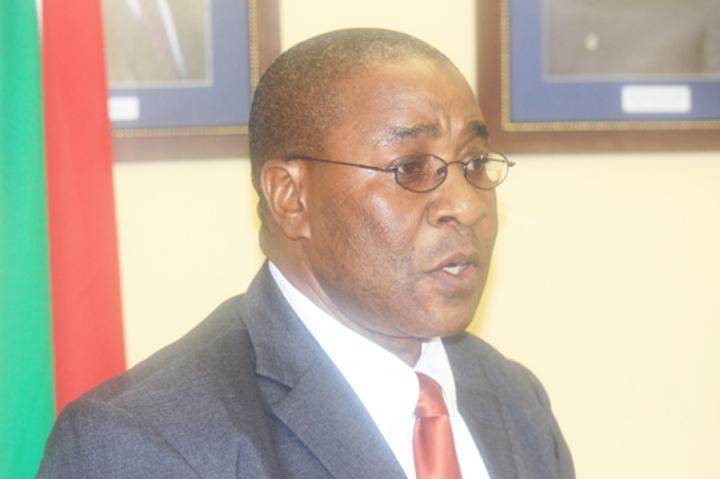
Africa-Press – Namibia. ZAMBEZI regional governor Lawrence Sampofu has urged local and traditional authorities to play an active role in assisting the government to create awareness around efforts to curb the spread of malaria.
He made this call during the Namibia-Zambia cross-border malaria initiative’s belated World Malaria Day commemorations, held at Katima Mulilo on Friday.
World Malaria Day is commemorated on 25 April. This year the theme is ‘Advance Equity, Build Resilience, End Malaria’.
According to Sampofu, the region is still experiencing a high number of perennial malaria outbreaks, despite interventions like vector control through indoor residual spraying (IRS), treatment of positive cases and extensive health education in the community.
He revealed that since the beginning of the year, the Zambezi region reported 5 460 positive cases and six deaths.
“This is not a good indicator, bearing in mind that our aim as a country is to eliminate malaria by the year 2030. Some of the contributing factors towards the outbreak is due to low IRS where there is hesitancy and resistance to spraying,” he said.
Sampofu emphasised that malaria emerges from the community and said it is the duty of community leaders to ensure that the correct information is shared extensively.
“We are all aware that the demographics and culture of the Zambezi region are shared with Zambia. This exposes the two countries to high possibilities of outbreaks, since mosquitoes have no border.
We cannot run away from the fact that a sick society is a non-productive society. Hence, the reason that health miniseries from both countries should work hand in hand with their communities to mitigate the transmission of malaria,” he said.
The regional chairperson of Faith Leader Advocacy for Malaria Elimination (Flame), Moses Musukubili, noted that the country’s economic downturn has affected the malaria response because sustainable livelihoods and health go hand in hand.
“I want to say to you as leaders that increasing resources for malaria and ensuring that our communities have access to malaria prevention and treatment options will save lives, and health systems will not be burdened by malaria.
I would like to encourage my fellow Flame leaders to take up the call of the movement, and become advocates for the elimination of malaria in Namibia,’ he said.
For More News And Analysis About Namibia Follow Africa-Press