Africa-Press – Namibia. NEIGHBOURING South Africa’s statistics bureau has indicated that between January and March this year, economic activity has bounced back to before Covid-19 levels, with eight of the 10 key sectors all recording growth.
The first quarter of 2022’s growth of 1,9% became the second consecutive growth quarter for the country, which had most of its gains wiped away by Covid-19-imposed trade restrictions.
At the end of March, Statistics SA (Stats SA) indicated the South African economy was valued at N$1,153 trillion in terms of output – a recovery from mid-2020 when it slumped to less than a trillion dollars.
Stats SA said the size of the economy is now at pre-pandemic levels, with real output slightly higher than what it was before.
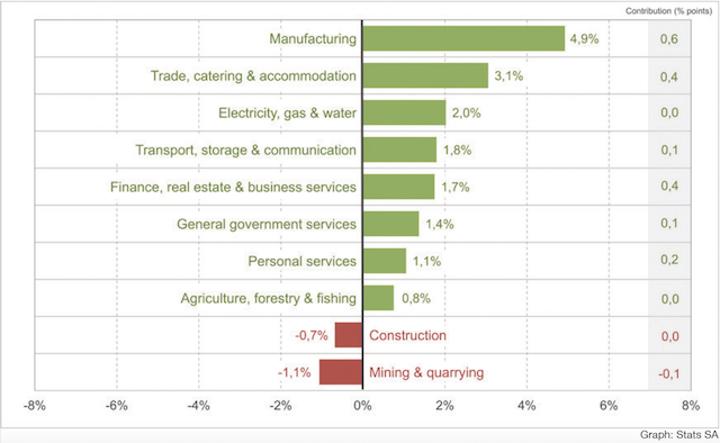
On the production side of the economy, eight of the 10 industries recorded positive growth in the first quarter, with manufacturing being the star performer, recording a 4,9% growth.
The sharp increase in manufacturing output was mainly driven by a rise in the production of petroleum and chemicals, food and beverages, and metals and machinery.
Finance, real estate and business services, as well as trade also made sizable positive contributions to gross domestic product (GDP) growth.
Trade activity was buoyant in the first quarter, with positive results from wholesale, retail, motor trade, and catering and accommodation.
After a strong fourth quarter, agriculture growth was more subdued in the first quarter, edging higher by 0,8%.
The rise in the first quarter was mainly underpinned by increased horticulture production.
On the downside, both mining and construction contracted in the first quarter at -1,1% and -0,7%, respectively.
Mining output was lower, mainly due to a pullback in the production of platinum group metals, iron ore and gold.
Construction saw its fourth consecutive quarter of contraction, with underwhelming results reported for residential buildings and construction works.
Stats SA also measures the expenditure side of GDP, providing an indication of total demand in the economy. Household consumption, government consumption, gross fixed capital formation, exports and imports all continued to grow in the first quarter.
Economic activity related to non-residential buildings, however, increased in the first quarter.
Imports were boosted by a rise in demand for motor vehicles, parts and accessories, mineral products, and animal and vegetable fats.
The economy also recorded a rise in exports, mainly driven by increased trade in motor vehicles, parts and accessories, mineral products, and machinery and equipment.
The automotive sector plays an important role in both export and import markets, as outlined in a recent article that tracks the flow of products through the South African economy.
Household consumption increased by 1,4% in the first quarter. The hospitality sector in particular saw a sharp rise in activity as consumer spending on restaurants and hotels increased by 6,5%.
The Namibia Statistics Agency is expected to release local figures at the end of this month.
For More News And Analysis About Namibia Follow Africa-Press