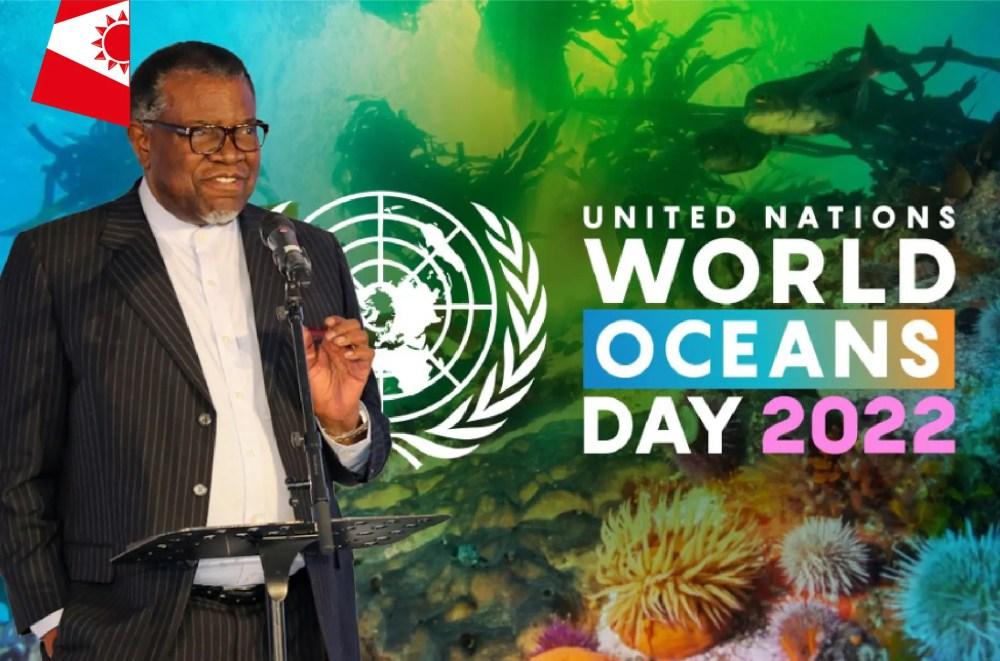
Africa-Press – Namibia. In commemoration of the United Nations’ World Oceans Day celebrated on 8 June, President Hage Geingob said it is imperative to urgently address the dreadful challenges oceans face as a result of harmful human activities.
“We are gathered here today, to celebrate the World Ocean’s Day in recognition of its immense importance and contribution in sustaining human life globally including in Namibia.
This year, the day is celebrated under the theme, “Revitalization: Collective Action for the Ocean” which focuses on the need to conserve marine resources, as well as protect, maintain and restore biological diversity, productivity, resilience and intrinsic value of oceans for the benefit of current and future generations.
Oceans are the heart and lungs of our planet. Global statistics shows that they comprise 97 percent of the Earth’s water; supply nearly half the oxygen we breathe; absorbs the carbon dioxide we produce; and provide food and economic opportunities to billions of people. Furthermore, oceans also assist in regulating global weather and temperature. As we continue to safeguard our oceans, it is imperative to urgently address the dreadful challenges that they are facing as a result of harmful human activities.
The importance of the ocean to the world and to Namibia in particular, cannot be over emphasized. As an example, Maritime transport accounts for 85 percent of all our domestic trade, while Marine Diamonds are the largest commodity and the biggest contributor to our GDP. Additionally, Namibia’s thriving fisheries sector provides employment and economic prosperity to thousands of Namibians, as well as food security.
Uniquely, Namibia is one of the few countries in the World where the Desert meets the sea. Consequently, our ocean provides a tourism gateway to our attractive coastline.
The recent discovery of Oil, the Kudu Gas fields and the development of the Green Hydrogen present countless socio-economic opportunities to the Namibian people, but at the same time also challenges on how best to exploit these resources for the wellbeing of all Namibians while giving due regards to conservation.
Therefore as part of its commitment to protect the Ocean, Namibia in 2018 joined thirteen (13) other Ocean based countries to declare 100% protection of the ocean. Our call for action recognizes that we have a collective responsibility to protect and restore the health of our ocean and build a sustainable ocean economy that can provide food, empower coastal communities, power our cities, transport people and goods as well as provide innovative solutions to global challenges.
In accepting this responsibility, we can give a blue boost to the economy today while mitigating and building resilience for future crises.
In this context, urgent action is required because our oceans are polluted, and continue to be at risk of pollution particularly from plastics and oil.
Each year, studies have revealed that eight million tons of plastics that enter the sea, are transformed into microplastics that enter into the food chain and impact ecosystems as well as animal and human health worldwide.
Additionally, overfishing, particularly Illegal, Unreported and Unregulated fishing, commonly known as IUU, are major causes of loss of biodiversity. On this matter, I believe that the Ministry of Fisheries and Marine Resources will double down on efforts to secure the safety of our fishing and marine resources through the use of modern and technologically advanced systems and strategies to ensure a zero illegal fishing rate in Namibian waters.
We must remember that every fish or marine resource stolen from the Namibian sea, means the loss of a job or income or business opportunity for countless of Namibians. We must endeavour to close down on all possible avenues for illegal fishing in Namibian waters as a matter of utmost priority.
Sadly, the continued increase in carbon emission is causing ocean acidifications which destroy biodiversity and cause sea levels to rise which in turn triggers floods threatening coastal people whom mostly rely on ocean biodiversity for their welfare. It is therefore vital that we protect the ocean and its rich life forms.
Director of Proceedings, Ladies and Gentlemen
Namibia is Party to the Convention on Biological Diversity and is bound by its three main goals, which are, the conservation of biological diversity; the sustainable use of its components; and the fair and equitable sharing of benefits arising from genetic resources.
In 2019, during the United Nations General Assembly meeting, I committed Namibia to four ocean-based actions as a member of the High- Level Panel (HLP) on Ocean Economy.
These are: To produce 144MW additional wind power by 2022;
Gazette 10% of our Exclusive Economic Zone as Marine Protected Areas (MPA) by 2020; Reduce greenhouse emission by 50% by 2050;
Annual appropriation of U$5 million to conduct research, control, monitoring and surveillance in Marine ecosystem.
We have not yet fully met some of the commitments since it is work in progress.
Furthermore, I call on the line Ministry and stakeholders to strengthen, scientific fisheries research, control, monitoring and surveillance of the Marine ecosystem for the management of Fisheries Resources and conducting of Environmental Impact Assessment of Ocean based industry.
These actions are to ensure Ocean ecosystem resilience. In this regard, Capacity development is key and institutions should explore innovative ocean-based financing mechanisms such as blue bonds and carbon trading to support research and other critical aspects of the ocean.
In addition, in line with this year’s theme, I am delighted to note that Namibia’s’ Hake Fishery is Certified by the Marine Stewardship Council (MSC), a globally recognized, science-based standard for sustainable fishing and seafood traceability. I am informed that Namibia is in the process of ensuring that other fisheries product are certified as well.
I am informed that, we are at an advance stage with the development of Namibia’s Sustainable Blue Economy Policy which will further strengthen linkages of the Ocean sectors towards sustainable development. I am also informed that, all our coastal Towns are involved in celebrating this years’ World Ocean Day mainly with beach clean- up campaigns. I commend this collective action and trust that it will become a tradition for us to clean our beaches on a quarterly basis.
I am also happy to note the inclusion of learners in the celebration of this important day.
Their knowledge, as demonstrated through debates here today, place emphasis on the fact that education continues to be a cornerstone to sustainable development. Maybe, the Ministry of Education can look at options how we can include Ocean literacy in school curricula to encourage learners from an early age to take up careers in Ocean related fields.
Namibia’s economic future and the livelihoods of many of its people are highly dependent on the state of our ocean. Let us therefore pull together to ensure the sustainability of our ocean and its resources.
Finally, I would like to thank the Ministry of Fisheries and Marine Resources and all stakeholders who have organized and contributed to the successful celebration of World Ocean Day in Namibia. Let us continue to do so every year.
With these words, it is now my singular honor and privilege to wish Namibia and the world a joyful celebration of the World Oceans Day.
I thank you.”
For More News And Analysis About Namibia Follow Africa-Press