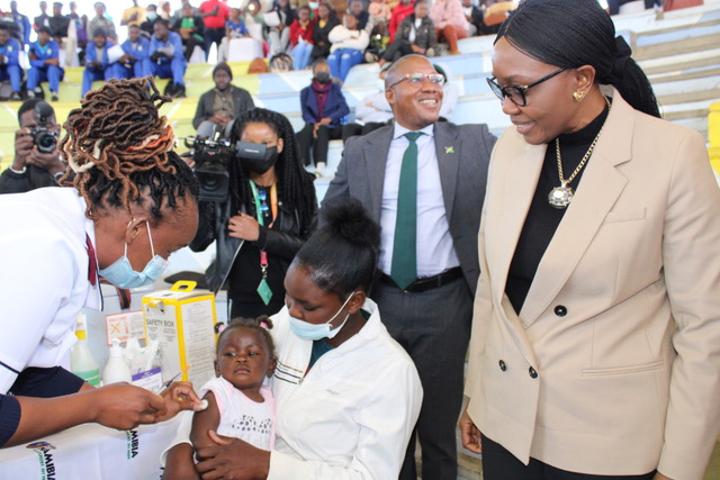
Africa-Press – Namibia. THE Ministry of Health and Social Services in collaboration with various organisations, such as the World Health Organisation and the United Nations Children’s Fund (Unicef), has launched a national integrated vaccination campaign.
Prime minister Saara Kungonelwa-Amadhila said at the event last week that the aim of the campaign is to ensure that Namibian children are vaccinated and protected against childhood diseases and Covid-19.
“I am very pleased to join you today for the launch of the two-week National Integrated Immunisation Campaign,” she said.
Kuugongelwa-Amadhila said a variety of health services would be offered to the inhbitants of the country’s various regions.
“During the two-week countrywide immunisation campaign, a wide range of health services will be offered, including measles and rubella immunisation for children under five, Covid-19 vaccination, screening and immunisation for children who missed other routine immunisation doses, and the provision of iron supplements for pregnant women.
“Other services will include the registration of births and the registration of vulnerable children for social grants,” she said.
“All the services will be offered at clinics and health facilities across the country. Mobile teams will also visit identified sites in communities.
“Sites to be visited in each region will be communicated through local radio stations, churches, schools and other platforms. I am urging the nation to participate in this exercise,” the prime minister said.
She said even though few Covid-19 cases are reported it is still necessary that measures are taken to prevent the further spread of the disease.
“The Covid-19 pandemic is still with us, and we still record cases on a daily basis, although at lower rates. It is important that we continue to curb and prevent further Covid-19 spread,” Kuugongelwa-Amadhila said.
“The Ministry of Health and Social Services revised the National Deployment and Vaccination Plan (NDVP) to respond to new scientific developments and advancements in technology,” minister of health and social services Kalumbi Shangula at the launch said.
He said the vaccination strategies for the integrated campaign were developed based on the practical experiences and lessons learned during the Covid-19 vaccination drive between March 2021 and May this year.
“One specific innovation that stood out was reaching out to the population through different means. This particularly highlighted the house-to-house approach as one option for better vaccination coverage.
“This campaign therefore took into account the innovations and data from vaccine hesitancy surveys, which indicated a total of 30% of the Namibian population are willing to be vaccinated if services are brought closer to them,” he said.
Shangula said the teams will spend up to three days in the field to reach the unreached.
Some 15% of the teams are set up at identified temporary sites and will move within defined localities to provide improved access.
He said 20% of the teams would provide mobile services moving from place to place in specific communities, based on mapping and social mobilisation prior to implementation.
“As has been stated before, we are here to witness the launch of the Integrated Vaccination Campaign. Vaccination is one of the most effective medical tools ever created,” the minister said.
Rachel Odede, Unicef’s country representative, said the organisation fully supports the campaign financially to reach all 14 regions.
“Unicef has provided a total of N$15,1 million for all 14 regions to effectively implement this integrated campaign,” she said.
For More News And Analysis About Namibia Follow Africa-Press