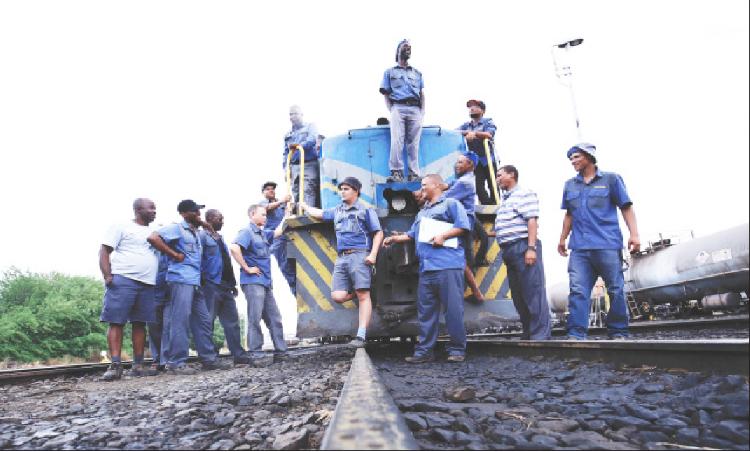
Africa-Press – Namibia. TRANSNAMIB spokesperson Abigail Raubenheimer said the company will apply the no work, no pay principle during the strike period.
TRANSNAMIB spokesperson Abigail Raubenheimer said the company will apply the no work, no pay principle during the strike period.
This comes after a court hearing on 29 July 2022, which saw the Namibia Transport and Allied Union (Natau) embark on a balloting process last Friday, where 726 TransNamib workers out of 788 voted in favour of a strike.
Raubenheimer, in a statement released yesterday, said TransNamib has a contingency plan in place, but the fact remains that the industrial action will negatively impact their operations and disrupt the normal scheduled train services for the duration of this planned industrial action, whose end date is not known.
“The company will apply the no work, no pay principle during the strike period. As a responsible corporate entity, we will try to provide essential train services to those key and strategic commodities and routes, within our operational capabilities,” she said.
Raubenheimer said the staff and management of TransNamib, with the support of the shareholder, would work to resolve this matter with the urgency it deserves.
“We will keep you abreast of all developments relating to this impasse. We would like to extend our assurance and sincerest apologies for the inconvenience this unfortunate event will cause to our customers and stakeholders,” she said.
Natau acting general secretary Narina Pollman said they are giving TransNamib 48 hours, starting yesterday, to respond to the workers’ request.
She said “48 hours starting today (Monday) is given to TransNamib and the parties shall during such notice period as well as thereafter, hold themselves available to meet, at the request of either party to the dispute or the conciliator, in a further endeavour to settle the dispute”.
Pollman said in the poll survey, 22 voted against the strike and 40 votes were spoiled.
This month, the chief executive officer of TransNamib, Johny Smith, said they have instituted an urgent application against Natau to interdict and restrain the union from conducting industrial action in the form of a strike.
“TransNamib does not have money for salary increments.
“Should employees choose to proceed with industrial action, the company will apply the no work, no pay principle during the strike period,” he said.
Smith said TransNamib’s financial woes continue due to its short-term cash-flow position, as well as its limited capacity in terms of rolling stock.
“As a company operating at a loss of more than N$10 million per month, its financial situation is precarious.
“The management of TransNamib has gone to great lengths to engage the union and our internal stakeholders on the perilous financial situation,” he said.
Smith said they remain hopeful and appeal to employees to evaluate and understand the dire consequences of industrial action for the already struggling entity.
This comes after a court hearing on 29 July 2022, which saw the Namibia Transport and Allied Union (Natau) embark on a balloting process last Friday, where 726 TransNamib workers out of 788 voted in favour of a strike.
Raubenheimer, in a statement released yesterday, said TransNamib has a contingency plan in place, but the fact remains that the industrial action will negatively impact their operations and disrupt the normal scheduled train services for the duration of this planned industrial action, whose end date is not known.
“The company will apply the no work, no pay principle during the strike period. As a responsible corporate entity, we will try to provide essential train services to those key and strategic commodities and routes, within our operational capabilities,” she said.
Raubenheimer said the staff and management of TransNamib, with the support of the shareholder, would work to resolve this matter with the urgency it deserves.
“We will keep you abreast of all developments relating to this impasse. We would like to extend our assurance and sincerest apologies for the inconvenience this unfortunate event will cause to our customers and stakeholders,” she said.
Natau acting general secretary Narina Pollman said they are giving TransNamib 48 hours, starting yesterday, to respond to the workers’ request.
She said “48 hours starting today (Monday) is given to TransNamib and the parties shall during such notice period as well as thereafter, hold themselves available to meet, at the request of either party to the dispute or the conciliator, in a further endeavour to settle the dispute”.
Pollman said in the poll survey, 22 voted against the strike and 40 votes were spoiled.
This month, the chief executive officer of TransNamib, Johny Smith, said they have instituted an urgent application against Natau to interdict and restrain the union from conducting industrial action in the form of a strike.
“TransNamib does not have money for salary increments.
“Should employees choose to proceed with industrial action, the company will apply the no work, no pay principle during the strike period,” he said.
Smith said TransNamib’s financial woes continue due to its short-term cash-flow position, as well as its limited capacity in terms of rolling stock.
“As a company operating at a loss of more than N$10 million per month, its financial situation is precarious.
“The management of TransNamib has gone to great lengths to engage the union and our internal stakeholders on the perilous financial situation,” he said.
Smith said they remain hopeful and appeal to employees to evaluate and understand the dire consequences of industrial action for the already struggling entity.
For More News And Analysis About Namibia Follow Africa-Press