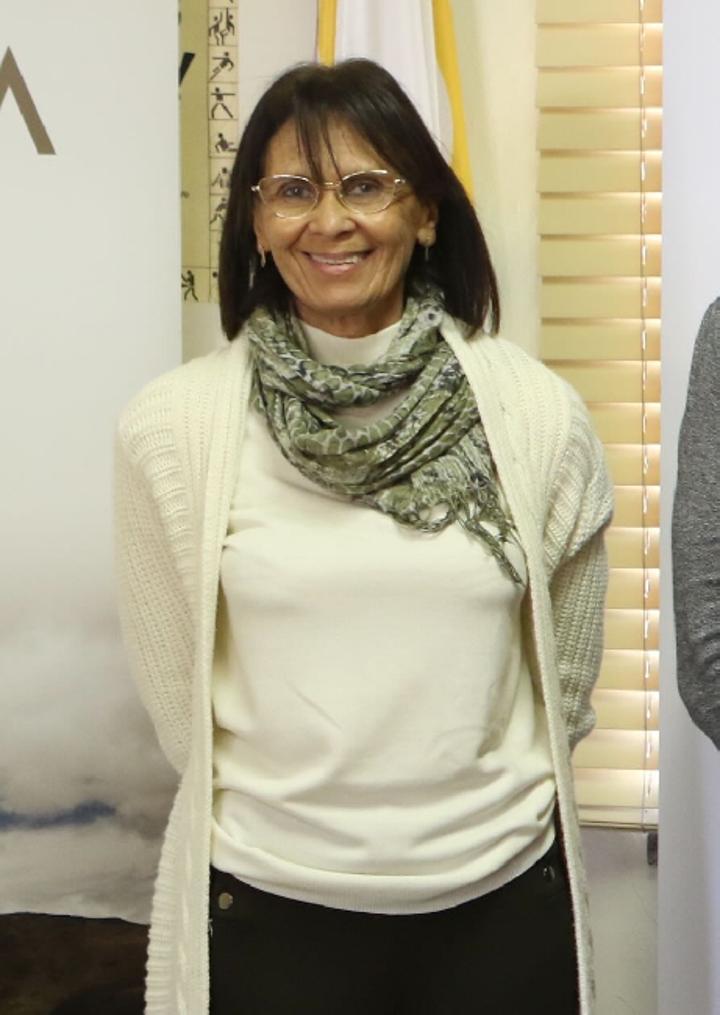
Africa-Press – Namibia. NAMIBIA’S Joan Smit is the centre of World Netball’s latest episode of the ‘Our Netball Family’ podcast series.
Smit, World Netball’s Africa regional development manager, discusses the importance of netball to her when growing up in Namibia before the country’s independence, the challenges she has faced, playing for Namibia’s first-ever national netball team, and what her role entails now at World Netball developing the Africa region.
In the one hour and 13 minutes open and honest chat, Joan starts by saying: “I grew up in the former South West Africa, which was then regarded as a province of South Africa.
“Being mixed race and growing up in an apartheid system I was then regarded as black, and we didn’t have many privileges.
“We were not allowed to a swimming pool, we were not allowed to a tennis court, and so the easiest sport for girls was netball and for boys was football.
“You don’t really need a netball court to play netball, you can do your own netball court, you can do your own posts, and you can do your own balls, and this is how we did it.
“I grew up in a big family, so we were eight sisters . . . after school when we got home, we had these wide-open streets, of course gravel, but that didn’t matter to us, as long as we could play.
“And, to be honest with you, we grew up as happy children, and netball for us was the only sport we knew, and at the time was fun, and as long as we as sisters could play with one another, that was absolutely the coolest thing.”
Joan faced many different challenges wanting to play netball.
But she and two of her sisters eventually went on to represent Namibia in the country’s first-ever netball team, following independence, at the 1991 Sydney World Championships.
Recalling that moment, Joan says: “I was extremely honoured to be appointed as captain for the team, and I will never forget, it was a totally unknown world to us.”
Since then, Joan has continued to help grow netball in Africa, and after joining World Netball in 2008 has worked on many development projects at elite and grassroots levels.
Joan has helped the number of world-ranked countries in Africa increase from three to 10 (as of 12th August), and has also been a significant part of key grassroots projects such as World Netball Netball Safaris and the Netball World Cup 2019 legacy project Net2019.
The Net2019 legacy project was set up to “empower women and girls through the power of netball and the legacy of the Netball World Cup 2019”, and one of the two countries chosen as a focus for this was Zambia in Africa.
Speaking on the success of the Net2019 project, Joan says: “I get goosebumps when I think about 2019, and where we (World Netball) started with England Netball and UK Sport.
“At World Netball we rolled out the programme exactly how we knew it would make a big impact.
“We concentrated on building netball at grassroots level, we concentrated on high performance, and we concentrated on the governance structures in Zambia.
“One of the most amazing things we created through a partnership with the Wallace Group and Sport in Action (a non-governmental organisation in Zambia) was the creation of the hub sites, and these hub sites were created in the poorest communities in Zambia, where we would identify an open space, make a netball court, a gravel netball court with netball posts, netball balls, sponsored by Gilbert, and then play netball in those rural and very poor areas.”
These hub sites are now engaging with over 8 000 children under 16 and have trained over 200 coaches nationwide.
Helping create them was a full-circle moment for Joan, who also started playing netball on a gravel court when she was growing up.
When asked how this made her feel, Joan says: “To hear all those boys and girls laugh and to see how they run and how happy they are, I think that is the most rewarding of it all for me.” – netball.sport
*To find out more about Joan Smit, listen to Episode 3 of the ‘Our Netball Family’ podcast on Apple Podcasts, Podbean and Google Podcasts.
Smit, World Netball’s Africa regional development manager, discusses the importance of netball to her when growing up in Namibia before the country’s independence, the challenges she has faced, playing for Namibia’s first-ever national netball team, and what her role entails now at World Netball developing the Africa region.
In the one hour and 13 minutes open and honest chat, Joan starts by saying: “I grew up in the former South West Africa, which was then regarded as a province of South Africa.
“Being mixed race and growing up in an apartheid system I was then regarded as black, and we didn’t have many privileges.
“We were not allowed to a swimming pool, we were not allowed to a tennis court, and so the easiest sport for girls was netball and for boys was football.
“You don’t really need a netball court to play netball, you can do your own netball court, you can do your own posts, and you can do your own balls, and this is how we did it.
“I grew up in a big family, so we were eight sisters . . . after school when we got home, we had these wide-open streets, of course gravel, but that didn’t matter to us, as long as we could play.
“And, to be honest with you, we grew up as happy children, and netball for us was the only sport we knew, and at the time was fun, and as long as we as sisters could play with one another, that was absolutely the coolest thing.”
Joan faced many different challenges wanting to play netball.
But she and two of her sisters eventually went on to represent Namibia in the country’s first-ever netball team, following independence, at the 1991 Sydney World Championships.
Recalling that moment, Joan says: “I was extremely honoured to be appointed as captain for the team, and I will never forget, it was a totally unknown world to us.”
Since then, Joan has continued to help grow netball in Africa, and after joining World Netball in 2008 has worked on many development projects at elite and grassroots levels.
Joan has helped the number of world-ranked countries in Africa increase from three to 10 (as of 12th August), and has also been a significant part of key grassroots projects such as World Netball Netball Safaris and the Netball World Cup 2019 legacy project Net2019.
The Net2019 legacy project was set up to “empower women and girls through the power of netball and the legacy of the Netball World Cup 2019”, and one of the two countries chosen as a focus for this was Zambia in Africa.
Speaking on the success of the Net2019 project, Joan says: “I get goosebumps when I think about 2019, and where we (World Netball) started with England Netball and UK Sport.
“At World Netball we rolled out the programme exactly how we knew it would make a big impact.
“We concentrated on building netball at grassroots level, we concentrated on high performance, and we concentrated on the governance structures in Zambia.
“One of the most amazing things we created through a partnership with the Wallace Group and Sport in Action (a non-governmental organisation in Zambia) was the creation of the hub sites, and these hub sites were created in the poorest communities in Zambia, where we would identify an open space, make a netball court, a gravel netball court with netball posts, netball balls, sponsored by Gilbert, and then play netball in those rural and very poor areas.”
These hub sites are now engaging with over 8 000 children under 16 and have trained over 200 coaches nationwide.
Helping create them was a full-circle moment for Joan, who also started playing netball on a gravel court when she was growing up.
When asked how this made her feel, Joan says: “To hear all those boys and girls laugh and to see how they run and how happy they are, I think that is the most rewarding of it all for me.” – netball.sport
*To find out more about Joan Smit, listen to Episode 3 of the ‘Our Netball Family’ podcast on Apple Podcasts, Podbean and Google Podcasts.
For More News And Analysis About Namibia Follow Africa-Press