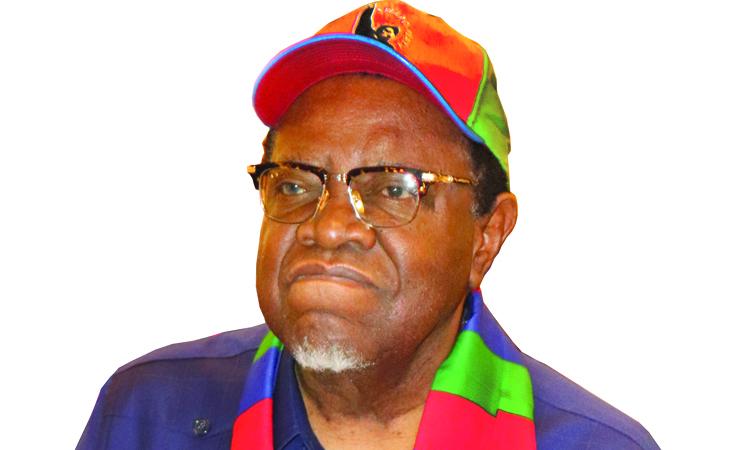
Africa-Press – Namibia. POLITICAL analysts and the opposition say president Hage Geingob seems to be in denial over his dwindling political power within Swapo.
This comes after deputy prime minister Netumbo Nandi-Ndaitwah was elected to the party’s vice president position without his endorsement on Monday.
State House yesterday declined to comment on the matter when approached.
Nandi-Ndaitwah will also take over state power should she win the 2024 presidential election.
Popular Democratic Movement (PDM) leader McHenry Venaani says Geingob’s decision to not publicly endorse his successor has led to him losing his grip on Swapo.
“It has also made his political space vulnerable, and it’s not good for governance. He could possibly become a lame duck president going forward,” he says.
Venaani says it will be very difficult for Geingob to assert authority from now on.
Political analyst Henning Melber says Geingob’s authority has declined due to a number of reasons – some which are self-inflicted and some which are beyond his control.
“But as an end result, a president in his last term often shows some wear and tear,” Melber says.
He says Team Harambee – spearheaded by Geingob during Swapo’s sixth elective congress in 2017 – is also showing signs of deterioration.
He says this further weakens Geingob’s authority, especially after the elections in 2019 and 2020, which for the first time significantly reduced the party’s prevailing control over the country’s policy.
“The president does not seem to be willing to accept that he is no longer perceived as a rising star,” Melber says.
He questioned the president’s dismissive attitude towards the opinions of political commentators.
Geingob has a limited ability to handle criticism and takes it as a personal insult, Melber says.
“Analysts . . . can only offer their interpretations, but engaging with these requires an ability beyond calling names,” he says.
He says Geingob should refrain from blaming political commentators for the faults of the party.
Melber lauded Geingob’s decision not to endorse any of the candidates for the elective congress, saying this, however, does not mean he has no influence.
“It is another way of seeking strategic influence under changing circumstances. I am sure the president had his preferred candidates and sought the best possible way to support them,” he says.
He says while the re-election of both Nandi-Ndaitwah as Swapo vice president and Sophia Shaningwa as secretary-general plays it safe, it shows delegates have a desire for continuity.
“This may reduce any internal hiccups and allow for a smooth transition in the next two years,” Melber says.
Political analyst Rui Tyitende stands by the assertion that Geingob’s authority is waning.
“Geingob is about to exit the corridors of power and is politically weak, and was hence unable to influence the outcome of the just-ended congress, despite being the head of state and head of the party,” Tyitende says.
All eyes are now on Geingob to see whether he will promote Nandi-Ndaitwah to the position of Namibia’s vice president or prime minister.
Geingob himself was promoted by his predecessor, Hifikepunye Pohamba, to the position of prime minister after having won the vice president position at Swapo’s fifth congress in 2012.
Tyitende, who attended the just-ended congress, says the atmosphere was a mixture between cordiality and tension.
At the height of his power after winning his re-election at the sixth party congress, Geingob fired then ministers Jerry Ekandjo and Pendukeni Iivula-Ithana from the Cabinet in 2018, because they challenged him for the leadership position.
In an opinion piece, political analyst Joseph Diescho suggested Geingob should promote Nandi-Ndaitwah to the position of prime minister and demote the current prime minister, Saara Kuugongelwa-Amadhila, to a normal ministerial position.
He said this was the case with Nahas Angula who moved down from prime minister to defence minister when Geingob won the vice presidential position in 2012.
“In other words, the president will take the risk and hope that Kuugongelwa-Amadhila will be happy as a normal minister and continue to serve, because she is still needed for the sake of continuity and stability of the government,” Diescho said.
He also suggested that if this does not happen Nandi-Ndaitwah should be promoted to vice president.
Among the reasons for this is that the government’s security detail should be upgraded, Diescho said.
For More News And Analysis About Namibia Follow Africa-Press