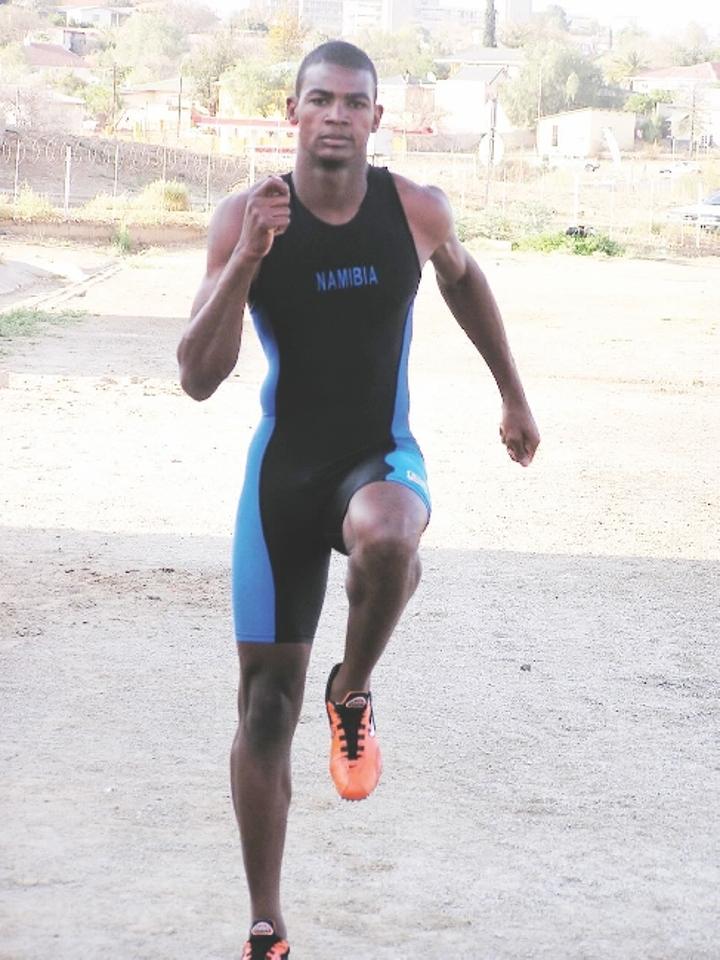
Africa-Press – Namibia. HISTORY will remember Hitjivirue Kaanjuka as one of the most promising young sprinters the country has ever produced.
Born at Coblenz, a small village near Grootfontein in the Otjozondjupa region, the speedy runner went on to test his talent at some of the most prestigious athletics events in the world.
After dominating school athletics, Kaanjuka first signed under Cheetahs Athletics Club before he jumped ship in 2001 to join world recognised athletics coach Letu Hamhola at the more prestigious Welwitschia Athletics Club, both in Windhoek.
Kaanjuka, who has an All-African Championships silver medal in the 4×100 relay, also went on to represent Namibia at the Commonwealth Games and the World Athletics Championships.
“Yes, I came a very long way since my primary school days at Van Rhyn in Windhoek, where I dominated the Victor Ludorum trophy as the best runner in the 100m and 200m boys’ sprints, and I continued my dominance at secondary level at Pioneers Boys School,” says Kaanjuka.
“My form at the regional school athletics championships drew the attention of the national athletics team selectors and I was eventually drafted into the Namibian team. I was also nominated for the Junior Sportsman of the Year award by the Namibia Sports Commission.”
Kaanjuka enjoyed a very exciting career on the Namibian tracks during a spell that also saw him, Even Tjiviju, Dantago Gurirab and Jesse Uri-khob setting a Namibian record in the 4×100 relay during the 2015 All-African Games in a time of 39.22.
He was also part of the relay team that set a new national record in the 4×200 event during the Penn Relays in Philadelphia in the United States in 2016, which are the world’s oldest relays stretching back over 112 years.
Kaanjuka, who only played a single rugby game at school level, is one of a few local athletes who can brag that he raced against Jamaican sprinter Usian Bolt – one of the greatest sprinters of all time – during the 200m sprint at the 2006 Commonwealth Games in Australia.
“I must say that it didn’t go well because I was completely star-struck. I was young and very naïve at that time. The most memorable and proud moment of my entire athletic career ended in tatters because I injured my foot and didn’t complete the race.
“However, the person with the biggest influence on my athletics career is Frank Fredericks. After watching his racing videos, I decided that I wanted to be like him. I used to run the 100m and 400m as well but I opted to only run the 200m influenced by him.”
Kaanjuka, who was the fastest man in the country in the 200m for three consecutive years between 2011 and 2013, describes himself as a sprinter who is very slow out of the blocks but with a very strong finish “because my stamina keeps me going”.
He explains that because of his slow start, the 100m dash was too short for him whereas the 400m was just too much of a technically complicated race, which requires lots of expertise.
He reveals that his exploits in his country’s colours prompted a university in the United States of America to offer him a scholarship, and he regrets till today that he declined the offer.
“I was approached by an American university shortly after the Commonwealth Games and it is my biggest regret that I didn’t accept that scholarship. I just think now how that could have impacted both my athletics and personal life,” he says, adding that he rather accepted a scholarship from the High Performance Centre of the University of Pretoria in South Africa.
Despite his disappointment, Kaanjuka says he is completely happy with his athletics career, adding that he enjoyed a very colourful and eventful career running for both the country and his Welwitschia Athletics Club.
Although still unmarried, the retired sprinter is a father of two children.
A normal day for Kaanjuka, who is employed as a constable in the Namibian Police Force since 2013, starts at 04h30, with exercise at 05h00, before he heads out to work.
“I am a crime prevention officer and one of my duties is to go out in the field on patrol and I also do arrests.”
He says one of the biggest challenges in his job is the slow pace of promotions.
“Imagine working on the same rank since 2013,” he says.
“It’s very tough because the cost of living is only getting higher. Even the rent is going up. It is becoming a little tough to keep up and I also have to provide for my two children.
“Another challenge in my job is to chase after a suspect with my AK-47 rifle and heavy boots. But I enjoy chasing them because it’s like exercising.”
The former national champion may have retired but he is still very much involved in athletics.
“I am part of some of the retired coach Letu’s (Hamhola) coaching, and I am particularly helping coach the national relay teams. I also have my own group of children that I am teaching the finer art of sprinting through my own experience as a former sprinter,” he says.
He admits that he misses the tough training that he had to go through, enjoying the adrenaline rush as the lactic acid kicked in before competitions, not forgetting all the travelling to places he could have only dreamt of, and especially the training camps when he was exposed to different cultures and had the opportunity to meet new people.
He admits this isn’t quite how he imagined his life would be after the end of his running days, as he always dreamt about a very successful life growing up, however, he is happy about the friends he made during his athletics career and the important people he met.
Kaanjuka, describes his training camp in Jamaica with his fellow Namibian athletes as a lifetime experience as it was always his dream to visit the land famous for its world class athletes and reggae music.
The retired sprinter advises young sprinters that the life of an athlete is all about hard work, intensive and consistent training, respect and discipline.
“I am one of the few Namibian athletes who have tasted competition at some of the most prestigious championships on the continent and internationally. I was at the All-African Games and I also showcased my talent at the Commonwealth Games and World Championships.
“My only regret is that I never competed at the Olympics because that remains every athlete’s dream to be part of the highest level of competition in world athletics. You have to respect yourself, stay committed to your training and dream Olympics,” he says.
Respect is essential in general life, he says, because culturally you are required to respect your elders, coaches, teammates and your peers in society.
He points out that discipline comes from home and it produces wonders when applied in your daily life “because you don’t need the constant supervision of your coach when you are disciplined and committed”, Kaanjuka concludes.
For More News And Analysis About Namibia Follow Africa-Press