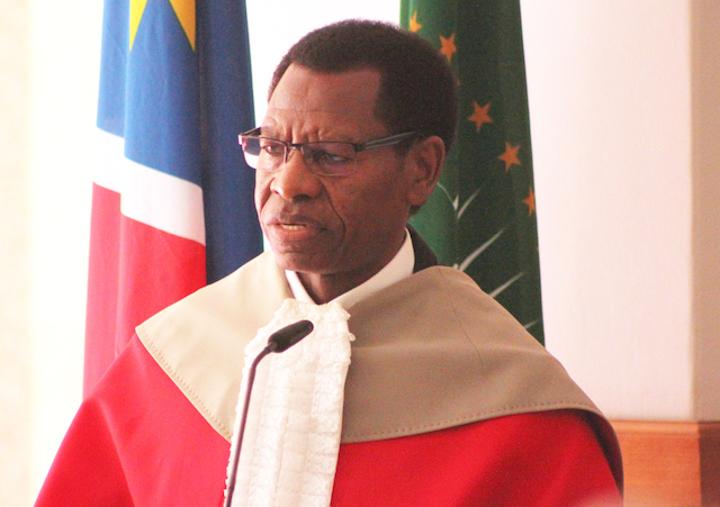
Africa-Press – Namibia. THE Office of the Judiciary is finding it difficult to recruit judges for Namibia’s High Court, chief justice Peter Shivute says.
Speaking at the opening of the 2023 legal year at the Supreme Court in Windhoek yesterday, Shivute said a number of judges of the High Court and the Supreme Court will be leaving the judiciary through retirement or for personal reasons over the next five years.
“Given that reality, we are already finding it difficult at the moment to recruit judges to the High Court,” Shivute said.
“Thus, there is a real concern about how the departing judges will be replaced. This is therefore a matter that is of national concern and will require the collective wisdom of all the organs of state.”
Shivute also said the Judicial Service Commission (JSC) has had discussions about addressing the gender imbalance on the country’s Supreme Court bench, which does not have any women judges.
The JSC is conducting consultations to address concerns about the lack of woman judges in the country’s top court, and he is confident he would be able to report progress on the matter next year, Shivute said.
He said the situation at the Supreme Court is part of a larger problem that confronts not only the judiciary in Namibia.
“The High Court is supposed to be the primary source of recruitment to the Supreme Court, but as we all know, finding willing and suitably qualified candidates for appointment to the High Court has not been plain sailing,” he remarked.
Turning to the country’s lower courts, Shivute noted that the performance of those courts did not show much improvement during 2022.
“For us to see a reduction in the pending cases we need more magistrates, more courtrooms, more support staff and sufficient funds to run periodical courts and to pay witness fees,” the chief justice said.
Also speaking at the event, president Hage Geingob pledged that Namibia’s judiciary would continue to enjoy “unfettered independence”.
“We view the establishment, maintenance and enhancement of our administration of justice as an integral component not only for the maintenance of peace and security within Namibia, but also for the advancement of our developmental agenda,” Geingob said.
“Therefore, the sacrosanctity of judicial independence in Namibia can never be questioned,” he stated.
The president further said there were consistent concerns about full court rolls and that matters brought before the courts were taking a long time to be finalised.
He encouraged the judiciary, together with the minister of justice and other key players in the legal fraternity, to explore innovative ways to increase court capacity, through the establishment of specialised courts such as community justice services, small claims courts, family courts and commercial courts.
Shivute reported that during the past year judges dealing with civil cases in the High Court attended to 10 014 civil actions, of which 6 465 matters were finalised.
Also during 2022, 1 012 civil cases were referred to court-connected mediation, resulting in out-of-court settlements in 332 of those matters.
Also in the High Court, judges presided over 140 criminal trials, of which only 20 were completed in the court’s main division in Windhoek, during 2022.
Of the criminal cases on the High Court’s roll during 2022, 63 involved violence against women and children and 21 involved fraud or theft, Shivute said.
The country’s lower courts dealt with 64 536 cases over the past year and finalised 26 756 matters, Shivute reported.
That figure is 9 065 more than the number of cases concluded in the lower courts during 2021, he said.
For More News And Analysis About Namibia Follow Africa-Press