Africa-Press – Namibia. The European Union (EU) and Namibia have taken concrete steps to advance their energy transition partnership, nearly a year after signing a Memorandum of Understanding (MoU) aimed at developing supply chains for rare earth metals and green hydrogen.
On the sidelines of the EU-Namibia Business Forum held in Brussels this week, European Commission President Ursula von der Leyen endorsed a 2023-2025 roadmap to support Namibia’s emerging renewable energy industry.
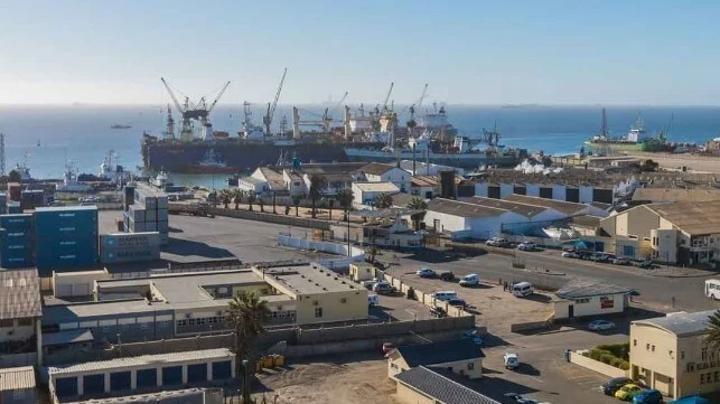
The EU is committing over one billion euros in investments and will support an upcoming study for the development of the Port of Walvis Bay into an industrial and logistics hub. This expansion is a critical part of the country’s efforts to achieve the desired capacity for energy exports, requiring approximately $2.1 billion in investments, with much of the focus on Walvis Bay.
Additionally, the EU will collaborate with the Port of Antwerp and Bruges International to create a master plan for the Port of Walvis Bay, encompassing multimodal infrastructure, spatial planning, and market organization. An important aspect of this agreement is the development of the Walvis Bay-Maputo Corridor, connecting the Atlantic to the Western Indian Ocean, which plays a crucial role in serving the Southern-Central Africa copper belt, a region with growing demand for copper from renewable energy industries.
The Dutch government has commissioned a feasibility study for the expansion of the Lüderitz port, situated 250 nautical miles south of the Port of Walvis Bay.
These infrastructure projects are pivotal for building the necessary large-scale capacity to support local metals processing and export. Namibia is well-positioned to supply the EU with green hydrogen and minerals essential for clean energy technologies.
In June, Namibia imposed a ban on the export of unprocessed lithium and rare earth metals, a move seen as advantageous by industry stakeholders, provided Namibia can establish the required industrial and logistical capacity.
Joe Walsh, the managing director of lithium processing company Lepidico, has announced plans to process battery-grade lithium at a plant to be constructed in Abu Dhabi, mainly due to the city’s proximity to an industrial and logistics hub. Lepidico is currently engaged in a lithium mining project in the Karibib region of Namibia.
For More News And Analysis About Namibia Follow Africa-Press