Africa-Press – Namibia. Losing a job is every employee’s worst nightmare. For Cyubahiro (not his real name), it became a harsh reality. He is one of 15 employees who were let go after their company adopted an AI-powered tool.
“I can say with certainty that we lost our jobs because of AI integration,” Cyubahiro says, adding that some of them were top performers, and that was explicitly mentioned in the dismissal letters.
Cyubahiro’s experience reflects a global conversation: as companies embrace AI, are employees being empowered—or quietly replaced?
AI has rapidly become a core part of the modern workplace. Once mainly used for simple queries or student assignments, AI-powered tools now play a role in customer service, finance, marketing, software development, and operations.
For businesses, the benefits are clear: speed, efficiency, accuracy, and cost reduction. For employees like Cyubahiro, however, the rise of AI raises pressing questions about job security and adaptation.
Cyubahiro worked as a customer support executive at a global fintech branch in Kigali, acting as a bridge between customers and an online trading platform.
“When I was hired, fluency in specific languages and a bachelor’s degree were essential,” he explained.
“Some days were hectic, others lighter, but there was always work. When AI came in, the company’s energy shifted. Training ramped up, conversations about AI dominated, and everything moved fast.”
At first, he didn’t expect the technology to impact his role. But after the introduction of an AI-powered chatbot, his workload began to shrink.
“What used to take 40 people could now be done by the bot in a short time,” Cyubahiro says. “Roles became redundant, and the company opted for restructuring.”
A global trend backed by data
Cyubahiro’s story aligns with findings in the World Economic Forum’s Future of Jobs Report 2025, which identifies digital access as a transformative trend shaping businesses by 2030. Eighty percent of employers expect AI and digital technologies to transform operations, while 58 percent cite robotics and automation as major disruptors.
Experts, however, differ on what this means for workers. Carl Mabuka, Head of Business and AI at Global Kwik Koders and co-founder of RWAiGHT, believes fears around AI are overblown.
“AI won’t take jobs—people who use it effectively will,” Mabuka says, comparing today’s moment to the introduction of the combustion engine in the early 1900s. “People feared that too. Technology didn’t destroy opportunity—it created new industries and roles.”
For Mabuka, the challenge lies in how fast individuals and organisations adapt. “Business is about efficiency and value. The problem isn’t AI—it’s how quickly people adjust.”
Carl Mabuka, Head of Business and AI at Global Kwik Koders and co-founder of RWAiGHT
He urges workers to view AI as a productivity partner, not a threat. “If you have access to a smartphone or laptop with internet, it would be unwise not to skill up. Stick to your lane, but integrate AI into your work.”
Yet he acknowledges that repetitive roles are more vulnerable to automation. “Future growth will favor creativity, empathy, human-centered design, and AI development. AI skills are already in high demand. These times aren’t scary—they’re exciting, depending on perspective.”
Mabuka also notes local opportunities: AI tools still struggle with languages like Kinyarwanda and Swahili, leaving room for human-centered customer service.
“Employers prioritise results over process,” he adds. “If one employee produces in one day what another does in a week, the math is simple. Those who adapt slowly will be left behind. Some jobs will disappear—and learning AI isn’t a guarantee.”
A more cautious perspective
Philbert Murwanashyaka, co-founder of YALI Lab, sees a genuine risk for many modern white-collar roles.
“Jobs like data entry, junior accounting, receptionists, and personal assistants are highly automatable,” he warns. “Some junior positions may vanish entirely.”
Philbert Murwanashyaka, co-founder of YALI Lab.
Even software development isn’t immune. “AI tools are performing tasks that junior developers used to handle. Often, only senior oversight is now required.”
Murwanashyaka stresses that simply learning to use AI isn’t enough. “We need to understand how AI works—how models operate, how decisions are made. That knowledge will matter more in the long run.”
He notes that blue-collar professions—plumbing, electrical work, technical trades—remain safer because they rely on physical skills and human presence.
Where both sides agree
Despite their differences, experts converge on one point: continuous learning is no longer optional.
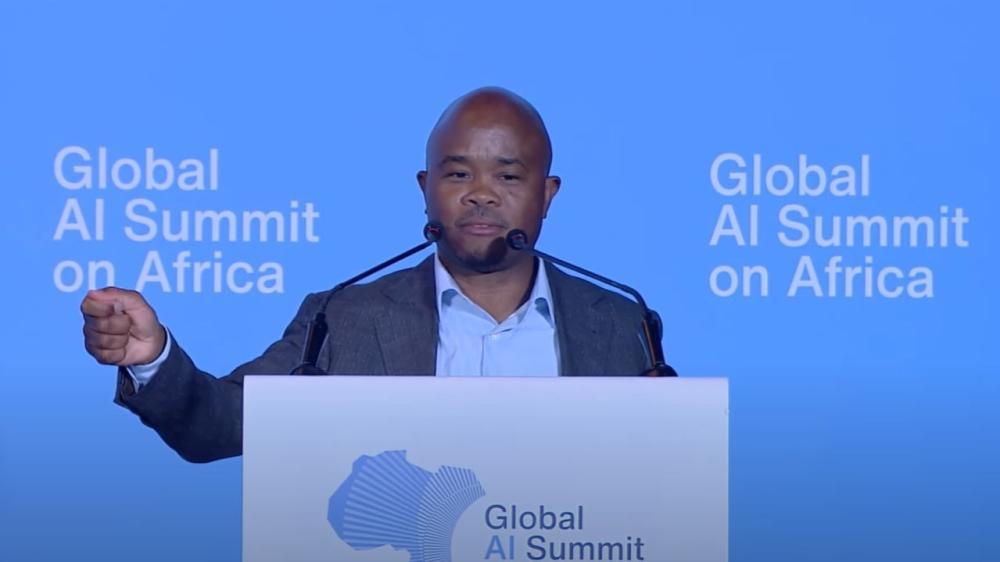
At the Global AI Summit on Africa in April last year, Fred Swaniker, founder and CEO of Sand Technologies, posed a challenge to young professionals: “How many of you would like an extra thirty points in IQ?”
“If you don’t learn generative AI, you’re leaving those points on the table,” he said. AI literacy is becoming a prerequisite for competitiveness in today’s economy.
A workforce at a crossroads
Stories like Cyubahiro’s underline the urgency of the moment. The debate is no longer whether AI will shape work, but who will be left behind and who will adapt.
Experts say the key question for employees today isn’t if AI is coming—it’s whether they’ll be ready when it arrives.


For More News And Analysis About Namibia Follow Africa-Press