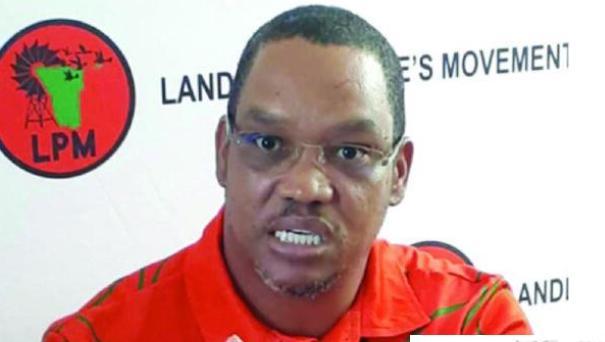
Africa-Press – Namibia. Landless People’s Movement (LPM) leader Bernadus Swartbooi says he understands why President Netumbo Nandi-Ndaitwah’s administration is gunning for a shift in oil powers as she is trying to find solutions for the oil sector.
Debating the Petroleum (Exploration and Production) Amendment Bill in Parliament, Swartbooi said the president is trying to confront serious concerns in the oil and energy sector.
However he said the bill is misguided.
He said the challenges include trust, corruption, and what he described as “power and resource grabs” within the system.
“There’s a problem there. It’s a problem of trust. There’s a problem of corruption. There’s a problem of power and resource grab,” Swartbooi said.
The bill proposes shifting authority over the oil and gas sector from the minister of industries, mines and energy to the Presidency. It would give the President powers to grant, renew, or revoke oil and gas licenses and formalise the Upstream Petroleum Unit, housed in the Office of the President.
Swartbooi argued that the move to centralise oversight raises a deeper issue.
“She is dealing with this matter to say, ‘Let me rescue this thing.’” That is, I think, her thinking. Let us park that idea there and not dismiss the good faith with which the president tries to attempt to answer a problem, but the outcome is not the right one,” he ropes in support for the oil bill on Tuesday.
Swartbooi’s support for the bill was then followed by that of the Namibia Economic Freedom Fighters (NEFF), which described it as a step towards reclaiming Namibia’s oil wealth.
NEFF member of parliament Longinus Iipumbu said in Parliament on Wednesday that Namibia must not allow oil discoveries to benefit foreign corporations while citizens remain poor.
He added that oil must instead become “a revolutionary instrument for economic freedom, industrialisation, and national dignity.”
The NEFF supports strengthening executive authority in petroleum governance. Iipumbu said the President represents the sovereign will of the people.
“Therefore, vesting final approval authority in the Presidency elevates petroleum governance from narrow bureaucratic control to a matter of national strategic importance and economic reparation,” he said.
He described petroleum as a strategic national asset that cannot be treated as an ordinary commodity.
“Its control cannot be left vulnerable to administrative weakness, regulatory capture, or external influence. It must be protected and directed at the highest level of state authority to ensure it serves the people, not private profit,” he said.
However, Iipumbu stressed that all petroleum approvals must first come from the Ministry of Mines and Energy.
He said this approach would strengthen sovereignty without weakening accountability.
Environment, Forestry and Tourism Minister Indileni Daniel also supported the bill and defended the shift to the presidency.
“Such a critical sector requires oversight from the highest executive level to ensure coordinated and decisive leadership. Keeping it with the presidency improves policy coordination, speeds up major investment decisions, and strengthens investor confidence by providing clear and stable authority,” Daniel said.
“This is not about centralising power but about safeguarding national interest, ensuring efficiency, and providing strong leadership in managing a resource that will shape the country’s future,” she said.
Meanwhile, member of parliament Bishop Festus Thomas also rejected the amendment. Thomas warned against concentrating oil powers in the Presidency.
“It is alarming to learn more about how the production of petroleum affects the economies of other nations or the causes of their production decline,” he said.
He urged lawmakers to vote against the bill.
“We argued that this increases secrecy, adds open-ended powers of discretion, diminishes fiscal safeguards, and reduces legislative and ministerial accountability,” he said.
Another member of parliament, Martin Lukato Lukato, said the bill is long overdue but called for strict checks and balances.
He warned that in some countries oil production has widened the gap between the ruling elite and the poor.
He, like Iipumbu, insisted that communities living near oil wells must benefit first.
“This means that at no time should the exploration of petroleum activities resort to the Office of the President. This is to avoid the temptation of the High Office of corruption but maintain checks and balances in the whole operation,” he said.
The bill also introduces conflict of interest rules. Senior officials in the Upstream Petroleum Unit would be barred from holding financial interests in licence-holding companies. Violations could attract a fine of up to N$20 000 or imprisonment of up to five years. The director general and deputy director general would have to submit statements of their assets, liabilities and business interests to the president shortly after appointment and whenever required.
For More News And Analysis About Namibia Follow Africa-Press