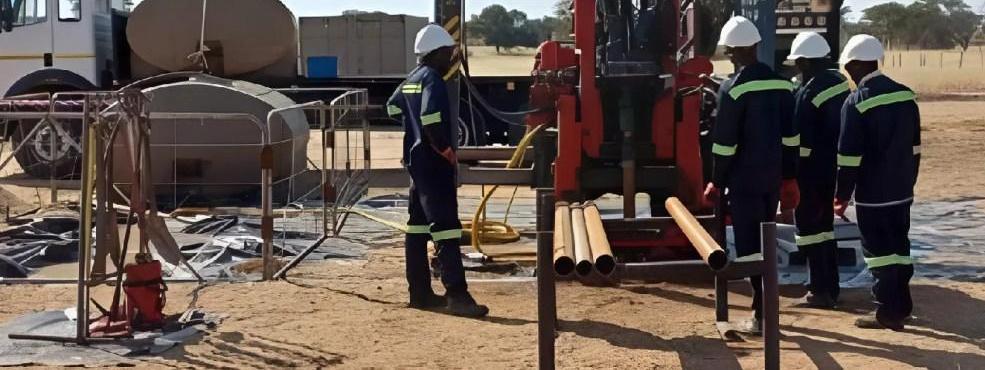
Africa-Press – Namibia. THE newly appointed Head and Executive Secretary of the Orange–Senqu River Commission (ORASECOM), Comfort Molosiwa, has expressed concern over in situ leach mining of uranium in the Stampriet Transboundary Aquifer System in Namibia. Molosiwa said that it could affect the water used by Botswana, which shares the Stampriet Transboundary Aquifer System with Namibia and several other countries.
Molosiwa’s comments came from a pre-meeting ahead of a High-Level Meeting that sought to determine the impact of uranium mining using the in situ leach mining method in the Stampriet Transboundary Aquifer System after concerns were raised.
The meeting followed fears from Namibian farmers that the in situ leaching mining solution could dissolve uranium and other toxic radioactive minerals into the groundwater, prompting the government to seek assistance from UNESCO to find a way forward on uranium mining in the Stampriet Artesian Basin.
According to Tanja Dahl from the Namibia Agriculture Union (NAU), a pre-meeting with 42 participants took place with ORASECOM in South Africa. ORASECOM is the transboundary river basin organization of four countries: Botswana, Lesotho, Namibia, and South Africa. It was formed to coordinate activities, implement decisions, and promote the equitable and sustainable development of the resources of the Orange-Senqu River. ORASECOM provides a forum for consultation and coordination between the riparian states to promote integrated water resources management and development within the basin.
The newly appointed Head and Executive Secretary Molosiwa from Botswana addressed the event, expressing concern over in situ leach mining, as it can affect the water used by Botswana. He also indicated that the actual size of the Stampriet Transboundary Aquifer System extends further into Botswana than originally thought.
Two UNESCO specialists, Ms. Amie Legget, a Senior Environmental Scientist from Australia involved with Innovative Groundwater Solutions (IGS), and Dr. Malcolm Siegel from New Mexico, with extensive experience in environmental geochemistry, groundwater remediation, drinking water treatment, and risk assessment, both commented on the shortcomings of the Environmental Impact Assessment submitted in the application for an Environmental Clearance Certificate for Test Mining.
Both experts pointed out that hydrogeological and hydrogeochemical details are missing, which are necessary for a complete understanding of a project of this magnitude. They recommended that further studies and modelling be conducted. Both agreed that possible mining should not compromise the groundwater quality in the target aquifer, especially since it is the only drinking water source for a vast and arid area.
It is clear that participants have opposing views. The Environmental Commissioner, Timotheus Mufeti, commented that the Ministries would acquire further internal and external reviews and that more information needs to be gathered before making a decision.
SAUMA will closely monitor any further developments and will act in the best interest of protecting our invaluable water resource for current and future generations.
For More News And Analysis About Namibia Follow Africa-Press