
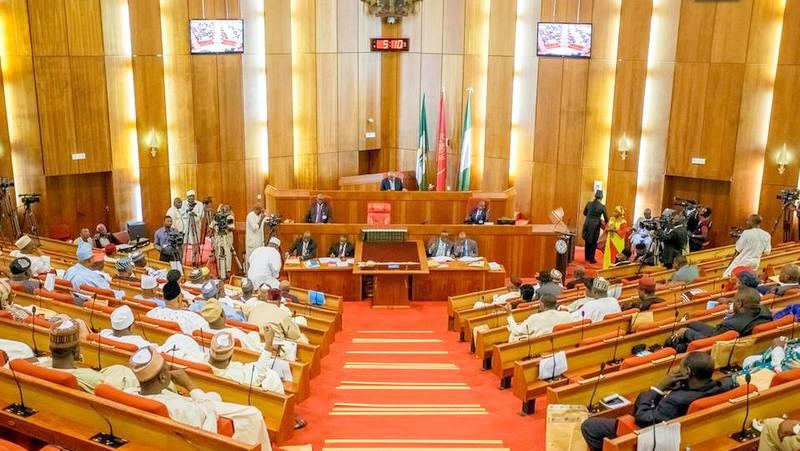
Africa-Press – Nigeria. The 2023 Nigerian Senate elections will be held on 25 February 2023 in all 109 senatorial districts where voters will elect senators using first-past-the-post voting. The last regular senatorial elections for all districts were in 2019.
Other federal elections, including the elections to the House of Representatives and the presidential election, will also be held on the same date while state elections will be held two weeks afterwards on 11 March. The winners of these Senate elections will serve beginning in the 10th Nigerian National Assembly. The APC have held a majority in the Senate since the 2015 elections and solidified that majority in 2019.
Background
After the 2015–2019 Senate term led by President of the Senate Bukola Saraki (Peoples Democratic Party) and with a slight All Progressives Congress majority, the 2019 elections were categorized by a large shift back towards the APC and the defeats of multiple high-profile senators—including Saraki. As in the House of Representatives, the APC solidified its majority after nearly losing it due to defections in 2018.
At the opening of the 9th Nigeria National Assembly, Ahmad Lawan (APC-Yobe North) was elected as Senate President and Ovie Omo-Agege (APC-Delta Central) became Deputy Senate President as the party avoided the internal struggles that led Saraki and Ike Ekweremadu to take those offices in 2015. Enyinnaya Abaribe (PDP-Abia South) became the Senate Minority Leader.During the first two years of the 2019–2023 term, the APC expanded its majority through the defections of six formerly PDP senators[b] but in the second half of the term, both parties were hit by several defections[c] as party primaries for 2023 neared along with three APC resignations. More defections occurred in the wake of party primaries as senators decamped to new parties (mainly in order to run for re-election),[e] most notably Abaribe who resigned as Minority Leader and joined APGA to run for re-election after withdrawing from the Abia PDP gubernatorial primary.
From the perspective of the APC, analysts viewed the 9th Senate as a change from the legislature versus executive disputes that were commonplace during the 8th Senate but critics derided the chamber as a rubber stamp that lacked the initiative to advocate for itself against the executive branch. In terms of specific major bills, the Senate was noted for passing the Sexual Harassment Bill in July 2020, the Finance Bill 2020 in December 2020, the Petroleum Industry Bill in July 2021, a new Electoral Act in January 2022, dozens of constitutional amendments and the Proceeds of Crime Bill in March 2022, and an Electoral Act amendment in May 2022 as well as being commended for rejecting former Buhari aide Lauretta Onochie’s nomination to INEC. On the other hand, it was criticized for voting down constitutional amendments for mandating women slots in legislatures and diaspora voting along with the continuous stalling of a key gender equality bill and rampant misappropriation of public funds. The senate was also accused of dereliction of oversight duty after several ministerial nominees were either barely questioned or asked to “take a bow” and go without questioning at confirmation hearings
Retirements
In total, 31 senators—including 17 APC senators, one NNPP senator, 12 PDP senators, and one YPP senator—decided to retire, 22 of whom are seeking another office.
Resignations
Three seats will be vacant on the day of the election due to resignations, none of which will be filled until the next Senate.
Incumbents withdrew
Six incumbents withdrew from primary elections. However, three of the senators later decamped from their original party and won the nomination of their new party.
In primary elections
Twenty incumbents (12 APC senators and 8 PDP senators) lost in primary elections. After the primary elections, three of the senators (2 APC senators and 1 PDP senator) defected to new parties with two of the senators (one each in the APC and PDP) then winning the nomination of the new party.
For More News And Analysis About Nigeria Follow Africa-Press