
Africa-Press – Nigeria. The Nigerian National Petroleum Corporation (NNPC) has accused Dangote Refinery of attempting to establish a monopolistic dominance over the local fuel market by legally challenging the fuel import licenses granted to competing companies.
This dispute comes at a highly sensitive time, with Dangote Group’s refining operations set to go public in September 2026, raising questions about the future of competition and energy policies in Africa’s largest economy.
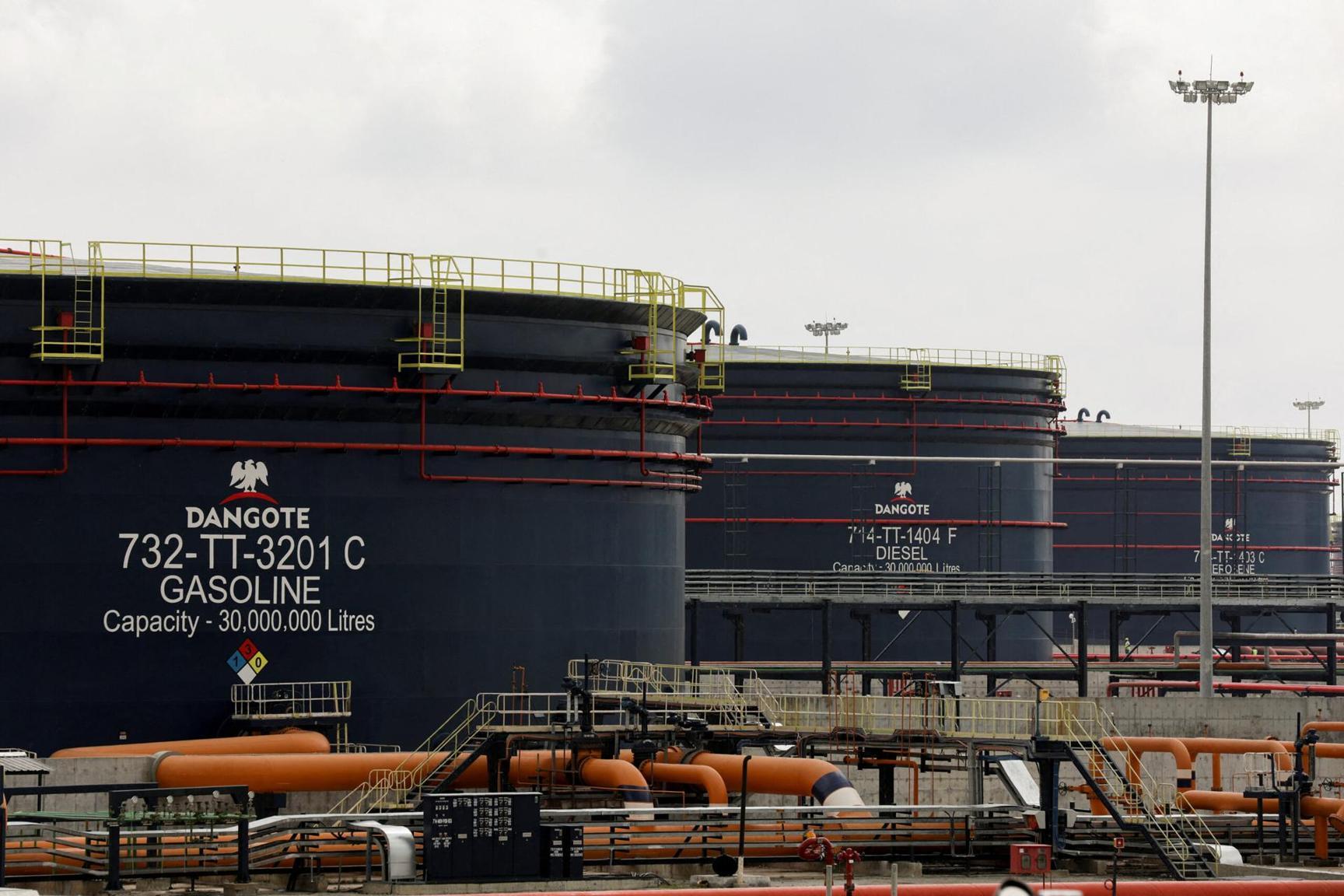
Dangote Refinery is the largest oil refinery in Africa, with a production capacity of 650,000 barrels per day. It was officially opened in May 2023 in Lagos after years of delays and at a cost exceeding $20 billion.
The project is viewed as one of the most ambitious industrial initiatives in the continent’s history, given its potential to end Nigeria’s reliance on fuel imports despite being Africa’s largest crude oil producer.
The current crisis began when Dangote Petroleum Refinery filed a lawsuit in April 2026 against the Nigerian Attorney General and the Nigerian Regulatory Authority for the Oil and Gas Sector, accusing the authorities of granting or renewing fuel import licenses to competing marketing companies, including the NNPC itself, which allegedly contradicts Nigerian laws prioritizing local refining.
In response, the NNPC accused Dangote of attempting to stifle competition and monopolize the local fuel market.
According to court documents reviewed by a local source, the state-owned company asserted that Dangote Refinery had not provided “reliable, independent, or verifiable” evidence to prove its ability to meet the entire local fuel demand or ensure stable nationwide supplies.
The regulatory authority argued that the law grants it discretionary powers to regulate imports within the framework of a “vertical integration” policy, clarifying that there is no comprehensive legal ban on imports unless there is actual local sufficiency.
Dangote Refinery represents an unprecedented project in sub-Saharan Africa, not only in terms of size but also in its expected impact on the Nigerian and regional economy. Nigeria, which produces vast amounts of crude oil, has relied for decades on importing most of its gasoline and diesel needs due to weak local refining capacities and the deterioration of government refineries.
Economic estimates suggest that Nigeria spent over $23 billion annually on importing refined petroleum products, which has placed a heavy burden on its foreign currency reserves and balance of payments.
Thus, Dangote Refinery is considered a strategic project capable of transforming the country from a massive fuel importer to a regional hub for refining and exporting.
However, the project has faced enormous challenges since its announcement in 2013, with costs rising from about $9 billion to over $20 billion, and its opening delayed by seven full years. The project has also encountered complications related to infrastructure, crude oil supply, financing, and fluctuations in government policies.
Although refining operations are set to gradually commence in early 2024, doubts remain about the refinery’s speed in reaching its maximum capacity and fully covering the Nigerian market.
Behind the project is Nigerian businessman Aliko Dangote, who is ranked as Africa’s richest person with a fortune estimated in the billions, according to Forbes rankings.
Over the past decades, Dangote has become a symbol of rising African capitalism, having built an economic empire spanning from cement and sugar to fertilizers, energy, and petrochemicals.
Born in 1957 in Kano, northern Nigeria, into a wealthy trading family, he studied business administration at Al-Azhar University in Cairo before returning to his country in the late 1970s to start his business with a small loan from a relative.
Over time, his business evolved into the largest industrial group in West Africa, with cement factories in several African countries, in addition to significant investments in fertilizers, transportation, and energy.
In April 2026, Dangote’s name returned to Time magazine’s list of the 100 most influential people in the world for the second time after his first appearance in 2014, alongside global figures such as the current U.S. President Donald Trump.
Despite his economic successes, Dangote’s career has not been without intersections with political power in Nigeria.
He has maintained strong relationships with successive governments that supported local industrial expansion, especially during the tenure of former President Olusegun Obasanjo.
However, the relationship with the current administration led by President Bola Ahmed Tinubu appears more complex. In January 2024, the anti-corruption commission raided Dangote Group’s offices as part of investigations related to foreign exchange transactions, which the group described at the time as “an unjustified embarrassment.”
The NNPC has also recently denied circulating accusations of deliberately obstructing the refinery or withholding crude oil supplies from it, asserting that crude allocations are subject to operational, commercial, security, and logistical considerations.
Dangote’s ambitions extend beyond refining; they include a massive economic project titled “Vision 2030,” aiming to raise the group’s revenues to $100 billion annually by the end of the current decade.
The plan includes expansion into natural gas, mining, ports, energy, pipelines, and even data centers.
The group also aims to double the refinery’s capacity to 1.4 million barrels per day in the future, as well as increase fertilizer production to 12 million tons annually, potentially making it the largest producer of urea in the world.
Observers believe that the success of these plans could reshape the energy and industrial landscape in Africa, granting the African private sector a larger role in regional economic integration projects, away from traditional government bureaucracy.
Nevertheless, challenges remain; the Nigerian market suffers from chronic structural imbalances, in addition to issues related to infrastructure, currency, governance, and corruption, as well as intense competition in the global energy sector.
Plans for establishing a joint regional oil refinery in East Africa have entered a new phase, following Kenyan President William Ruto’s announcement that countries in the region are discussing the establishment of the “Tanga Refinery,” a massive project planned to be implemented at the Tanzanian port of Tanga, similar to the Nigerian Dangote Refinery.
The Nigerian businessman, Africa’s richest person Aliko Dangote, has offered to undertake the project within four to five years if the concerned governments agree and provide the necessary support.
These statements came during the Africa We Build 2026 summit held in Nairobi, Kenya’s capital, in late April.
At that time, Dangote stated that he could commit to building a similar refinery in East Africa if three or four governments agreed on the project.
He confirmed that the Tanga Refinery could be implemented within four or five years and that the Nigerian experience has proven that the continent can accomplish giant industrial projects if political will and institutional support are available.
Dangote also noted that the Nigerian project is still on an expansion path aiming to raise total production capacity to 1.4 million barrels per day, reflecting ambitions that extend beyond the local market to meet broader regional needs.