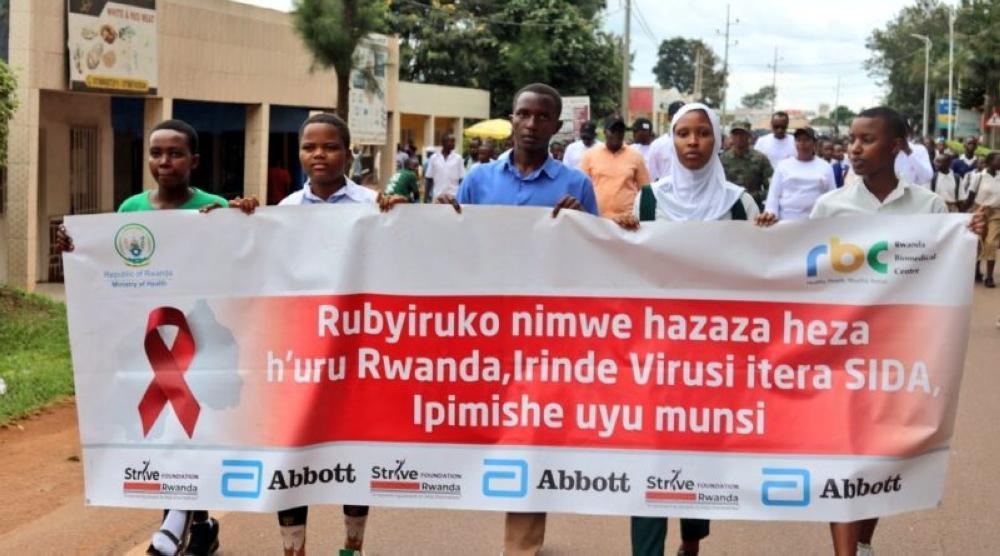
Africa-Press – Rwanda. As Rwanda joins the rest of the world in marking World AIDS Day on Monday, December 1, health officials say the country has made major gains in the fight against the disease, though challenges remain.
According to information from Rwanda Biomedical Centre (RBC), key achievements include the reduction of mother-to-child transmission to below 2 percent, in addition to maintaining the adult HIV prevalence rate at 3 percent for the past decade.
Speaking to The New Times, Dr. Basile Ikuzo, Director of the HIV Prevention Unit at RBC, commended the strides made in mother-to-child transmission programmes, explaining that they have been achieved through universal testing of pregnant women and strong community follow-up.
Commenting on the fact that Rwanda has maintained a 3 percent adult HIV prevalence, he noted that it is “a clear indicator of epidemic control.”
Such progress is in line with the Joint United Nations Programme on HIV/AIDS (UNAIDS) goal of ending AIDS as a public health threat by 2030, a target that envisions zero new HIV infections and zero AIDS-related deaths.
Dr. Ikuzo also pointed out that Rwanda has already met UNAIDS’ 95-95-95 targets, which require that 95 percent of people with HIV know their status, 95 percent of those diagnosed receive sustained antiretroviral therapy, and 95 percent of those on treatment achieve viral suppression.
He stressed the importance of antiretroviral therapy in the HIV fight.
“In 2023, over 216,000 adults were receiving Antiretroviral Therapy (ART). AIDS-related deaths have fallen to roughly 2,600 per year,” he noted.
Despite these achievements, Dr. Ikuzo acknowledged that challenges remain.
“We are still seeing high vulnerability and new infections among adolescents and young adults, particularly adolescent girls and young women,” he said.
“Data indicates thousands of new infections among the youths each year,” he added.
Key populations, he said, continue to face higher prevalence, with female sex workers at approximately 35.2 per cent and men who have sex with men around 5.8 per cent. He also pointed to geographic and social “hotspots,” particularly in Kigali and along transport corridors, where incidence is higher.
Funding pressures are another concern.
“External funding for prevention is plateauing or declining, yet outreach needs to increase,” he said, adding that the old problem of stigma still lingers around, affecting the uptake of services.
“Misinformation on social media, fear of disclosure, and moral judgement from families or communities keep people away from services,” he added, as he noted that the health ministry is responding with a range of measures.
“We are implementing community-based testing and treatment, including index testing, workplace testing, multi-month dispensing,” he said.
HIV self-testing is now distributed through health facilities, and is available in pharmacies, and key-population networks.
He also pointed out that RBC is scaling up the rollout of pre-exposure prophylaxis (PrEP). For instance, currently, the country is piloting the long-acting injectable CAB-LA in priority districts and among key populations.
Looking ahead, Dr Ikuzo expressed cautious optimism. “Given the current low incidence of 0.08 per cent annually, high ART coverage, and strong political commitment, Rwanda is on track to maintain epidemic control and move closer to ending AIDS as a public health threat by 2030,” he said.
For More News And Analysis About Rwanda Follow Africa-Press