
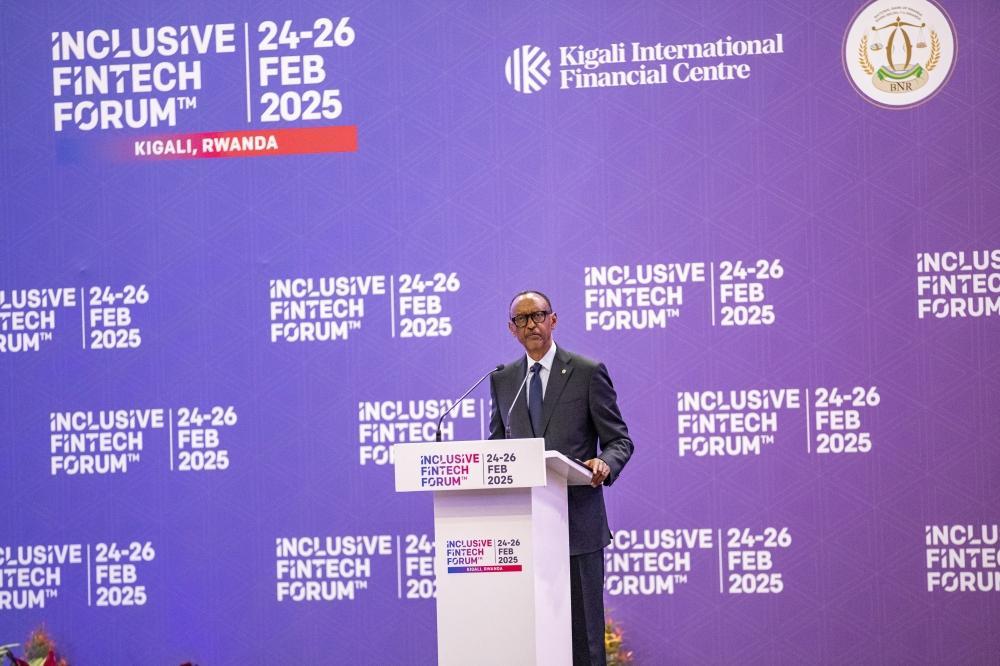
Africa-Press – Rwanda. Rwanda is positioning itself as a leading FinTech hub in Africa through its FinTech Strategy 2024–2029, which envisions Rwanda as the Africa’s FinTech center of gravity. This ambition prompts scepticism: can a small market challenge established giants like Nigeria, Kenya, South Africa, and Egypt? These Big Four have traditionally dominated the FinTech sector through sheer market size and funding, attracting 80% of Africa’s FinTech investment in 2024 alone.
Rwanda’s FinTech Strategy acknowledges this reality by refining a unique competitive environment focused on regulatory excellence, innovative infrastructure, and regional expansion, rather than relying solely on domestic scale. Rwanda’s momentum is already evident; its startup funding increased six-fold to $38 million in 2023, and it is now targeting a position as the best in Africa and a top 30 global ranking on the Global FinTech Index by 2029.
Although Rwanda currently lacks representation on the 2025 CNBC and Statista list of leading global FinTech firms, a list dominated by Nigeria, Kenya, Egypt, and South Africa, its focus is on breeding indigenous champions capable of cross-border expansion. As of June 2025, Rwanda’s FinTech ecosystem already includes more than 20 payment aggregators, 10 remittance providers, and seven e-money issuers, indicating a rapidly expanding ecosystem.
Rwanda’s primary competitive edge is regulatory excellence. Unlike larger African markets plagued by regulatory fragmentation, which might require multi-agency approvals from bodies like the Central Bank of Nigeria, the Nigerian Securities and Exchange Commission, and other agencies, in Nigeria, or complex coordination in Kenya where Central Bank of Kenya, Communications Authority of Kenya, and other agencies, have to be consulted for the launch of a FinTech, Rwanda provides cohesive oversight primarily through the National Bank of Rwanda (NBR).
In Rwanda, apart from banks and deposit-taking microfinance institutions already licensed by NBR to provide payment services, any entity intending to operate as a payment service provider (PSP) in Rwanda must obtain a license from NBR, the principal regulator of fintech in Rwanda.
For an applicant to secure a PSP license, NBR requires them to be a company incorporated in Rwanda, maintain a permanent place of business or registered office in Rwanda, and have their chief executive officer or managing director be a citizen or resident of Rwanda. Moreover, PSPs must satisfy stated initial capital requirements. For non-deposit-taking e-money issuers, this requires keeping 100% of the e-money float in liquid assets. Once licensed, PSPs are required among other things to protect customer funds by keeping them separate from their own assets, clearly communicating terms and conditions, especially when products are in testing phases.
Rwanda’s FinTech legal framework is clearly pro-innovation, with FinTech Sandboxes for testing complex solutions, simplified licensing process aiming for 3–4 months compared to 6–12 months in some competing markets, and a preferential corporate income tax rates (as low as 0% for qualified headquarters investments) to reduced 15% rates for priority sectors such as ICT (FinTech inclusive), among others, provided they meet the required investment thresholds.
Rwanda’s digital infrastructure directly supports financial inclusion through an ecosystem built on the ongoing 5G rollout, e-Kash, and a digital ID system that enables rapid KYC processes for previously unbanked populations.
Kigali has emerged as a significant innovation hub, ascending to 7th place in Middle East and Africa for innovation and 61st globally (and 8th in Africa) in recent global FinTech rankings, 2025. The presence of key innovation hubs like Westerwelle Startup Haus, Norrsken House Kigali, combined with Rwanda’s strong performance in labour productivity growth (27th globally), business-friendly policies (5th), and graduates in science and engineering (26th), indicate a growing and capable talent pool.
The FinTech Strategy targets creating 7,500 new jobs in the FinTech sector by 2029. This ambition is supported by specialised two-year entrepreneurship and talent visa streams for foreign startup founders, students, and remote workers in priority fields, addressing skill gaps that constrain growth in other markets.
Rwanda’s proposal for success is leveraging its small, focused domestic market as a testing ground for solutions designed for regional scale. The strategic focus on cross-border expansion is clear: A Memorandum of Understanding signed between the Bank of Ghana and the NBR on February 25, 2025, introduces a license passporting framework and interoperability, enabling regulated FinTechs to expand mobile money and remittance services immediately beyond Rwanda’s borders.
To sustain this growth beyond 2029, Rwanda plans to improve global collaboration, develop strong digital infrastructure like a citizen-centric central data repository, and strengthen regulatory expertise. These measures are imperative to achieving the overall 2029 goals of attracting 300 FinTech players, securing $200 million in investments, and reaching an 80% FinTech adoption rate. Rwanda is not competing on size, but on agility and strategic positioning, providing a launchpad for FinTechs planning to conquer the broader African market.
So, is Rwanda ready to become Africa’s FinTech center of gravity? Yes, it is ready, and it is high time for FinTech investors to consider Rwanda when making capital allocation decisions.
The author is a Corporate and Legal Services Lead at Andersen, a tax, legal, and business advisory firm in Rwanda.
For More News And Analysis About Rwanda Follow Africa-Press