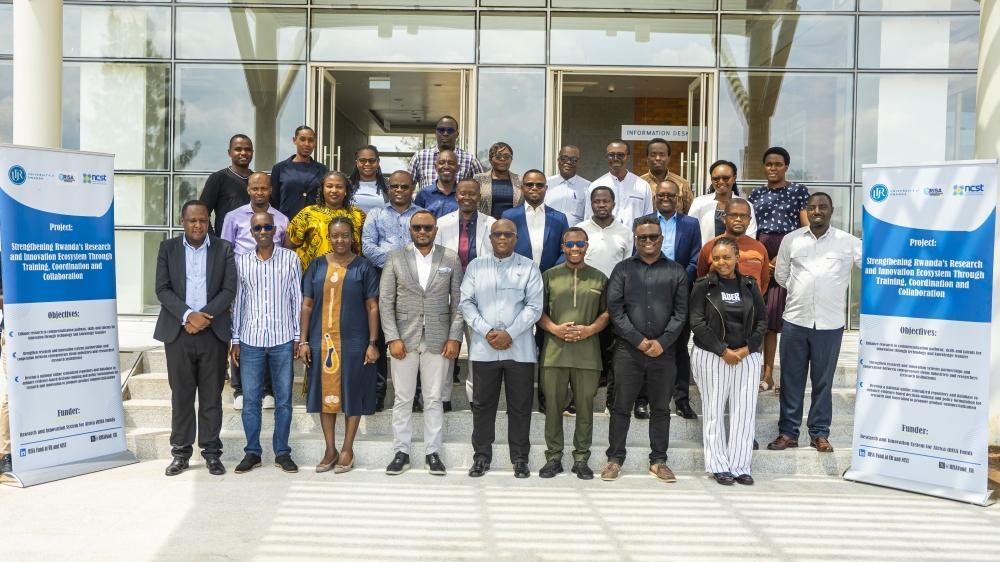
Africa-Press – Rwanda. University of Rwanda (UR), in partnership with the National Council for Science and Technology (NCST), has developed an Entrepreneurial Institutional Maturity Framework (EIMF) designed to assess and strengthen entrepreneurship development within higher learning institutions across the country.
The EIMF aims to measure how universities embed entrepreneurship and innovation into their strategies, practices, and operations, and to track their progress across maturity levels as part of supporting the commercialisation of research and innovations. By offering clear benchmarks and measurable indicators, the tool is expected to help institutions improve their competitiveness, align with national innovation priorities, and contribute more effectively to Rwanda’s economic growth.
The framework was presented on November 28, 2025, to key stakeholders in the national innovation system to gather inputs and comments that will inform the final version of the document.
According to Prof. Samuel Mutarindwa, Director of Research and Innovation at the University of Rwanda, the framework builds on lessons from global models such as those of the EU, Organization for Economic Cooperation and Development (OECD), UN Economic Commission for Africa, and Kenya’s AMI framework.
He said a grant was secured to implement a project titled “Strengthening Rwanda’s Research and Innovation Ecosystem Through Training, Coordination, and Collaboration,” of which the development of the Entrepreneurial Institution Maturity Framework was a part.
The project is funded through the Research and Innovation Systems for Africa (RISA) Fund programme, supported by the UK Foreign, Commonwealth and Development Office (FCDO), which aims to enhance research and innovation ecosystems across Africa. This project follows the successful implementation of a previous initiative that developed the National Technology Transfer and Commercialisation Strategy, also funded by the FCDO.
The current project aims to build nationwide capacity through Training of Trainers (ToT) to boost research entrepreneurship and innovation skills. It also focuses on fostering collaboration between academia and industry to drive market-relevant innovations. Strengthened research and innovation systems will enable effective technology development and knowledge transfer.
The long-term goal is to support a sustainable research and innovation ecosystem that contributes to Rwanda’s economic growth.
“Universities are doing a lot in terms of entrepreneurship and innovation. They are teaching, supporting innovation activities, and establishing innovation and incubation centres, laboratories, and technology transfer and commercialisation offices. But now, we don’t really know whether they are doing it correctly. So, what does it take for a university to be called entrepreneurial and innovative? With the new framework, we can determine that a university is at a particular stage depending on how it scores against set indicators regarding entrepreneurship and innovation,” Mutarindwa explained.
There are six key indicators to measure universities’ entrepreneurship maturity, he said. These include leadership, governance, financing, infrastructure, human capital, policies and strategies, entrepreneurial education, and industrial linkages.
“These are standard metrics we use to show the extent to which universities embrace and embed strategies and operations in alignment with innovation and entrepreneurship. This framework helps us assess these metrics across different maturity levels, unlike traditional methods, which just score these metrics at one stage. The stages are: traditional, emerging, developing, mature, and world-class.
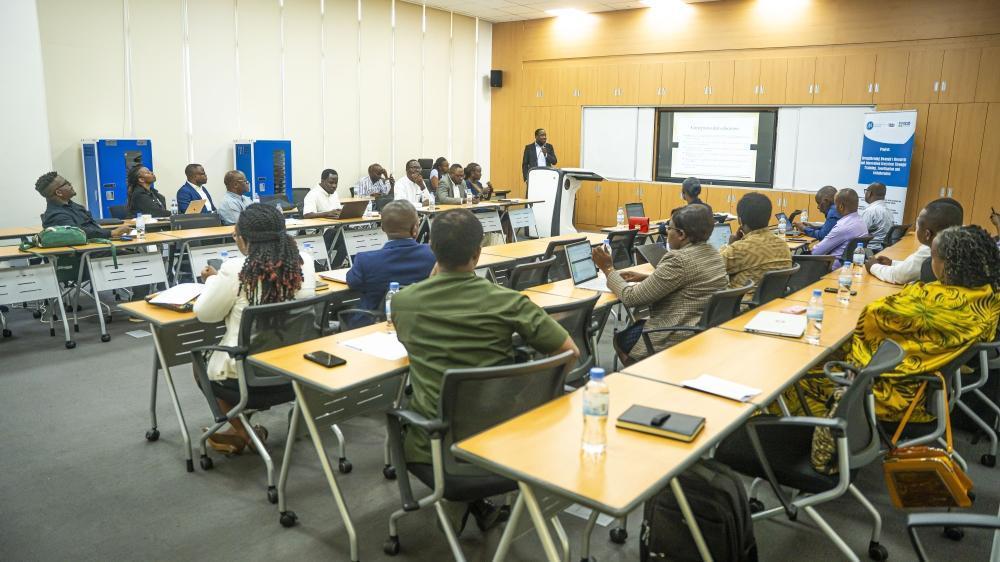
UR and NCST launched a framework to track entrepreneurship in universities during a November 28 event in Kigali, presenting it to key innovation stakeholders for feedback to refine the final document. Photo by Keza Kellya Raissa
With the new framework, we can determine that a university is at a particular stage depending on how it scores against set indicators regarding entrepreneurship and innovation,” Mutarindwa explained.
He said 15 universities are already participating in this assessment. Through a situational analysis of these universities, he explained that most are at mildly developing maturity stages, with some still at traditional stages.
Strengths include growing institutional commitment, expanding innovation infrastructure (incubation centres, laboratories, technology transfer offices), industry partnerships, entrepreneurial culture, and emerging experiential pedagogy. Weaknesses include limited innovation financing, inconsistent policy implementation, weak commercialisation pathways, low intellectual property output, and insufficient faculty incentives.
“Opportunities lie in integrating national policies, entrepreneurship strategies, and increased demand for practical, entrepreneurial graduates. Most of the universities are positioned in the mildly developing maturity stage… entrepreneurship intents exist, but institutionalisation and financing remain insufficient to reach many of the goals.”
The framework introduces an Input-Process-Output (IPO) model, adding a systematic approach to track progression across maturity stages: traditional, emerging, developing, mature, and world-class. Each stage identifies required inputs, processes, and outputs to guide universities in transitioning to higher maturity.
“It evaluates entrepreneurship and innovation maturity as a systematic and progressive process. It enables high-level self-learning to benchmark, identify gaps, and track measured progress,” Mutarindwa added.
Dr Esperance Munganyinka, Head of the Department of the National Research and Innovation Fund (NRIF) at NCST, and co-Principal Investigator of the project, said the framework was developed under the project “Strengthening Rwanda’s Research and Innovation Ecosystem through Training, Coordination, and Collaboration,” which has three main objectives. These include enhancing research and commercialisation pathways through skills and talent development for innovation, strengthening research and innovation systems partnerships through collaboration between academia and industry, and developing a national online centralised repository and database, in collaboration with the University of Rwanda and other key stakeholders.
“A key goal of developing the EIMF is to promote entrepreneurial and innovative skills for technology and knowledge transfer across the country. This can only be achieved by transforming academic research into practical applications. Every year we graduate students—but how do we transform academic knowledge into practical applications? This is a challenge. Use of EIMF will guide the development of entrepreneurship, boost competitiveness, foster innovation, and attract investment for technology transfer and commercialisation of innovations for industrial growth to drive Rwanda’s development, aligning with Vision 2050,” she said.
She urged higher learning institutions to use this framework as a model. “It is both a framework and a monitoring tool to evaluate entrepreneurship levels.”
Dr. Raymond Ndikumana delivers his remarks at the launch event, emphasising that universities hold the highest knowledge capacity. Photo by Keza Kellya Raissa
Dr Raymond Ndikumana, Deputy Vice-Chancellor for Strategic Planning and Administration at the University of Rwanda, said: “Universities are the ones with the highest knowledge capacity. This knowledge needs to be used, and we need an ecosystem that allows not just professors but also students to innovate. The mission of the University of Rwanda is to nurture that next generation of talent. We must take this framework seriously.”
He added that the maturity framework is an ideal tool to compare institutional performance across critical metrics. “This framework has been developed to continuously track entrepreneurship development across higher learning institutions and to foster competitiveness and innovation. Importantly, the Maturity Framework highlights areas where institutional performance can be strengthened. It describes various scales of entrepreneurship development, ranging from traditional universities to world-class universities.”

For More News And Analysis About Rwanda Follow Africa-Press