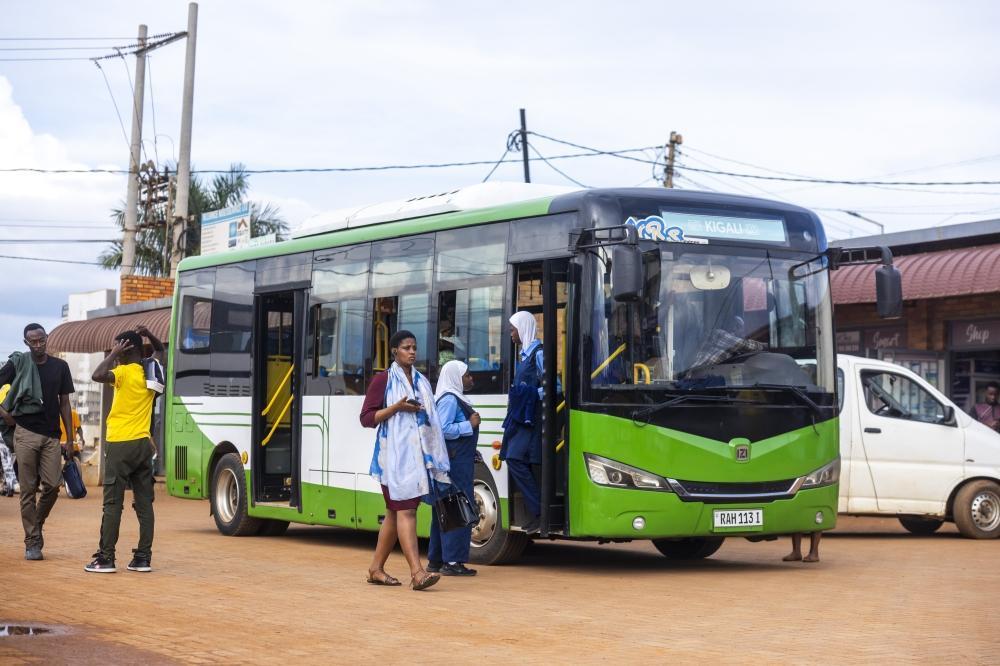
Africa-Press – Rwanda. Private bus operators have expressed mixed reactions as Kigali rolls out a new service-led public transport model designed to ensure buses run fixed and predictable timetables for reliability.
While many welcome the new model, they express concerns especially on the part of leasing buses to the government.
As part of the new model, which will be implemented by a newly created state-owned company Ecofleet Solutions, private operators can lease their buses to the government.
However, the state company does not accept to lease private operators’ buses with poor maintenance and state i.e. any bus that is eight years older and above will be excluded from the leasing model.
Charles Ngarambe, Chief Executive of Kigali Bus Services (KBS), said the company has started operating under the new framework, noting that government intervention was helping to address long-standing gaps.
“In the past, delays were often blamed on drivers and fuel-use responsibilities, but the new system brings more certainty because key operational burdens are now shared with the government,” he said.
According to Ngarambe, the collaboration between public institutions and private operators will help resolve bottlenecks in the short term, while paving the way for stronger service improvements in the future.
However, he pointed out that some buses were not selected for operations under the new model where private operators will lease their own buses to the government.
This, he said, has created immediate concerns.
Only 30 per cent of KBS’s fleet of 76 buses was leased to the Ecofleet Solutions Company.
He said buses, mainly those older than eight years, had been excluded from the leasing model.
“These buses had bank loans and staff attached to them. We are working with the government to see how these challenges can be addressed,” he said.
Meanwhile, he said, despite some drivers currently having no work, the need for additional drivers is likely to rise as more kilometres are added to the network due to making many rounds on routes.
Nilla Munezero, Chief Executive of Royal Express, said that the new model is a good idea, but transition challenges remain, saying that the real impact of the new model would become clearer after a few days of operation.
He noted that initial glitches were to be expected as operators adapt to revised routes, traffic patterns and an ageing traffic-light system.
“The idea itself is good, and it is expected to address challenges such as diesel costs through compensation mechanisms,” he said.
Munezero said that improving traffic-light priority, especially during peak hours, would further strengthen the model’s effectiveness.
He said, however, that the sector is still recovering from the effects of Covid-19.
“Royal Express, like other operators, has bank loans tied to buses that were not selected under the new system,” he said.
He noted that the company is waiting for a clear solution on the fate of the affected vehicles.
Some of the Royal Express vehicles are currently under a leasing contract with Ecofleet.
Under the arrangement, Royal Express supplies buses for leasing while also providing drivers through a service-contract model.
The company saw 22 of its buses, around 30 per cent of its fleet, selected to operate under the leasing model, he said.
Munezero added that operational changes mean the company will have to part ways with some staff.
“The workers we will remain with or be able to hire are mainly drivers, yet we had other categories of staff,” he said.
The rationale
The model, set to be launched on Tuesday, December 2, was approved by Cabinet on November 28.
It is expected to change how buses are deployed, how operators are monitored and, crucially, how passengers experience daily travel.
The reform replaces the long-running net-cost model, which has faced persistent challenges including fragmented management, inconsistent service and outdated systems.
Jean de Dieu Uwihanganye, Minister of State for Infrastructure said that during the bidding process to select operators to work with Ecofleet Solutions, vehicles with poor maintenance and state are not considered.
He said it requires compliance with several independent criteria, each of which can block entry if not satisfied.
“There isn’t just one single approval or licence needed. Operators must separately meet conditions for operating, fuel provision, maintenance, and cleanliness. Each of these is treated as its own category, with its own standards and obligations,” he explained.
Together, he added, they create multiple hurdles that companies or individuals must clear before being allowed to run buses under the new model.
For More News And Analysis About Rwanda Follow Africa-Press