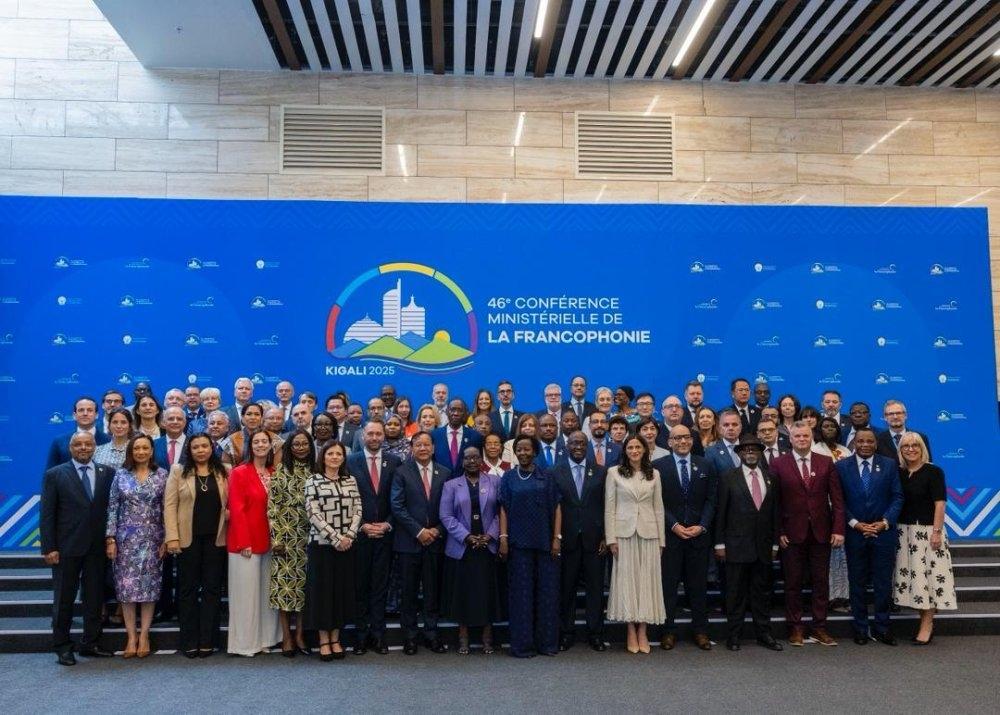
Africa-Press – Rwanda. As Kigali hosted the Francophonie Summit, Rwanda placed its youth and women at the heart of the global Francophonie movement. With discussions focused on employment, education, and cultural exchange, the country’s renewed commitment to promoting French has become increasingly visible. But what does the language truly mean for young Rwandans today?
Rwanda adopted English as its main language of instruction in 2008. Today, French is one of the four official languages alongside Kinyarwanda, English, and Swahili, but exposure differs widely between urban and rural areas.
Renewed support from the OIF, Alliance Française, and the Ministry of Education is helping boost young people’s interest in French.
The 2023-2024 report of the National Institute of Statistics of Rwanda (NISR) shows the percentage of the youth population speaking French: 5,4% of the youth people aged 16-30 years. The School Data Management System (SDMS) for the 2024 – 2025 academic year highlights Rwanda’s growing teaching capacity in French. Primary school French teachers are 7,943, in secondary school French teachers are 2,700, and in TVET, French teachers are 177.
Behind these numbers are the young voices redefining what French means in Rwanda today.
Gateway to global opportunity
For videographer Bertrand Munyazikwiye, French is a tool for work and global connection.
Raised in Kigali and working as an independent creative, Munyazikwiye sees the language as an opportunity for both his career and personal growth. He highlighted two key points: a language of opportunity and career advancement.
French has especially allowed him to collaborate with international clients. “If I weren’t able to speak French, I would not be able to work with many of the people I met,” he said.
For him, the language is also a bridge to global ideas and networks. Through practice and conversations, French has opened doors to new perspectives, partnerships, and professional opportunities beyond Rwanda’s borders.
“French is not just a language; it is a gateway to a global creative market,” Munyazikwiye explained.
Cultural identity and heritage
For interpreter Lavinie Bienvenue Uwumukiza, French carries cultural depth and personal meaning. As a freelance interpreter and transcriptionist, she connects language with identity.
She emphasised that, “French represents a rooted culture; it was the first foreign language my parents and elders were introduced to.”
For her, la Francophonie represents shared history, cultural exchange, and diversity, values that resonate with young Rwandans seeking identity and international exposure.
However, she noted, with English now the language of instruction, exposure to French is decreasing in many schools, creating inequalities in access. Yet, not all young francophones come from environments where the language is easily accessible.
Jean Claude Hategekimana, from Nyamagabe District, shared his experience: “French became difficult for me after the changes in education. I stopped learning it in Primary 2. My parents do not speak it, and in rural areas, we don’t have private schools teaching French.
“Many young people lose the motivation to learn. If I had learned it well, maybe I wouldn’t still be living here. We have no tourism or sectors where French could open opportunities. Rural areas lack the infrastructure to make this easier.”
His testimony reflects the reality of many rural youths as opportunity gaps remain.
To David Mbani, a French teacher at Discovery International School, in the Gisozi area of Kigali, the situation in classrooms shows the complexity of promoting French today.
The biggest barrier, according to him, is perception.
“Students think French is only useful in primary or secondary school. They believe that at university everything will be in English, so they don’t put much effort into French,” Mbani said.
“As teachers, we show them that multilingualism brings more opportunities later in life,” he added.
As Rwanda positions itself globally, multilingualism is becoming a development tool. For young professional Merissa Iradukunda, the country’s official policy supports multilingual engagement and speaking French is strategic.
French, like any other international language, broadens access to jobs, scholarships, and international collaborations. “The more you know the language, the more you help the country reach its goals,” Iradukunda said.
Through French, she shares Rwanda’s culture and history, including Ndi Umunyarwanda, a philosophy rooted in unity and healing.
“I have been living in Central Africa, Gabon, where we speak French ever since I was five. I learned it there and it helps me to understand their culture and share mine,” she added.
Despite Rwanda’s shift to English, young people agree that speaking multiple languages is not a burden but a reflection of the country’s openness and ambition.
The stories of Munyazikwiye, Uwumukiza, Hategekimana, Iradukunda, and the perspective of the teacher, Mbani, reveal a shared truth.
For Rwanda’s youth who speak it, French is more than a language; it is an identity, an opportunity, and a tool for global connection.
For More News And Analysis About Rwanda Follow Africa-Press