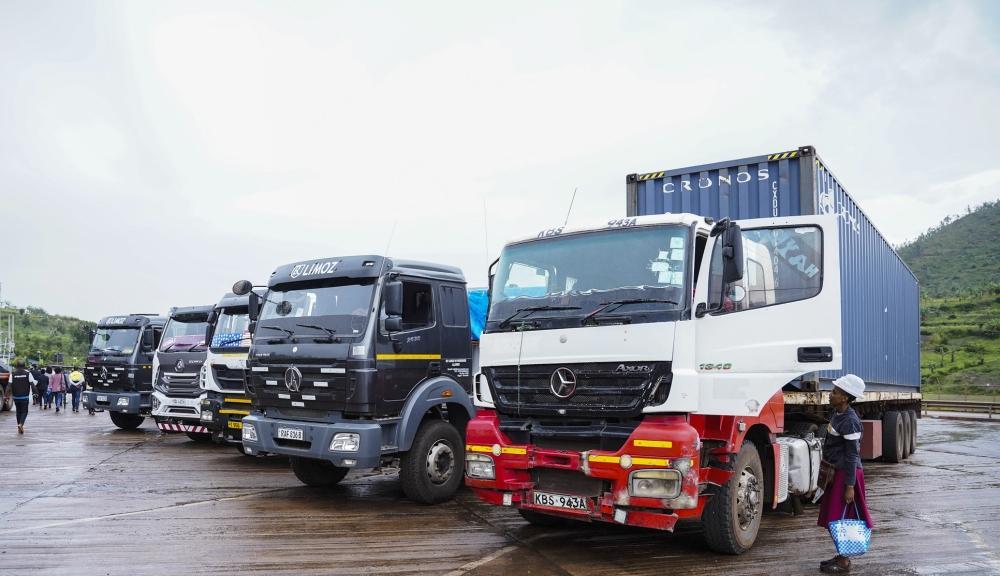
Africa-Press – Rwanda. The government has pledged to address concerns over inadequate truck parking facilities, amid complaints from lawmakers and truck drivers who say the shortage is contributing to fatigue, accidents and financial losses.
MP Pie Nizeyimana said that designated places where trucks can stop to rest remain very limited due to inadequate infrastructure. He described it as “unfair” that drivers who stop to rest in order to avoid accidents—by parking at fuel stations or in spacious areas off the road—are fined by traffic police.
He was speaking during a plenary sitting of the Chamber of Deputies on December 29, as MPs began voting on the draft law governing road traffic.
Nizeyimana added that the penalties are imposed twice because trucks carry two number plates, one at the front and another at the back.
“As a result, a driver who stops simply because they are exhausted and want to rest to avoid causing an accident ends up being penalised,” Nizeyimana said.
He called for the issue to be revisited, urging authorities to clarify whether such drivers should continue to be punished or whether some tolerance should be applied as the country works to develop the necessary infrastructure.
In response, the Minister of Infrastructure, Jimmy Gasore, acknowledged that truck parking areas are a critical part of transport infrastructure and agreed that existing facilities are insufficient.
Gasore said the concerns raised by MP Nizeyimana are currently being treated as an advocacy issue. He noted that the ministry is working with the police to explore ways of easing the situation for truck drivers, including ensuring access to parking areas and avoiding excessive penalties when drivers stop in appropriate places that do not compromise road safety.
“This advocacy is meant to prevent a real and understandable problem, where a driver has nowhere to park but feels exhausted. In the absence of designated parking areas and before the necessary infrastructure is built, there should be a way to accommodate such drivers,” the minister said.
However, Gasore said the government is working on projects in collaboration with the Northern Corridor and the Central Corridor – in the East Africa region – to expand truck parking capacity and equip facilities with essential services, commonly referred to as roadside stations. These include toilets, food outlets and other basic amenities.
The Northern Corridor, which is about 1,700 kilometres long, starts at the port of Mombasa and serves Kenya, Uganda, Rwanda, Burundi and eastern DR Congo. The Central Corridor, about 1,300 kilometres long, begins at the port of Dar es Salaam and serves Tanzania, Zambia, Rwanda, Burundi, Uganda and eastern DR Congo, according to the East African Community (EAC).
The nature of the issue
Speaking to The New Times, Noel Nkurikiye, a truck driver and the Secretary General of the Rwanda Professional Truck Drivers’ Union, said the lack of adequate parking facilities remains a serious challenge.
He indicated that drivers transporting goods from neighbouring countries often face long delays at border posts. He cited the example of Rusumo Customs at the Rwanda–Tanzania border, where the clearing process can take up to five hours.
“By the time the process is completed, the driver is already exhausted, yet there is no place to rest until reaching Rugende in Kigali,” he said.
Even at Rugende, which is the main designated truck parking area located in Gasabo District, Kigali, facilities are limited. Nkurikiye said the site can accommodate about 100 trucks but has no sleeping facilities, forcing drivers to sleep in their vehicles.
Nkurikiye said that another small parking area exists at Kadasumbwa in Rwamagana District, Eastern Province, but it can accommodate no more than 10 trucks, making it inadequate for the growing demand.
The union has more than 400 active members and estimates that there are over 6,000 truck drivers operating across Rwanda.
“From Rusumo to Kigali, the only officially recognised parking area is in Rugende, near Kabuga, and even that one does not meet the required standards. When you park there, there is nowhere to sleep—you have to sleep in the truck,” Nkurikiye said.
He added that the shortage of parking affects not only local drivers but also foreign truck drivers entering Rwanda.
While drivers could park at fuel stations to rest, this is not allowed. “If you park at a fuel station today, you are immediately fined [by traffic police],” Nkurikiye said.
According to the union, drivers are somehow fined twice for illegal parking because penalties are issued for both number plates—the one at the front of the truck and the one at the back of the trailer. The fine is Rwf25,000 per plate, amounting to Rwf50,000. The same penalties apply to parking on undesignated roadside areas.
He warned that the lack of such facilities leads to driver fatigue, which increases the risk of accidents as drivers may fall asleep at the wheel.
“A driver who has not rested is not safe on the road,” he said, adding that mechanical breakdowns also become more dangerous when there is nowhere safe to park and inspect a vehicle.
Beyond fatigue-related accidents, he highlighted security risks. He said there are cases where drivers arrive at border posts in the evening, complete clearance late at night and are instructed to move their trucks to make room for others. With nowhere to park, they are forced to drive through the night.
In some isolated or steep sections of the road, he said, thieves sometimes vandalise trucks and steal goods after tearing protective covers, especially for commodities like cement.
“In such cases, the loss is borne by the truck driver,” he observed.
The need for adequate parking facilities
Nkurikiye stressed the need for secure parking areas with basic amenities.
“We need facilities that meet required standards—showers, restaurants, places to sleep and, where possible, areas for recreation. In short, spacious and well-equipped parking areas,” he said.
He further noted that investment in truck parking facilities or roadside stations—whether by government or the private sector—would be financially viable. He said operators could earn revenue from food services, parking fees, showers and other services, making it a profitable long-term investment.
For More News And Analysis About Rwanda Follow Africa-Press