Dr Alex Mvuka Ntung
Africa-Press – Rwanda. Scholars on genocide often refer to the “path” of genocide to explain the structural stages and processes that transform social, ethnic, or religious tensions into systematic mass murder.
In some public forums, I have discussed what I consider to be a “path” of genocide in a geographical context. This challenges our existing understanding of the concept of “genocide,” which is linked to the state and the nationality of the victims and perpetrators—considering that genocide is state-sponsored and occurs within a country’s borders.
I would rather extend the discussion to an ideology of genocide without borders in the Great Lakes Region—a journey of this ideology through history across the region, manifesting itself differently by drawing from local drivers.
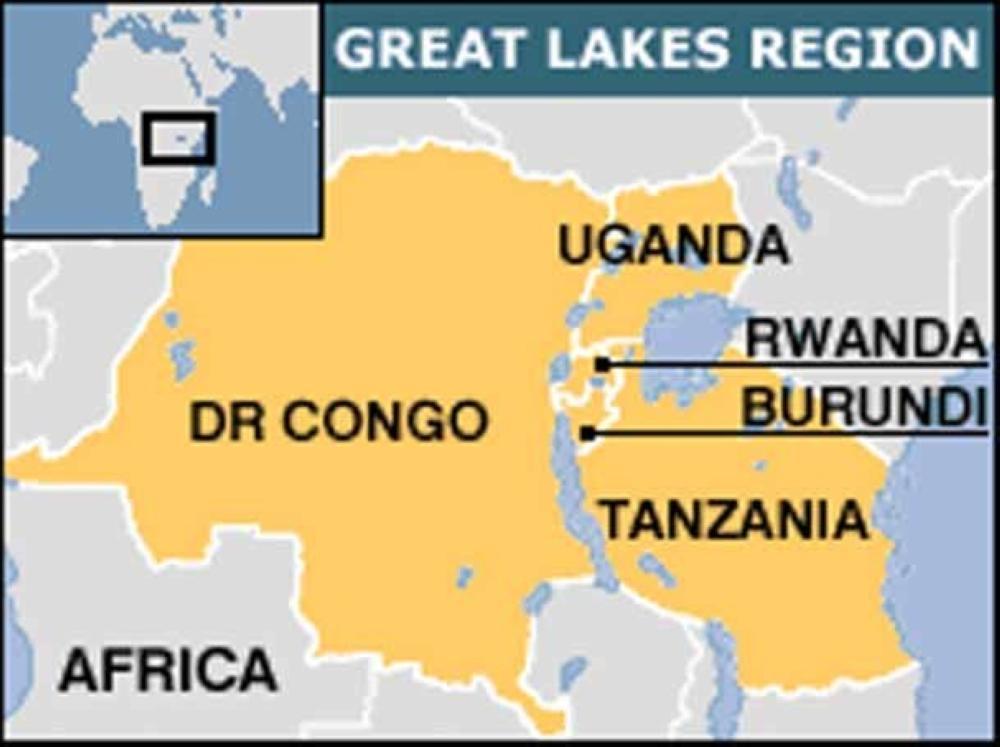
This ideology either develops simultaneously or independently but is fuelled by similar underlying factors or interconnected ideology. Using an analogical illustration, I consider this an ideological virus that can particularly affect Uganda, Rwanda, Burundi, and DR Congo. It is not constrained by national boundaries or physical borders.
The region can be compared to a house, and countries to rooms. The house is affected by a virus. If one room implements strict and effective measures to eradicate the virus, but another has neither the will to contain nor the will to combat it, and instead does everything to spread it, then the entire house, or the other rooms, risk becoming contaminated. Currently, this virus has found fertile ground in DR Congo: it is well-maintained, nurtured, and multiplied there.
In this article I call upon all the regional head of states to consider that the propagation of this virus in one state of the region has a direct effect and consequences for other states and has triggered or is most likely to trigger regional conflict, resulting in security instability for all. Either all the regional states must collectively eradicate it, or each country must take responsibility for destroying the virus, wherever it propagates.
Why the genocidal ideology is one and indivisible
There is an assumption that the Genocide against the Tutsi in Rwanda in 1994 spilled over the border into DR Congo or that it started in 1994. I argue that there are internal causes but with regional interlinkages. It is rather an interconnected genocide—the 1994 Genocide against the Tutsi transcended borders. I would like to provide a simplified explanation.
The countries of the region are linked by a shared history, and their populations share similar cultural, linguistic, and sociological factors; the countries’ borders are artificial. The region, particularly Rwanda, Burundi, and DR Congo, experienced a similar colonial system marked by the marginalization and division of ethnic groups – ethnicizing some (non-Tutsi) and racializing others (Tutsi).
The question of ethnic identity is a colonial legacy, reinforced by conspiracy theories developed by some European researchers. The region has also been influenced by mythical colonial theories, notably those categorizing people as so-called Hamitic or Nilotic peoples and the Bantu. These cultural, linguistic, and morphological characteristics have been instrumentalized and used as a basis for the intention to destroy and exterminate certain groups, constructing an ideology of exclusion and systemic violence.
The region has also been affected by refugee flows fleeing conflict, ethnic violence, and genocide. There is a long history of Hutu refugees from Burundi and Rwanda in DR Congo and Tanzania, as well as Congolese Tutsi refugees in Burundi, Rwanda, Kenya, and Uganda. Other Congolese ethnic groups have also found refuge in Uganda, Tanzania, Burundi, and Rwanda, as have Burundian Tutsi refugees in Rwanda. However, the determining factors of these refugees are rooted from the ideology or its consequences. Over the years, these refugees generate narratives of their experiences of dispossession and violence to reinforce the construction of ethnic identities and their ideological differentiation.
DR Congo is a breeding ground for major factors of instability in the region
DR Congo is regularly described as a failed state.
Studies in political economy show that poor governance and abuses of power by state authorities are major factors of instability in the region. Its army has failed in its mission to protect the population and guarantee security for numerous reasons. Its members are often mobilized unofficially along ethnic and regional lines. The country’s vast size, combined with the proliferation of insurgencies and armed groups supported by the government, poses a major challenge to military efforts to maintain regional security.
The ideology has become a form of governance system and related various political rhetorics focus on ethnocentrism. It is manifested through hate speech, the mobilisation of extremist armed groups, and the contestation of identity of certain ethnic groups, and development of narratives that deny them existence and livelihood. In the collective imagination of most Congolese, a Tutsi is a potential danger – portrayed as immortal, insensitive to physical and moral pain, unable to feel thirst or hunger, a creature without sentiments.
Such hateful ideas are disseminated through the national platforms and endorsed by the political actors.
Selective measures to contain the threat
Rwanda’s involvement in eradicating this ideology in DR Congo is often viewed negatively by some countries in the region, particularly Burundi and DR Congo. Yet, Uganda is present in Ituri to defend its borders against the ADF.
Burundi has been operating in DR Congo for over four years, both for security reasons and, more importantly, driven by the desire to promote this genocidal ideology. DR Congo thus acts as an ideological breeding ground, even a factory for disseminating this ideology, and has succeeded in creating armed groups that carry and perpetuate its spread. These groups do not have any other political grievances other than the ambition to kill and destroy one group of people because of their ethnicity. They also vow to remove the Rwandan president from power because of the imagined identity that his physical features represent. Similarly, MONUSCO is present in DR Congo for reasons of international security. Rwanda, however, has more reason to be concerned.
This ideology of genocide is carried out in DR Congo by targeting certain Congolese ethnic groups, systematically associated with Rwanda or with the image of “Rwandan.” Those who are victims are historically sent to Rwanda. In Kinshasa, there is a populist policy of competing in the degree of hatred toward Rwanda, used as a means of gaining power or justifying governance failures. The victims of this ideology in DR Congo are threatened with displacement in the same context as the genocide against the Tutsi in Rwanda in 1994. Rwanda is perceived by some Western powers as an obstacle, even a troublesome actor, in the exploitation of DR Congo’s resources. Rwanda remains a constant target in the political rhetoric of this borderless ideology. These perceptions serve to legitimize Rwanda’s direct or indirect involvement.
Final thought
There is a rampant cross-border genocide ideology.
It is a virus that poses a threat to all countries. DR Congo has created fertile ground for its spread throughout the region. One of the major challenges facing the East African Community (EAC) lies in its strategies for promoting regional integration through genuine rapprochement between its peoples.
Sustainable economic development without the elimination of internal conflicts remains utopian. It is therefore essential to focus on resolving ideological conflicts and correcting the excesses of internal politics within certain member states. Ideally, collective diplomatic action is needed to eradicate this ideological virus; otherwise, each state is forced to fend for itself to defend or contain this threat, wherever it may originate.
Source: The New Times
For More News And Analysis About Rwanda Follow Africa-Press