Africa-Press – Rwanda. Two years after Rwanda launched the 4×4 Health Workforce Reform, the impact is becoming visible across the health system.
The country has sharply increased the number of students training in medicine, nursing, midwifery and specialised fields, while hospitals are beginning to offer services that once forced patients to seek care abroad.
More than 16,000 students are now enrolled in health training programmes nationwide, part of an ambitious effort to quadruple the size and skills of the health workforce and strengthen service delivery at all levels.
Expanding training and equipment
A central pillar of the reform has been the expansion of training programmes alongside major investments in medical equipment.
Hospitals and teaching institutions have received high-tech devices through Rwanda Medical Supply, with careful planning to ensure the equipment meets national standards, integrates with existing systems and can be maintained sustainably.
Among the most notable additions are East Africa’s first robotic neurosurgical microscopes, now in use at King Faisal Hospital Rwanda and the University Teaching Hospital of Butare. These microscopes support highly delicate brain surgeries while also serving as training tools for future neurosurgeons.
Other new equipment includes gastroenterology towers, high-resolution maternal–fetal ultrasound systems that improve prenatal imaging, and a specialised catheterisation laboratory for advanced heart procedures.
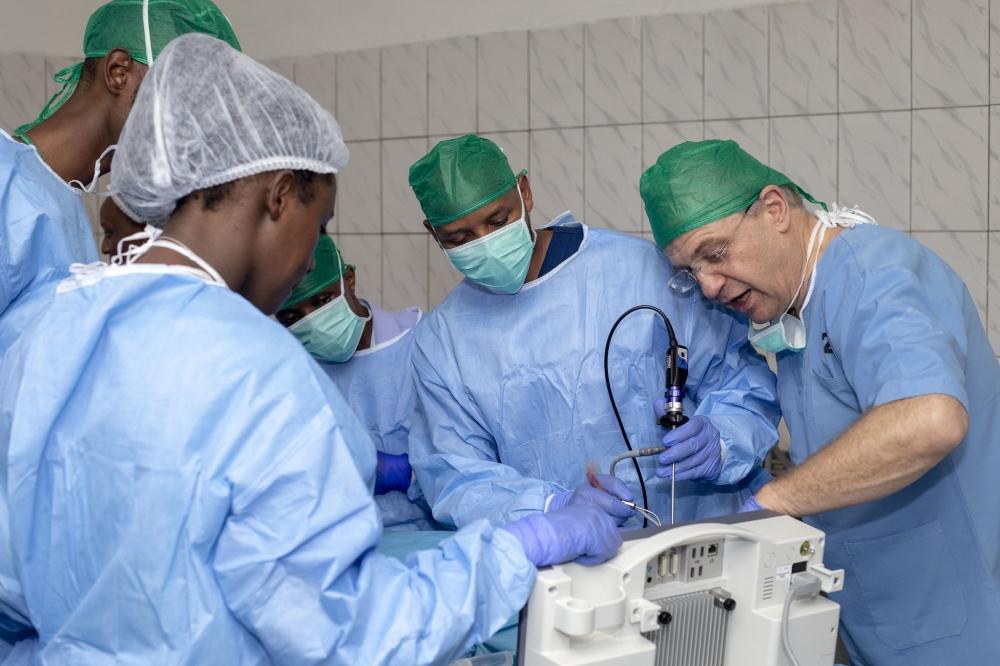
To support fellowship training in cardiology, surgery, anaesthesiology, oncology and internal medicine, hospitals have also added surgical theatres, anaesthesia machines, endoscopy systems and advanced diagnostic tools.
Cutting reliance on overseas referrals
For years, Rwanda relied heavily on overseas referrals for specialised treatment, a process that was costly for the government and emotionally taxing for patients and families.
Between January 2020 and February 2025, 352 patients were referred abroad at a cost exceeding $6 million, mainly for cancer care, heart treatment and kidney transplants.
The reform is steadily reversing this trend. Rwanda’s first kidney transplant programme, launched at King Faisal Hospital in 2023, has already carried out more than 90 transplants with successful outcomes.
As a result, referral costs for renal transplants previously totalling more than $700,000 dropped to zero in 2024 and 2025.
Paediatric cardiac surgery is now offered year-round, enabling children with heart conditions to receive timely care without waiting for periodic visits by foreign medical teams.
In cancer care, Rwanda has acquired its first PET scanner, which will be installed at the Rwanda Military Referral and Teaching Hospital, and is developing the country’s first bone marrow treatment centre. Alongside this infrastructure, the government is investing in training oncologists and specialised support staff to run these new services.
Stronger specialist services beyond Kigali
The reform has also strengthened staffing and services at Level II Teaching Hospitals, which serve large catchment areas across the country.
Obstetrics and gynaecology residency programmes now ensure specialists are available around the clock, reducing maternal complications and easing pressure on national referral hospitals.
Nyagatare District Hospital, for example, had no permanent specialists two years ago. It now employs three obstetrician-gynaecologists, a general surgeon and a paediatrician.
At Kibungo Level II Teaching Hospital, the number of specialists has risen from four to more than 16 across seven specialties, with new services such as emergency medicine and intensive care now available.
Maternal–fetal care has improved significantly. The Maternal Fetal Medicine Unit now performs advanced interventions that were previously unavailable in Rwanda, including intrauterine transfusions for fetuses with severe anaemia and treatments for fetal heart rhythm disorders.
Conditions such as Placenta Accreta Spectrum, once associated with severe bleeding during childbirth, are now diagnosed early and managed through structured imaging and team-based surgical planning.
Gastroenterology services have also expanded. Tertiary hospitals are performing three times as many procedures as before, waiting lists have shortened, and advanced treatments—such as endoscopic removal of large polyps, management of bleeding oesophageal veins and stent placement for blocked bile ducts—have become routine.
Managing the workforce with digital tools
Despite the progress, staffing shortages remain a challenge. By December 2025, only about two-thirds of approved public health positions were filled, with general practitioners and specialists accounting for roughly a third of all posts.
A new staffing plan is being developed to meet growing needs at primary, district and referral hospitals.
To improve planning and accountability, the Ministry of Health has rolled out the Health Workforce Management System, a national digital platform that tracks training, licensing, deployment, career progression and specialisation.
Once fully operational, it is expected to provide real-time data to guide staffing decisions.
Nurses are also being trained to use digital tools embedded in electronic medical records that support screening, diagnosis and referrals, while remaining central to patient care.
Continuous mentorship and hands-on training are helping to maintain quality standards and support professional growth.
Persistent gaps
Significant gaps remain in infrastructure. Hospitals continue to face shortages of intensive care beds and operating theatres. By 2025, only 167 of the 700 operating theatres and 179 of the 1,265 ICU beds the country needs were in place.
These constraints are slowing the expansion of specialist services and are expected to be addressed in the next phase of the reform.
Even so, the early results of the 4×4 strategy suggest a clear shift: more Rwandans are accessing specialised care closer to home, supported by a growing workforce and steadily improving facilities.
########
What is Rwanda’s 4×4 health workforce?
Launched in 2023, it is Rwanda’s health workforce reform aimed at building specialist medical capacity locally and reducing reliance on treatment abroad.
Why is it called “4×4”?
Because it targets four priority medical fields using four coordinated strategies to train, deploy and retain specialists.
Which medical fields are prioritised?
Cancer care (oncology), cardiology, nephrology, and anaesthesia and critical care.
What problem does it address?
The high cost and limited access caused by referring patients overseas for specialised treatment.
What does it aim to achieve?
To ensure advanced medical care is delivered inside Rwanda, improving access while cutting referral costs.
For More News And Analysis About Rwanda Follow Africa-Press