Africa-Press – Rwanda. In the midst of genocide ideology, misinformation and disinformation can spread easily, especially among young people born after the 1994 Genocide against the Tutsi. Social media, widely used by the youth, has become one of the main channels through which false or distorted narratives circulate.
For young Rwandans in the diaspora, this means they have a responsibility to carry forward Kwibuka, remembering more than one million lives lost.
The youth abroad are already taking on this responsibility in different ways, using what they learn about the truth to challenge misinformation and keep the memory alive
Benjamin Ahishakiye, a Rwandan medical student based in Morocco, said that acknowledging the devastating impact of the 1994 Genocide on the country and its people is the reason Kwibuka must continue.
He explained that remembrance helps young people, particularly those living abroad, understand their history and recognise their role in ensuring such a tragedy never happens again.
“Kwibuka helps us access accurate information about the Genocide. It allows us to respond when people from different countries ask about it, and to correct those who may have been misinformed.”
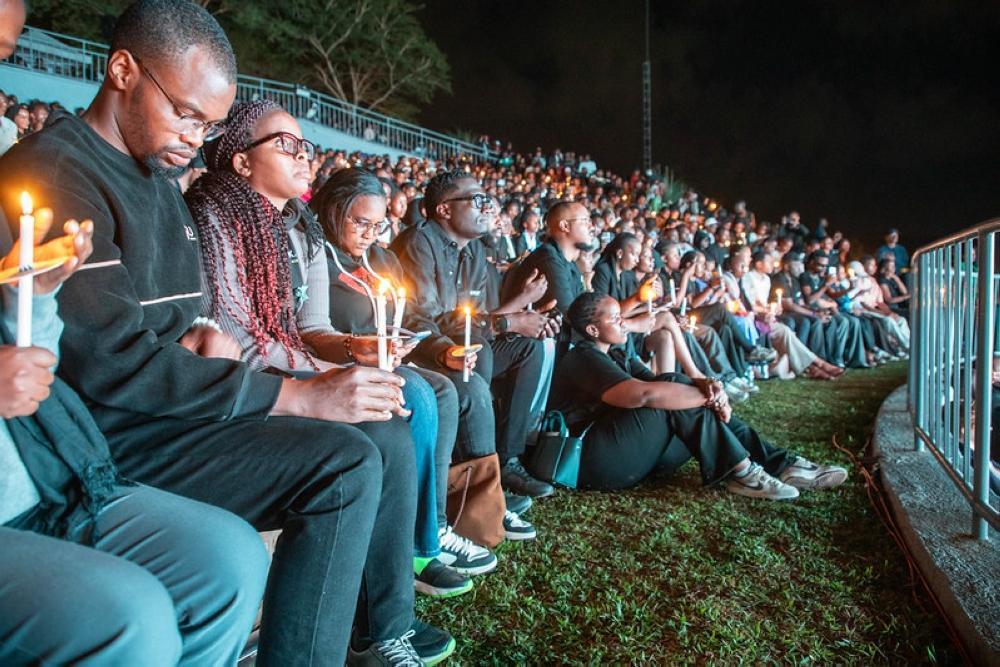
A youth holds a burning candle during the “Our Past” event at Nyanza Genocide Memorial on Thursday, April 9, in remembrance of lives lost in the 1994 Genocide against the Tutsi.
Ahishakiye added that young people can keep the memory alive by taking part in commemoration activities, sharing stories on social media, and promoting the Ndi Umunyarwanda spirit, which emphasises unity and a shared national identity.
Landry Ntwali, a student pursuing a degree in Pharmacy at United States International University-Africa in Nairobi, noted that the commemoration period is a time of learning and reflection.
Although many young people were not born during the Genocide, they often feel a responsibility to understand what happened, stay connected to their roots, and contribute to preventing such tragedies in the future, he noted.
Ntwali explained that Rwandan youth have a role to play in preserving memory by promoting unity, rejecting divisionism, and standing against hate speech and discrimination.
He said this begins with learning about the past and understanding its causes and consequences, then using that knowledge to educate others, whether through conversations or by sharing accurate information online.
Omar Iradukunda, a student studying Artificial Intelligence and Data Science in Algeria, noted that remembrance is a way of staying connected to identity, to history, and to a shared responsibility as part of a new generation.
He notes that Kwibuka is not only about remembering the Genocide, but also about honouring the lives lost, standing with survivors, and ensuring that the truth is neither denied nor forgotten.
“Sometimes our leaders come to meet us, share the history, and inspire patriotism. These moments bring us together and strengthen our connection to our country, even when we are far away.”
Distance can create a sense of disconnection, but Kwibuka helps bring Rwandans back together. It reinforces the idea that remembrance is not only for those who witnessed the tragedy, but also for those who must protect its truth and carry it forward, Iradukunda added.
Kwibuka is a time of reflection, unity, and responsibility. It positions young people as the voice of memory and as builders of a future based on humanity, dignity, and the commitment to “Never Again.”
“For us, the younger generation, preserving the memory of the Genocide starts with learning the truth and being willing to speak about it with honesty and respect. It shouldn’t be something only remembered at a certain time, but something reflected in everyday actions like how people speak, how they treat others, and the values they live by,” Iradukunda said. He noted that keeping the message of ‘Never Again’ alive means rejecting hatred, division, and genocide ideology in all its forms, and standing against discrimination and misinformation in everyday life. It also means recognising that even small daily choices, such as words, conversations, and attitudes, carry weight.
“For us in the diaspora, there is also a responsibility to share Rwanda’s history with the world, especially where it is not well understood. Through education, dialogue, community engagement, and responsible use of social media, we can help raise awareness and preserve memory. We are called to live by the values of unity, resilience, compassion, and truth. ‘Never Again’ is not just a phrase, but a commitment lived through everyday actions,” Iradukunda stated.
Blessing Gasana, who lives in Kenya, noted that sometimes people think Kwibuka is only about 100 days. However, she explained that for them as youth, it is about what they do with the other 265 days of the year.
“When we study hard, when we start businesses, when we tell our own stories, we take the power back, and that is how we honour the lives lost, by living so fully and so creatively. And by flourishing in a way the world can’t help but see the beauty of the Rwanda we are building today,” she said.
For More News And Analysis About Rwanda Follow Africa-Press