

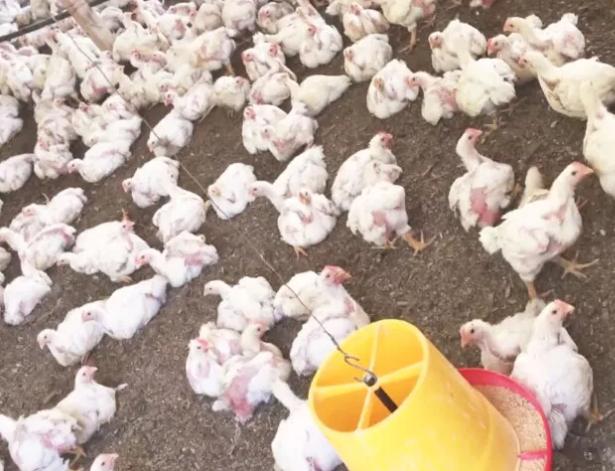
Africa-Press – Senegal. Chicken, widely consumed during the celebration of Eid el-Fitr or Korité, is a rare commodity in the henhouses of the Sangalkam area (west), where a large part of the poultry was decimated by avian flu and the Newcastle disease virus, found the APS.
Cheikh Bâ, a farmer in his thirties, is nostalgic for the boom years of his poultry activities. Of the 900 chicks he acquired recently, only about 200 have reached maturity, the rest being decimated by the Newcastle virus. « It’s big losses that we suffer because of the virus », says the young poultry farmer, all worried.
According to local poultry farmers, the Newcastle virus is rampant in Sangalkam and nearby localities, one of the most important poultry farming areas in the country.
The disease appeared in Cheikh Bâ’s chicken coop when the chicks were twenty-five days old. “I lost about 1 million CFA francs spent on poultry feed and the purchase of chicks,” worries Mr. Bâ.
Ibrahima Touré partage la même inquiétude avec lui. Le virus de la maladie de Newcastle, très contagieux, a fait son apparition dans son poulailler situé près de la route reliant Niakoulrab à Ndiakhirate. ‘’Elle a ravagé près de 3.000 des 5.000 sujets que nous possédions. Il nous restait quelque 2.000 têtes, que nous étions obligés d’abattre pour réduire les risques de propagation de la maladie’’, raconte M. Touré.
Selon lui, la grippe aviaire est apparue dans la zone, précédant la maladie de Newcastle. Aujourd’hui, l’éleveur de volaille estime avoir perdu plus de 5 millions de francs CFA. Cette estimation ne prend pas en compte les dépenses qu’il a faites pour les soins vétérinaires, dit-il.
Distraught, Ibrahima Touré is now content with his laying hens, which have been “less affected” by avian flu and Newcastle disease than chicks. The hens have lost more than 50% of their ability to lay eggs, he laments.
Babacar Mbaye is one of the poultry farmers who fell victim to the avian flu epidemic and the Newcastle disease virus. “We suffered big losses,” he worries, recalling having acquired thousands of chicks.
« We lost almost everything », regrets the young poultry farmer. He claims to have spent nearly 7 million CFA francs for the acquisition of the chicks and their food.
There is no doubt that chicken, a favorite food for the Eid al-Fitr celebration, will be in short supply due to the many poultry heads decimated in the Sangalkam area, according to local breeders .
« There will be no chicken in Niakoulrab », maintains Ibrahima Touré, fully aware of the extent of the damage to the chicken coops in the area.
« We don’t know what to do to mitigate the losses »
According to Cheikh Bâ, the shortage is all the more likely as the chicks that survived the epidemic did not reach the size and weight required to be consumed during Eid al-Fitr, the festival marking the end of the Ramadan.
In Niakoulrab, Amy Diop, a housekeeper, regrets the losses suffered by poultry farmers. “Consumers will feel these losses a lot,” she worries.
Some consumers fear higher chicken prices. « We must expect a rise in prices because we have lost too much. We don’t know what to do to mitigate the losses, » says Babacar Mbaye, one of many farmers upset by the mass disappearance of poultry.
According to Cheikh Bâ, the chicken weighing between 1.5 and 2 kilos is sold for 2,500 CFA francs among poultry farmers and 3,000 or 3,500 once plucked, outside the henhouses.
Poultry farmers also fear the loss of jobs in this important poultry area. This is the case of Babacar Mbaye, who employs six people to maintain his chicken coop and three others responsible for selling the produce.
Ibrahima Touré seeks to save an economy for which he collaborates with three people to be remunerated.
« We seized Sedima (a poultry company) but it has not reacted yet, » said Mr. Touré of his supplier of chicks and poultry feed.
Another company supplying chicks to Babacar Mbaye denied responsibility when contacted by the breeder after the poultry died.
Pour plus d’informations et d’analyses sur la Senegal, suivez Africa-Press