
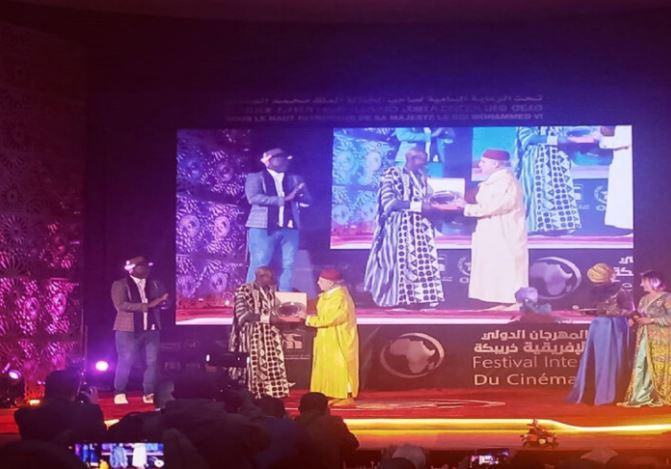
Africa-Press – Senegal. La 23ème édition du Festival international du cinéma africain de Khouribga (FICAK) au Maroc s’est ouverte, samedi soir, avec un hommage »émouvant » rendu au cinéaste burkinabé Drissa Touré, en reconnaissance à la contribution au cinéma africain de celui qui est passé de la gloire sur les marches de la croisette au festival de Cannes en France en 1991 avec son film « Laada » à la déchéance, en devenant vendeur de bois.
De l’envoyée spéciale de l’APS: Fatou Kiné Sène
In front of a full movie theater stormed by moviegoers from various walks of life, Drissa Touré, a self-taught director with more than thirty years of cinematographic practice, felt that this honor is “a rebirth and a resurrection”.
»C’est une renaissance, une résurrection. Il y a eu beaucoup d’émotions, parce que je me suis rappelé de 1991 lorsque je faisais le film +Laada+, paix à l’âme de Nour-Eddine Saïl (décédé en 2020, il était l’un des fondateurs et ambassadeurs du FICAK), on était à Paris et il m’a amené ici et son cheval de bataille était de faire vivre le cinéma africain », a réagi le réalisateur Burkinabé après avoir reçu le trophée d’honneur du Festival international du cinéma africain de Khouribga (6 au 13 mai).
For Drissa Touré, overflowing with emotion, this tribute is a coincidence of history, because he recalls, « it is here that I am paid tribute, more than twenty years later when I was in the lethargy, that’s what is moving, interesting when you have a passion for cinema”.
FICAK’s opening film entitled « Le taxi, le cinema et moi » dedicated to him by his compatriot Salam Zampaligré retraces the journey of a 71-year-old filmmaker who rose from fame on the steps of the Croisette to the Cannes Film Festival. in France in 1991 with his film « Laada » to forfeiture with a job selling wood in Gaoua, a village in Burkina Faso.
This creative documentary thus paints the portrait and cinematographic career of Drissa Touré, a former taxi driver who once had the famous Senegalese filmmaker Ousmane Sembène (1923-2007) as a passenger. The latter tells him that he was a docker in Marseilles (France) before entering the cinema.
Drissa Touré suit les pas de Sembène, celui que l’on appelle affectueusement »l’aîné des anciens », dont on célèbre cette année le centenaire de sa naissance. Il est devenu le taximan passé au cinéma et réalise neuf films entre 1981 avec le court métrage « Le sort » et 2002 avec « Pays de mon rêve ».
Cette édition du FICAK, placé sous le haut patronage de sa Majesté le Roi Mohamed VI, a aussi rendu un vibrant hommage à l’acteur marocain de 59 ans Bachir Ouakine, un habitant de Khouribga.
Apart from the tributes, the four juries (Feature film, short film, critics’ prize and the Don Quixote prize) were presented to the public, the administrative authorities and other personalities from the cinema and the arts who came to attend the official opening.
Le jury long métrage est présidé par Stanislas Bemile Méda (Burkina Faso) et le court métrage par l’actrice marocaine Salima Benmoumen. Ils décerneront des prix avec des noms de cinéastes très connus tels que Sembène Ousmane, Idrissa Ouédraogo, Nour-Eddine Saïl, Paulin Soumanou Vieyra, Nejip Ayed, entre autres figures emblématiques du 7e art africain.
The president of the foundation of the international festival of African cinema of Khouribga, El Habib El Malki for his part greeted all those who have worked for the recognition of the festival at the international level since its creation in 1977, the third by its longevity after the days Carthage Film Festival (JCC 1966) and the Ouagadougou Pan-African Film Festival (Fespaco 1969).
Il a fait remarquer que cette année les douze longs métrages et quinze courts métrages présentent une »variété de genres et une diversité linguistique ».
Pour plus d’informations et d’analyses sur la Senegal, suivez Africa-Press