Africa-Press – Seychelles. ‘Seychelles can now test for monkeypox’ – public health
Seychelles now has the means to test for the monkeypox virus with the arrival of the required reagent in the country, should there be a need.
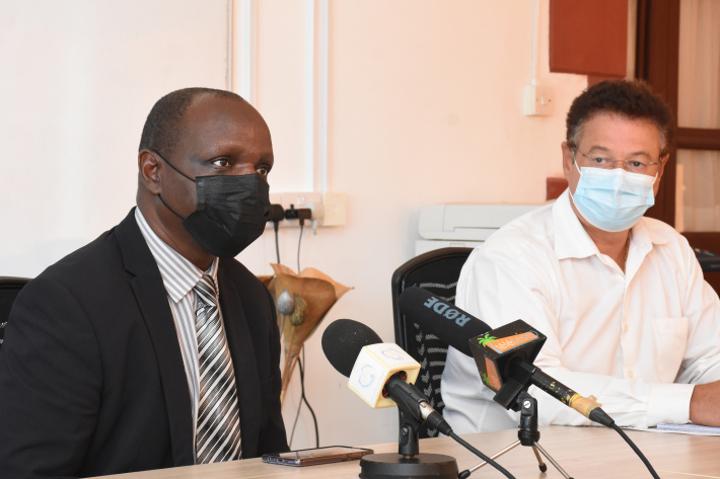
This was announced at a press conference yesterday morning with the Public Health Commissioner, Dr Jude Gedeon, and the WHO (World Health Organisation) representative in Seychelles, Dr Rex Mpazanje.
The press conference was organised in the wake of the recent declaration by the WHO that the monkeypox is a global health emergeny.
During this meeting, it was also pointed out that the majority of cases detected so far have been males engaging in sexual practices with other males.
Now with currently over 20,000 cases of monkeypox since January of this year, the virus has been detected in 77 countries worldwide. 99% of these cases are male, with 95% having had sex with other males. As of now, the virus has caused two recorded deaths in Ghana and three in Nigeria.
This declaration is in line with the instrument WHO currently uses, which is the H.R. 2005, which empowers WHO to make such declarations.
Dr Mpazanje explained that this declaration followed a meeting over an advisory panel that had convened as part of the protocol. The panel agreed that the outbreak is progressively increasing, although not at an exponential rate as other outbreaks such as Covid-19.
Dr Mpazanje went on to acknowledge that the virus has so far been concentrated largely in a particular group of people.
“I think 90% of cases or so, are among people who have had sex with men and therefore there was clear concern at an international level.”
He added that the decision to go forward with the declaration was also swayed by the fact that the outbreak was increasing in countries that are not endemic for monkeypox.
The declaration also outlined key measures that some countries, categorised in four groups, need to adopt. Dr Mpazanje made note of the different groups being “countries that are currently having cases, countries that have not reported cases or have not had any cases in the last 21 days, countries that manufacture some of the instruments like vaccines and diagnostics, and countries that have zoonotic transmission from animals to humans”.
On his part, Dr Gedeon said that the symptoms being presented in males that have had sex with other males are atypical from the usual.
“What is unusual is the way the symptoms are being presented in this new group. Before, the rash would start in the face and then spread, but now it seems the rash forms on their private parts or around their anus, and then other symptoms appear.”
He reminded that the incubation period of the virus can range from one to three weeks, and the symptoms can last for two or three weeks.
During the time that the infected persons exhibit these symptoms, they remain infectious up until their lesions have completely dried and the scabs have fallen off.
An infected person needs to be treated in isolation. At the moment, there isn’t a specific treatment for monkeypox, but rather supportive treatment that tends to the exhibited symptoms.
Meanwhile Dr Gedeon has confirmed that the necessary reagent to test for the virus has been brought into the country. Before, five samples had been sent abroad to be tested due to the lack of testing reagent and returned with negatives results.
“Now we can do this test locally. So now if we detect a case that we suspect, we can confirm within 24 or 48 hours if it’s the virus,” he stated.
“In terms of preparation here in Seychelles, our response system was triggered a few months ago and we already have a committee meeting regularly.”
Dr Gedeon further added that preparations have been made on the surveillance that they do and alerts have been sent to both public and private medical centres weeks ago to advise them on what they should look out for.
For More News And Analysis About Seychelles Follow Africa-Press