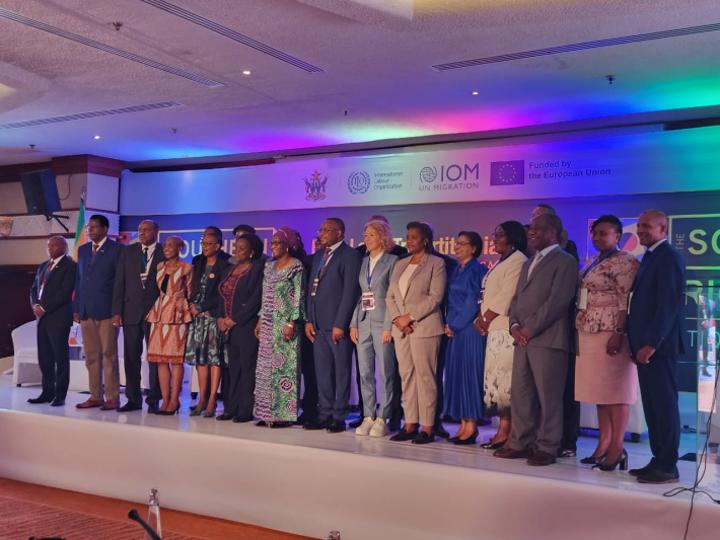
Africa-Press – Seychelles. The Minister for Employment and Social Affairs, Patricia Francourt, last week attended a high-level tripartite dialogue on the topic of ‘Labour Migration Governance in the SADC Region’.
The forum took place from November 29-30 in Victoria Falls, Zimbabwe.
The meeting, that saw the participation of all actors in the world of work, i.e. ministries of labour, workers and employers’ organisations, was organised by the International Labour Organisation (ILO) and the International Organisation for Migration (IOM) (through the SAMM project) with the financial support of the European Union and collaboration of the Ministry of Public Service, Labour & Social Welfare of Zimbabwe.
The main objectives were to, among others:
a) Assess progress made on labour migration governance, examine gaps and challenges as well as opportunities to consider for the Region;
b) Identify priority areas of collaboration, share existing and proposed good practices as well as contributions to labour migration governance.
The minister was accompanied to the meeting by Veronique Bresson, the executive director and Susan Morel, the chief polity analyst. The meeting also saw the participation of social partners represented by Antoine Robinson and Felix Charles from the Seychelles Federation of Workers Union (SFWU) on the part of workers and Donald Monnaie and Kevin Barbe from the General Employers Trade Unions Seychelles (GETUS) on the part of employers.
As a country that holds high regard to the contribution of migrant workers to the Seychelles economy, the delegation had much to share with other countries of the region on good practices vis a vis labour migration governance, while at the same time acknowledging that we also have our fair share of challenges to surmount, same as it is throughout the region and globally. The discussions centred on three thematic subjects:
i) Addressing labour and skills shortages at all skills levels;
ii) Fostering the protection of the human and labour rights of migrant workers;
iii) Admission and post-admission gender-responsive and evidence-based Labour Migration Policies.
The delegation proudly shared its good labour migration governance processes, that the meeting was informed, came about through the establishment of a specific unit under the ministry responsible for labour, introduced in 2013, to manage the recruitment of migrant workers and ensuring their welfare while working in the country. Through this set-up, the ministry was able to establish, among other things, a systematic process for recruitment of migrant workers and allow for the transfer of skills wherever possible. Another positive move that the country undertook that was shared was the launching of our National Labour Migration Policy in 2019 to guide all partners on the governance of labour migration in the country.
The delegation also shared its fair and ethical recruitment tools and practices in regards to employment of non-Seychellois workers.
The registration and certification of Employment agencies which are regulated by the Employment Act 1995 is a mechanism that helps to facilitate good recruitment practices.
The Act also states that employment contracts of migrant workers must be attested by Employment Department (competent officer).
The recruitment guideline and quota system for non-Seychellois and administrative procedures are also in place to provide guidance on recruitment process.
The meeting appreciated that although Seychelles has the appropriate legal framework, it also plans to modernise legislation in regards to employment agencies for better protection of migrant workers and improved governance.
A good practice shared was the signature of Bilateral Labour Agreements with Bangladesh in 2019 which designates employment agencies to be used for recruitment of workers.
As an outcome, the meeting sought the commitment of all partners on the possibility of achieving a Statement of Intent on Labour Migration Governance in the SADC Region whereby, among other aspects, all actors[1] give their commitment to improve labour migration governance in the SADC Region and establishing monitoring systems to measure progress. Work on the document ensues. The meeting organisers will share with Member States once it is complete.
The accompanying photos show the Seychelles delegation and other highlights of the meeting.
Press release from the Ministry of Employment & Social Affairs
EDITOR’S NOTE: The Southern African Migration Management (SAMM) Project is a United Nations Multi-Agency programme composed of the International LabourOrganisation (ILO), the International Organisation for Migration (IOM), the United Nations High Commissioner for Refugees (UNHCR) and the United Nations Office on Drugs and Crime (UNODC). The SAMM Project is designed to improve migration management in the Southern African and Indian Ocean region guided by, and contributing to the realization of, the 2030 Sustainable Development Agenda goal 8 on decent work and economic growth and goal 10 on reducing inequalities. The European Union is supporting and funding the implementation of the project.
SAMM’S target countries are all 16 SADC Member States: Angola, Botswana, Comoros, the Democratic Republic of the Congo (DRC), Eswatini, Lesotho, Madagascar, Malawi, Mauritius, Mozambique, Namibia, Seychelles, South Africa, Tanzania, Zambia and Zimbabwe.
[1] Composes of: Southern African Trade Union Coordination Council (SATUCC), SADC Private Sector Forum and SADC countries’ government
For More News And Analysis About Seychelles Follow Africa-Press