Africa-Press – Seychelles. Much like humans inhabiting islands and coastal areas are vulnerable to the impacts of climate change such as rising sea levels and the increasing frequency and severity of adverse weather conditions, so too are sea turtles. The survival of sea turtle species is linked to the availability of and accessibility to their nesting grounds, which is limited to certain beaches on islands and coastal areas that are free from other [human-induced] threats and disturbances, such as noise, pollution and obstacles. However, when these few suitable nesting grounds are impacted by extreme high tides, the result is the damage and loss of turtle nests.
This was the case on Mahé’s southernmost beaches in late January to early February – which remain the island’s most important turtle nesting sites – when unusually high tides caused severe sand erosion, exposing the turtle nests that had been laid there.
As it is estimated that only one out of a thousand (or more) sea turtle hatchlings survive to maturity, the loss of turtle egg clutches poses a serious risk to the perpetuity of the species.
Fortunately, the Marine Conservation Society Seychelles (MCSS) Turtle Team monitors these important sea turtle nesting beaches, which are in the process of being nominated as seasonally protected areas under the Ridge to Reef Project* and relocates nests that are at risk of destruction and loss.
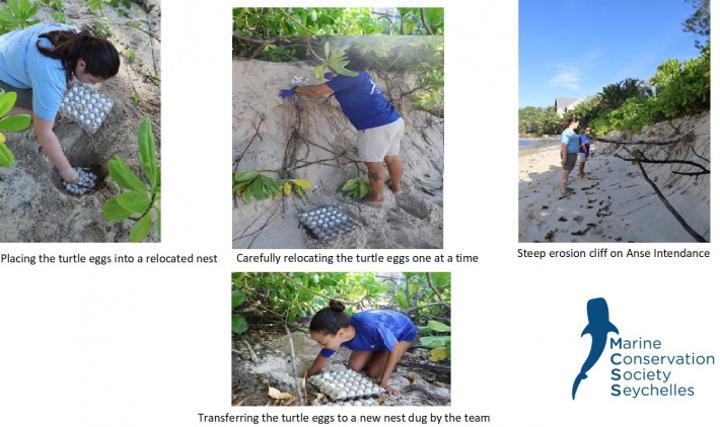
Four such nests on Anse Intendance were exposed in the steep erosion cliffs that towered over our team in early February, leaving the eggs that had once been buried deep down in the sand jutting out the side of the cliffs.
Our team got straight to work carefully digging out each individual egg and placing it in egg trays to be transferred to a more suitable location.
Turtle nest relocations are very delicate work, with each egg having to be kept in the same orientation as it was found, so as not to prevent the development of the embryo.
It is with great delight that we report that all four relocated turtle nests on Anse Intendance hatched successfully a month or so later, with a total count of 211 hatched shells.
Our Turtle Team also had the pleasure of seeing 44 live hatchlings emerge from one of the four nests.
MCSS collects data on egg clutch survival by counting the number of eggs that hatched successfully and those that did not following the emergence of hatchlings from a nest.
As part of MCSS’ ‘Adopt a Beach’ collaboration with Kreolor on Anse Intendance, staff members from the jewellery brand joined and assisted the MCSS team in collecting this data.
Though it is not possible to know the success rate of the relocated nests, as some of the eggs were likely lost in the eroded sand, it is good to know that conservation interventions such as nest relocations may contribute to the survival of sea turtle species.
For information on how you can sponsor a sea turtle or make a donation to MCSS’ ongoing research and conservation activities, visit our website www.mcss.sc or email [email protected].
*The Marine Conservation Society Seychelles’Seasonal Protected Areas Project is funded under the GOS-GEF-UNDP project entitled “A Ridge to Reef Approach for the Integrated Management of Marine, Coastal and Terrestrial Ecosystems in the Seychelles” (Ridge to Reef Project). The projects’ objective is to manage and conserve the flow of marine, coastal and terrestrial ecosystem services in targeted islands of the Seychelles for multiple benefits through the Ridge-to-Reef approach.
For More News And Analysis About Seychelles Follow Africa-Press