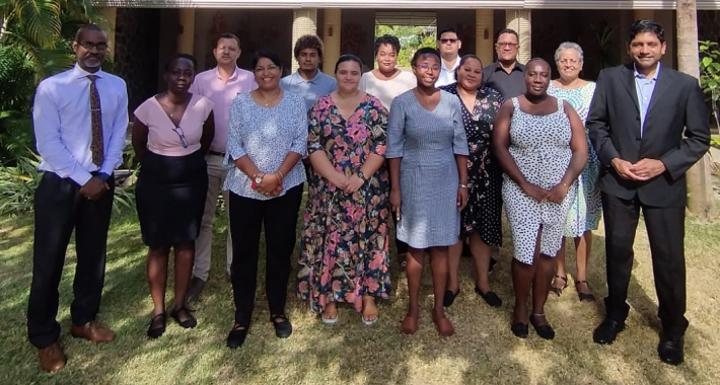
Africa-Press – Seychelles. A training on conflict-sensitive reporting organized by the Indian Ocean Commission (IOC) is currently taking place at the Escale Resort Marina & Spa, Mahé. These long-awaited courses by the Seychellois media, followed by about fifteen journalists, will end on Friday, June 16.
This training is part of the governance, peace and stability (GPS) project of the IOC financed by the French Development Agency (AFD). It is Jean-Luc Mootoosamy, journalist from CFI, the French Media Development Agency representing the IOC, and Rassin Vannier, president of the Association of Journalists in the Seychelles, who lead this training.
During this first day yesterday, journalists from the various newsrooms in the country participated in several sessions to better know their audiences and who they are addressing; the definition of a crisis; how tensions are covered in the Seychellois media landscape; what kind of journalism during a tense, conflicting period and journalistic ethics and deontology.
The participants, happy to be able to discuss certain subjects of their daily life, took part in the very lively discussions during this training. They used French, English and Creole as a means of communication.
The Permanent Liaison Officer (LPO) of the Seychelles for the IOC, Ralph Agrippina, thanked the AFD which, through its generous funding of the GPS program of the IOC, made possible the holding of this training workshop. He thanked the IOC for maintaining this important training in Seychelles.
“Journalism being a noble profession, its practice then becomes a privilege that must be exercised in a spirit of responsibility. Journalistic responsibility means unwavering adherence to the requirements of the profession such as verifying sources and cross-checking information, always complying with professional ethics, ensuring the integrity of information and journalistic integrity and also not not put his life in danger”, said Mr Agrippina during his opening speech.
He also spoke of the social responsibility of the journalist, which is to ensure that his press articles, radio programs or television reports are free from elements of misinformation, that they do not participate in disinformation and do not stir up racial or ethnic hatreds. The social responsibility of the journalist is to support society in its evolution by promoting living together, underlined the OPL of Seychelles.
The COI trainer, Mr. Mootoosamy remarked after this first day, “that there is a very great curiosity among Seychellois colleagues and a very healthy curiosity, because they are journalists who want to learn. Our brothers and sisters are eager to learn and have shown humility according to their respective experiences. The subject of crisis-sensitive coverage is not discussed much in Seychelles and my role is to guide colleagues on methods that have worked in other countries where I have worked. I am happy to share and pass on this way of covering sensitive events”.
The enthusiasm of the participants was palpable and the IOC trainer stressed that forming a pair with the Seychellois journalist Rassin Vannier is important. “I am a child of the Indian Ocean but I believe that this is not enough to carry out this training alone. For my first training in the Seychelles, it was a necessity to have someone from the country next to me. The IOC will continue in this type of training with other themes such as elections, coverage of democratic institutions, among others. The journalistic diversity that I saw in the audience of this first day is promising for future trainings that the IOC will organize within the framework of this GPS project”.
After the first day, the president of the Association of Media Professionals Seychelles (AMPS), Rassin Vannier shared his satisfaction, because according to him “we were able to address the interesting subjects which directly concern journalists. It was also a refresher course for us and to bring us up to date on the reasons for being of journalists. Alone on a small island, we often tend to forget that we have a very important role. This training is also essential for young journalists. They also need this base”.
This time the COI used an interesting format, Mr. Vannier added. “Jean-Luc Mootoosamy is Mauritian and Swiss and he already knows our region and in collaboration with Seychellois journalists, he understands our reality better. We must now adapt this south-south collaboration. Often we have north-south collaboration and that doesn’t really understand our reality,” Mr. Vannier said.
On the program for the next two days of training: the safety of journalists and cohabitation with content generated by artificial intelligence.
For More News And Analysis About Seychelles Follow Africa-Press