Africa-Press – Seychelles. 22 thousand Creole words defined by Seyselwa
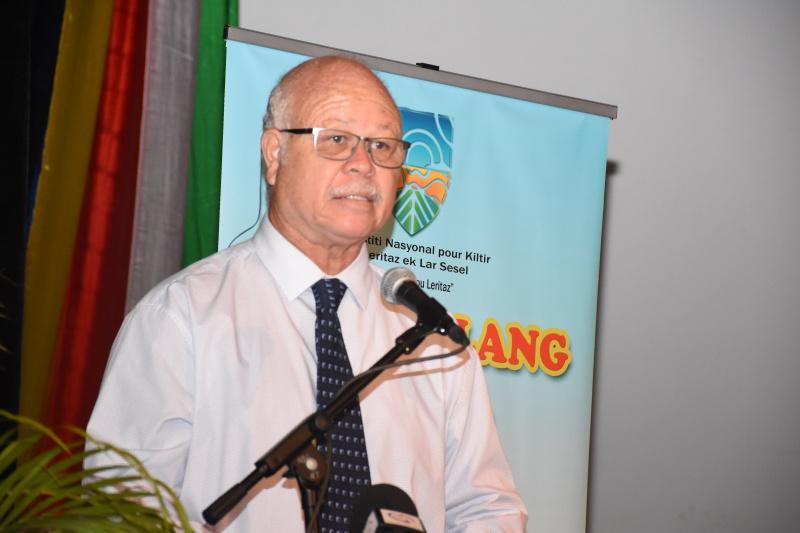
A first Seychellois Creole monolingual dictionary that includes 22 thousand words was officially launched yesterday morning by the secretary general of the National Institute for Culture, Heritage and Country of Seychelles, David Andre.
This was in a ceremony at the Mont Fleuri National Theater.
This dictionary materialized after several years.
It was Marie-Therese Hossen who came up with this idea 40 years ago when she took the position as the first director of the Creole Institute. And this story came back in March 14 last year, when Penda Choppy joined the post of director of the Creole Institute at the time, since the institution’s mandate was to create tools for language development and standardization.
When he launched the dictionary, Mr. Andre described the event as historic and very symbolic for Seychelles, and one that he is proud of.
“This event marks the beginning of the work of a team with multiple skills and knowledge, which has been going on for 14 years.”
Mr. Andre says that this dictionary is not just a linguistic tool to improve vocabulary, research or verify spelling and word sense.
“More than that, it helps strengthen the transmission and preservation of cultural knowledge and knowledge, broadening general and linguistic culture to the same level as English and French in our trilingual context.”
There are 15 members who are part of the Creole Language Committee who are working on this dictionary; five from the Creole Institute and 10 outside members who have a particular concern with language. Among them were Regina Melanie, Marcel Rosalie and Michel Savy who are not among us.
According to prose, they were divided into smaller groups where they were given a group of twenty words to define. This is then put in the donation bank. Words whose definition is not clear are sent to the committee for further discussion. Once the word is defined, there is a review committee, and it is after another similar process that the word is validated.
One of these members is Erica Fanchette, who was the secretary of the committee, then the senior sergeant at the Creole Institute, who testified to withdraw this intense, detailed and long work that required a lot of research work that took them everywhere. across the country, to be able to pick up all possible words in the Seychellois Creole language.
Ms. Fanchette says that the country is based there, since the language is dynamic and continuously evolving, the Seychelles Academy will not be late to work on its next edition.
“Every day new words are added, so next year we will begin to re-arrange our data bank to add new words that different ministries have added, meaning we will review the dictionary again in three years. Even if we use as many Creole words, sometimes one or two will help us,” according to Mrs. Fanchette.
This dictionary is also based on Creole lexicon. The financing of this dictionary was made by Unesco, which gave two sums; firstly 16 thousand US dollars (R311,435) during the biennial 2010-2011 Creole Institute for its research and production work. A second sum of 15 thousand US dollars, (R313,378.73) during the 2020-2021 biennial for the publication of this dictionary.
The secretary general of the Unesco National Commission for Seychelles, Vicky Michel, who addressed the guests, said that the organization approved this project because it is in line with their program on culture.
“This organization has a mandate to support countries in their efforts to promote the mother tongue,” he said.
Mrs. Michel added that Seychelles now has a reference document that “our teachers, students, tour operators and even tourists can use to learn and speak the Seychellois Creole language”.
One of the former members of this committee, Tessa Henderson, who has a great interest in linguistics and is also an expert in the media, described this experience as a very exciting and exciting one where not only did a lot of research, and learned a lot, but also made many acquaintances. people who are passionate about the Creole language.
Mrs. Henderson always said that it was her childhood dream to one day see such a work, and even if it took a lot of time to research, read, consult with other documents, and have conversations with old and young, it is a work worth the effort. It is also interesting to be able to discover many new words.
“An example is the word ‘disability’ that is used in the sport of golf, so how to incorporate it next to what we understand as having a disability. So there was an opportunity to bring in new words that were being used and are still being used.”
As a symbolic gesture during the ceremony, Flora Bendavid, executive director of the Seychelles Academy, presented a copy of the dictionary to the three branches of government. Minister Rose-Marie Hoareau accepted on the Legislative side, Honorable Gervais Henrie on the Legislative side and Julianne Esticot for Judiciary.
The other copy was presented to Marie-Therese Hossen who initiated this prose; Minister for Education, Justin Valentin; Cecile Kalebi who is the permanent secretary of the National Institute for Culture, Heritage and Country of Seychelles; Julien Zelime for the University of Seychelles; Doctor Anne Gabriel for the Ministry of Health; Per Danny Elizabeth from SIFCO, and Gerard Govinden, chief executive of NISA who published this dictionary.
The price of this dictionary is not yet defined, but according to Lakademi Kreol it will not be more than R800.
Before this monolingual Creole dictionary, Seychelles had a Creole-French dictionary written by Danielle D’Offay (de St Jorre) and Guy Lionnet which gave the equivalent of Creole words in French.
For More News And Analysis About Seychelles Follow Africa-Press