Africa-Press – Seychelles. Early Childhood Care and Education (ECCE) teachers from crèche to P2 in schools from across the country have learned about promoting Social Emotional Learning (SEL) and the use of Neuroscience to advance ECCE for the wellbeing of children, as well as their academic learning.
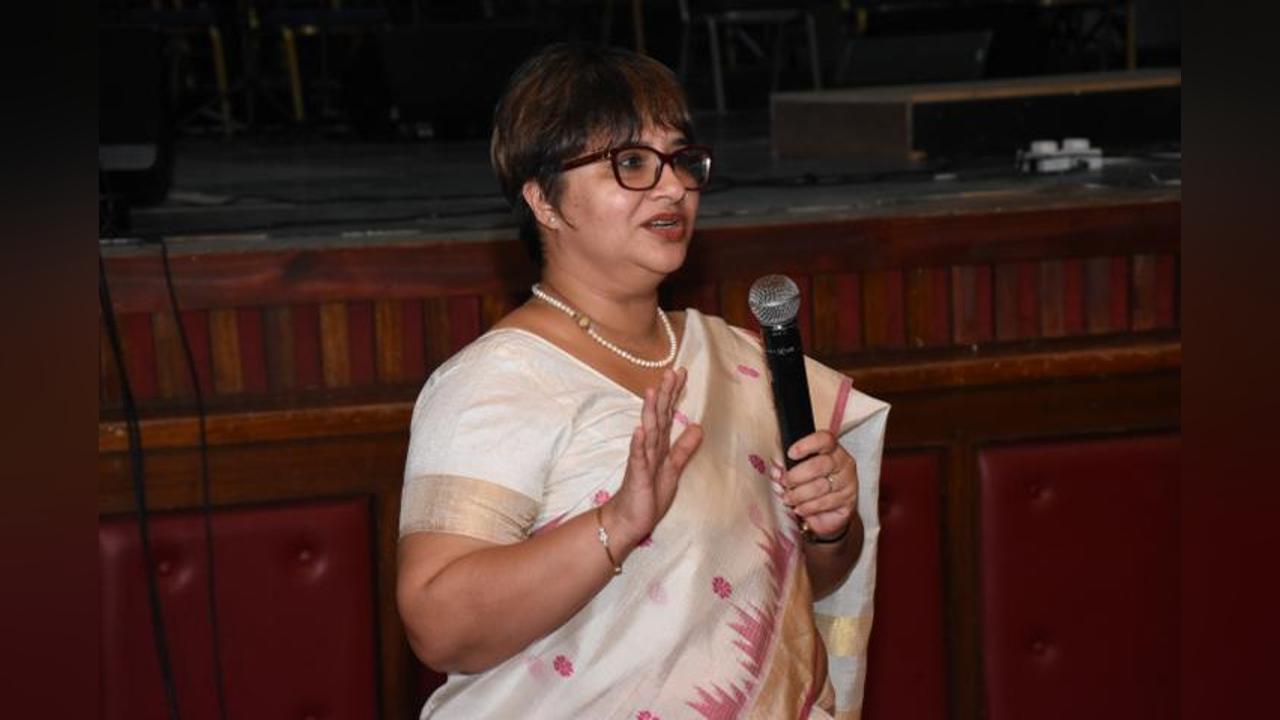
This was from a talk held by renowned neuroscience expert Dr Nandini Chatterjee from Unesco Mahatma Ghandi Institute of Education for Peace and Sustainable Development (MGIEP), based in New Delhi, India.
Dr Chatterjee shared her experience and expertise in SEL and beyond in her talk entitled ‘Building Better Brains for Learning and Development’.
The talk took place on Tuesday at the International Conference Centre Seychelles (ICCS) in the presence of the principal secretary for Education Sector Development, John Lesperance, ministry officials, members of the ECCE technical teams and other partners in ECCE as well as head teachers.
Dr Chatterjee, along with Dr Anya Chakraborty from MGIEP, is currently in the country as part of a project initiated by the Education Sector ECCE technical team, which aims to promote SEL at early childhood level in schools.
The talk forms part of a series of activities being organised since the start of the week to help bring about meaningful change in the early learning environment within schools by empowering teachers with knowledge, skills, and motivation to build healthy and supportive relationships with their pupils and contribute to the holistic development and advancement of pupils’ learning.
Speaking to the press, Catrina Monthy, education psychologist in the Ministry of Education, said that throughout the past decade while working on a number of projects under the National Action Plans for ECCE, they have always been concerned with the holistic development of children and in contributing in tangible and useful ways to young children’s wellbeing and development, and to the development of the ECCE system as a whole.
She noted that in schools, their key focus was often on academic achievement and technical skills. However, they do come back time and time again to the importance of SEL: the intrapersonal and interpersonal skills of the learners and educators, emotional literacy, self-management, perseverance, motivation, and so many other aspects, which they do not necessarily teach or assess directly, but are nevertheless vital to the learning and development of their pupils while they are at school and beyond.
“We recognise the importance of SEL for the wellbeing of our students, as well as their academic learning. Moreover, our experiences in schools underline the challenges our learners and staff face when SEL is not well developed,” she said.
Mrs Monthy explained that the project they are working on is aimed at developing an ECCE-SEL Framework – based on research evidence and our local experience, providing training for teachers and assistant teachers to enhance their capacity to support children’s SEL, to implement the framework in 3 pilot schools, namely Au Cap, Bel Eau and Plaisance primary, to engage parents and also collect data for potential improvement and enhancement of the ECCE-SEL programme.
She noted that SEL is happening in the schools but it is not systematic in covering all the important aspects and it is the reason why they are seeking the help from MGIEP represented by Dr Chatterjee along with Dr Chakraborty for the formulation of a concrete framework to help teachers address SEL in their classrooms that will get the young students to bond relationship with them and to feel safe and comfortable.
“Social Emotional Learning is as important as being intellectual and physical. We do know that if they feel stressed and do not feel safe and accepted, it is very difficult for them to master new information given as compared to having a good competence on SEL where it has been found they feel a lot safer and happy, they perform better academically and they have good relations, not only in schools but also outside for their own development and wellbeing,” said Mrs Monthy.
She noted that there are plans to expand the SEL programme to other schools including into high classes.
Dr Chatterjee, whose presentation was on the effect of the brain in relation to SEL, said one of the most important things learned over the last 20 years is that when the brain learns, if the regions involved in emotions processing are not explicitly engaged learning will not happen.
“In order to make learning a rewarding experience it is critical that we engage emotion areas. When emotion areas are involved the learning is deep and it can be useful for children. Given that emotion plays a role in learning, we want find ways to bring emotions into the conversation into the classroom,” Dr Chatterjee said.
She noted that when teachers build relationships with their students, the latter will nurture those relations and will also learn that good relationships are important for their wellbeing.
She added that people with maximum happiness have healthy relationships.
“So there are two things that we are trying to do and one is to bring in Social Emotional Learning as a part of curriculum learning and the second is for children to be aware that cultivating human relationships, which are healthy, is a very satisfying process that is life long and it doesn’t end with school,” the doctor added.
Dr Chatterjee stated that if teachers want to make sure their students are learning, they have to start building relationships with them. To do that the teachers must first look at the emotional wellbeing of the pupils. If they are unhappy, stressed and overworked they will not be able to participate in building healthy relationships whether at school or at home.
She also emphasised on the participation of parents in building bonded emotional relationships with children and with teachers at school.
For More News And Analysis About Seychelles Follow Africa-Press