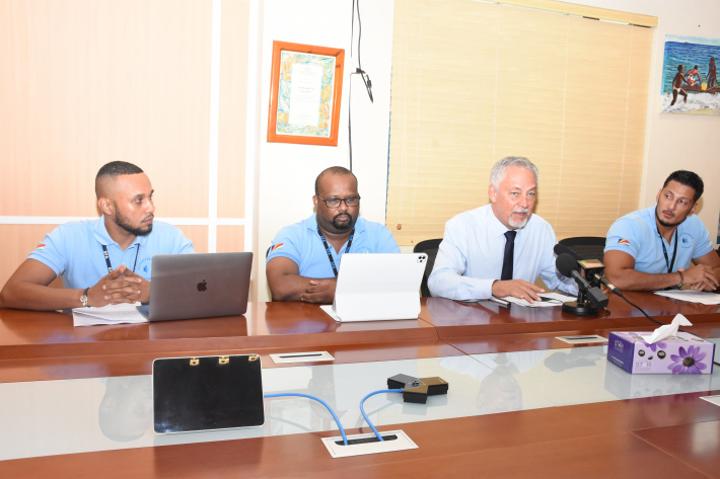
Africa-Press – Seychelles. The Ministry of Fisheries & the Blue Economy has presented its fisheries co-management plan of the Mahé plateau line and trap fishery.
This was in a press conference held yesterday at the ministry’s main office, Maison Collet, Victoria.
Present for the press conference were the Minister for Fisheries and the Blue Economy, Jean-François Ferrari; Johnny Louys, head of department: monitoring control and surveillance; Yannick Roucou, legal adviser and Ameer Ibrahim, head of fisheries management and technical fisheries coordination.
The aim of the fisheries co-management plan is to effectively manage the fishing resource to sustain the industry, the economical value, ecological and social benefits.
The co-management plan is a joint collaboration between the ministry and stakeholders in the industry consisting of three main components – research, enforcement and legal.
The plan, which has been in development since 2007, was enforced in January this year and has currently reached the implementation stage.
Central to the plan are management strategies and regulations that were developed to address fishery issues identified and prioritised by stakeholders and evolved based on stakeholder feedback during the consultation process.
Minister Ferrari stated that just like the tuna stock, over the years the demersal fish are also being affected in terms of quantity, size and changes in location. So far demersal fishing has been open in Seychelles without proper regulations. He added that currently there are more fishing vessels and fewer fish being caught. According to the Seychelles’ Report to the Fisheries Transparency Initiative (FiTI) | 2020 the level of fishing pressure subject to overfishing is 43.5% a rate that is higher than the maximum sustainable yield (MSY).
“Scientific studies show that some stocks are under pressure,” Minister Ferrari said.
He further emphasised that the situation is quite alarming however they have taken measures to create awareness and ensure that there is significant reduction of impact on the sector. The ministry made the decision to soften the implementation during the first six months while focusing its efforts on education. This is to aid in reducing the overfishing of juvenile fish and promote best practices in the industry.
“We are entering another phase in the implementation of the Mahé plateau trap and line fishery. This is a fishery that is practiced by local artisanal fishermen but also by recreational fishermen and sports fishermen,” Minister Ferrari said.
He noted that the plan came in force after various discussions and negotiations with fishers and stakeholders.
Part of the co-management plan is the regulations which pertain to recreational and sports fishers. Brought about by their recommendations these actors will be able to pursue their passion although they will not be able to sell their catch. Selling will require a licence whereas for sports fishers it will be on a tag and release basis. This is to continue to protect and sustain the environment.
The minister also gave an example to such fishers in areas such as Eden Island that practices recreational and sports fishing regularly. He stressed that they will be monitoring and have various other measures being implemented.
Yannick Roucou, the legal officer, stated that there are obligations on both fishers and consumers to ensure that they are not buying or catching fish that are in contradictory to the regulations stipulated. Commercial fishers will also gradually need to utilise small vessel tracking unit similar to VMS.
As part of the regulations fishers will have a bag limit of 20 fish per person per trip, a figure that may be revised in the future. Other than the 20 fish per person, there is also a limit on the number of bourgeois (Red Snapper) and Job gris. In addition to the limit the minimum measures of the two fish should be above 32cm, a figure that is still quite low as the fish matures at 52cm. However the ministry has taken the concerns of the fishers into consideration and settled at 32cm.
This mean that in terms of regulations there is a minimum length and bag limit. Spot checks will be conducted in areas such as fishing outlets, sea patrol, landing sites, limit on fish trap per person (20 traps) and fish trap needs to be tagged an registered. The ministry will also conduct coastal inspections, seize fish traps, review spawning aggregation sites and can prohibit sales as well.
The ministry encourages all commercial fishers to be licenced and provide receipts to customers for proof as people will have the responsibility for burden of proof.
Other than the public, the ministry will be closely monitoring the restaurants and hotels when it comes to ‘plate sized’ fish. The officers noted that of the reasons the juvenile fish are being bought also is due to the ‘plate sized’ aspect which is appealing to the hotel industry. They advised against this practice as it is leading to the depletion of resources.
The Ministry of Fisheries and the Blue Economy is rolling out educational and awareness programmes to further educate the public on the issues of overfishing, fishing juvenile fish and how to sustain the sector.
The public can view the ministry’s website to access the list of commercial fishers as well as to have an overview of the regulations.
The ministry recognises that it is a difficult situation to maneuver and exercise however the measures are fluid and will later be revised by the ministry and the relevant stakeholders.
For More News And Analysis About Seychelles Follow Africa-Press