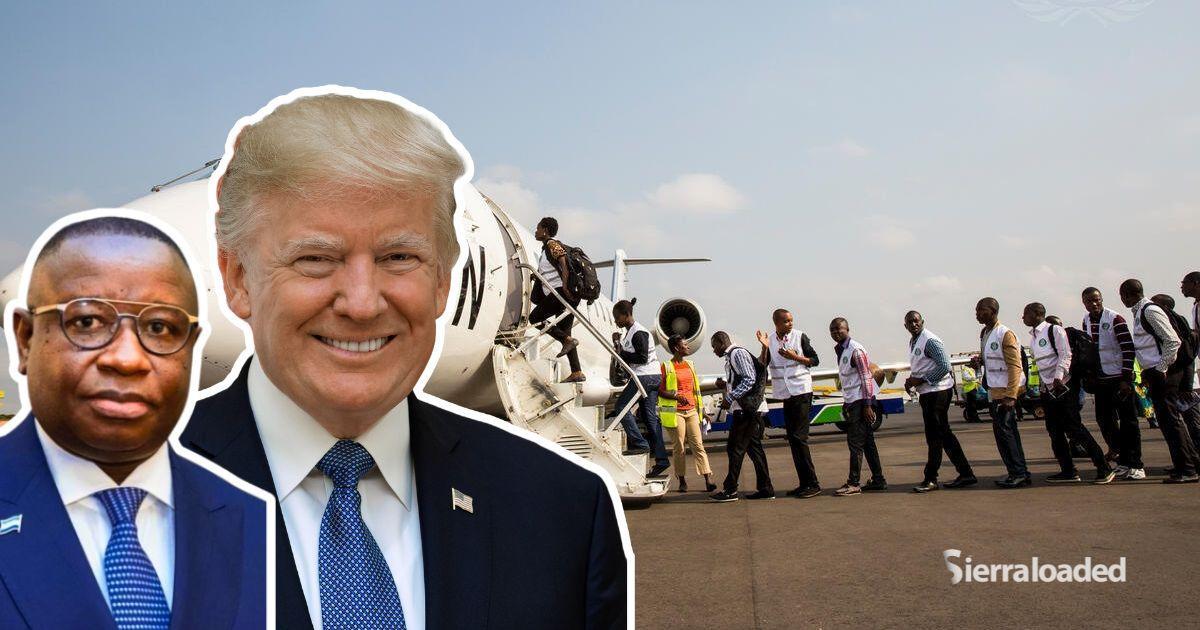
Africa-Press – Sierra-Leone. At first glance, the $1.5 million grant from the United States government to facilitate the repatriation of “Third-Party Nationals” (TPNs) to Sierra Leone presents itself as a humanitarian gesture.
However, a deeper critique reveals significant complexities regarding national sovereignty, economic priorities, the opacity of the agreement, and the long-term implications for Sierra Leone’s already fragile social infrastructure.
The most pressing concern is the nature of the “international partnership” and how Sierra Leone became the designated destination for these individuals. The term “Third-Party Nationals” typically refers to individuals who are not citizens of the country from which they are being removed (presumably the US) and who cannot be returned to their country of origin. But why Sierra Leone?
The scheme raises the specter of other nations outsourcing their migration management burdens to a poorer, aid-dependent country. While the US provides a finite grant of $1.5 million, Sierra Leone is assuming long-term sovereign responsibility for these individuals.
Once these individuals are repatriated, they become Sierra Leone’s problem, straining local resources, infrastructure, and potentially local security dynamics, long after the US grant money has been spent.
This arrangement risks positioning Sierra Leone as a receptacle for individuals deemed undesirable, raising ethical questions about whether this constitutes humanitarian aid.
The allocation of $1.5 million requires intense scrutiny. Depending on the number of individuals involved, this sum may be grossly insufficient to cover “reception, temporary hosting, and humanitarian services” to international standards.
When compared to what Britain paid to Rwanda, for the repatriation of asylum seekers, under the Migration and Economic Development Partnership (£240 million, equivalent of $321,488,400USD), our payment of $1.5 million, becomes laughably inadequate.
This suggests that our government cannot value the worth of a simple contract nor negotiate for value, an international transaction of this nature.
Reportedly, Minister of Information, Chernor Bah’s statement describes this as a “structured humanitarian intervention,” but the announcement appears to have been made without broad public consultation.
The Cabinet approved the agreement, but there is no indication that Parliament (which holds the purse strings) or civil society organizations were adequately consulted regarding the terms of liability. The public has a right to know the demographic and security profile of those being forcibly settled in their communities.
In the final analysis, while the stated goal of treating individuals with dignity is commendable, this critique highlights that the scheme appears to be a lopsided transaction. The United States gains the benefit of clearing its backlog of third-party nationals at a relatively low fixed cost, while Sierra Leone, assumes the indefinite sovereign, security, and economic liabilities.
For this scheme to be equitable, the government of Sierra Leone must disclose the full terms of the agreement, ensure that funding is adequate to prevent local resource diversion, and secure a binding commitment from international partners regarding long-term liability for these individuals.
For More News And Analysis About Sierra-Leone Follow Africa-Press