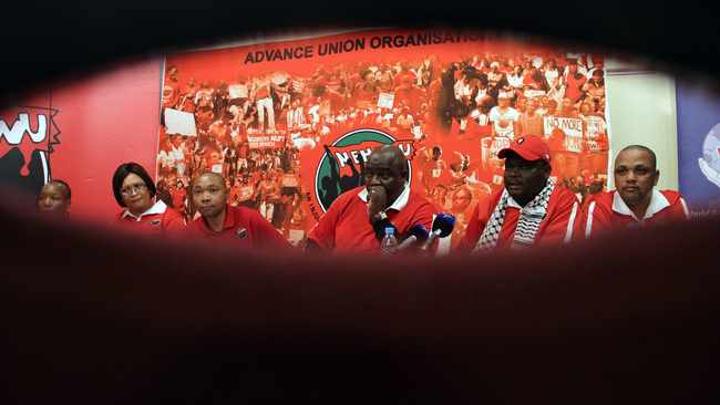
Africa-Press – South-Africa. The country’s biggest public service union, the National Education, Health and Allied Workers’ Union (Nehawu), on Tuesday warned the government that the salary increase it failed to implement last year was not a freebie.
Nehawu, which is also trade union federation Cosatu’s largest affiliate, was among the unions representing public servants making oral arguments at the Constitutional Court, where government employees are challenging the Labour Appeal Court ruling that found the final leg of the wage agreement signed in 2018 unlawful and unconstitutional.
William Mokhare SC, representing Nehawu, told the apex court that the government unlawfully refused to implement the agreement.
”It still remains a debt to the one who was supposed to perform. The increase is not a freebie, it’s a quid pro quo (something for something) payment for services rendered,” said Mokhare.
He argued that Nehawu was enforcing the payment of the debt owed to public servants and was not rendering services as these have already been rendered.
”The obligation does not go away, services have been rendered and the government must pay,” explained Mokhare.
He said paying was the only way for the government to honour the agreement.
”A defence of inability to pay or unaffordability is not a defence in law. One cannot raise it as a valid defence in law,” Mokhare said.
Ngwako Maenetje SC, representing other Cosatu affiliates, the SA Democratic Teachers’ Union, the Democratic Nursing Organisation of SA and the Police and Prisons Civil Rights Union, said the government signed the deal knowing that it was R30.2 billion outside its budget or compensation envelope in order to remove possible negative perception and limit the possibility of labour unrest.
He said the Constitutional Court has wide discretion and that even if the agreement is found invalid, the court must enforce it.
”It must be compelled either to comply or go back to the negotiating table,” said Maenetje, adding that this was the remedy the three Cosatu affiliates are proposing, which is just and equitable.
According to Maenetje, the government must lead by example and that the prejudice suffered by its employees goes to the heart of collective bargaining.
”The implications for workers generally are far-reaching,” he said of the knock-on effects of the government ignoring collective bargaining agreements.
The hearing continues.
Political Bureau