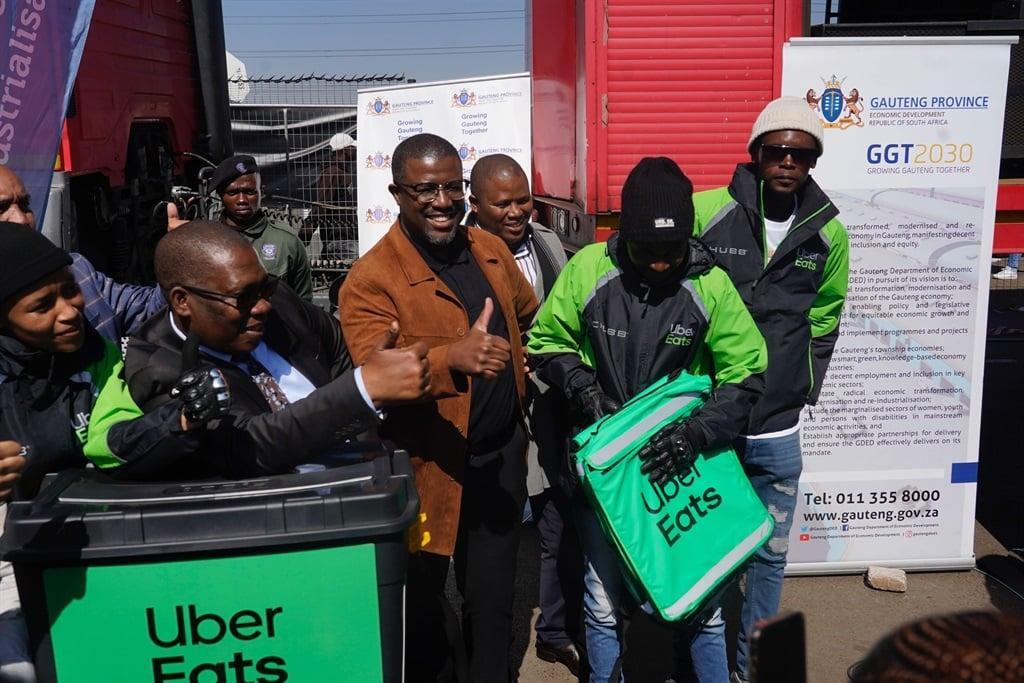
Africa-Press – South-Africa. In what Uber Eats has hailed a global first, the delivery platform is partnering with the Gauteng provincial government to significantly increase its footprint in the province’s townships, such as Soweto and Atteridgeville.
The pilot project, officially launched on Friday, will see about 2 000 courier jobs being created over three years and also see Uber Eats investing R200 million in township restaurant and “dark kitchen” development. If successful, these kitchens, essentially virtual kitchens providing meals only for delivery, will be rolled out to townships locally and worldwide.
The plan is to provide customers in these markets access to traditional cuisine, as well as standard fast-food fare and other customer favourites, said Nakampe Molewa, regional general manager for sub-Saharan Africa at Uber Eats.
“There are very successful chicken eateries in the townships, so [with] chicken being the main protein in SA, we expect to see chicken play a huge part of the offerings in these restaurants. We want to celebrate local cuisine and ensure that local entrepreneurs get a chance and a bite at this apple,” he told News24.
Molewa, who was speaking just before the official launch ceremony, said the group already has some presence in townships such as Soweto, Mamelodi, and Atteridgeville, but it had not “really penetrated” markets in any meaningful fashion. Most operations remained small, he said.
The project, which Molewa said was “literally a first in the world” for Uber Eats, was being closely watched not just in SA, but also from the group’s San Francisco headquarters in the US, given its potential as a possible model for its operations elsewhere.
Molewa explained:
Global model
In a statement that accompanied the launch, Uber Eats said that by March 2024, it aimed to “onboard 200 merchants and 150 delivery people”.
Explaining how the project would work, he said it was being rolled out in partnership with the Gauteng Department of Economic Development, which would play a central role in facilitating financing for couriers it identifies to acquire motorbikes and other transport. Specific training would also be given to these chosen couriers.
Working in a similar way to an offtake agreement, Uber Eats would incorporate these couriers into its ecosystem to service these township areas, creating about 2 000 jobs over the next three years.
However, Uber Eats believed even more jobs would be created through its investment, which is aimed at ensuring there was a ready system that could service the demand.
It explained:
The statement further explained what these investments would entail. “We are going to make major investments in the hardware we offer them such as the tablets that are used for deliveries and all the software that comes with it. We are going to make investments in training them to make sure that they are fully versed on how the ecosystem works. We are going to make investments in promotions with them to make sure they hit the target prices and that their prices are at such a level they can attract interest them.”
Uber Eats will also provide more affordable access to its Uber Eats “Ads” function on the app, which promotes the names of restaurants and gives them more visibility when customers go online to order food.
Empowerment push
Molewa is confident the project will work, saying that it is important to bear in mind that the group was not trying to create new processes or systems in its rollout, which was “something that works well in our favour”.
He said at the same time, empowerment was an “imperative” for Uber Eats in SA as it was the “right thing to do”.
Meanwhile, Uber Eats was still assessing a report released earlier this week by the Competition Commission that aims to level the playing fields on online retail platforms.
Among other things, the commission, which is SA’s top competition authority, wants online food delivery platforms such as Uber Eats and Mr D to inform customers if they charge restaurants a commission fee, and that the menu items may be priced differently than in restaurants.
The report also concluded that the ability to extract higher commission fees from independent restaurants, “up to twice that of local delivery platforms, is part of the reason that the leading platforms can engage in the sustained use of aggressive promotions and subsidised delivery”.
The inquiry said that Uber Eats “must implement the standardised, tiered commission fee structure it is currently experimenting with, whereby independent restaurants have the option of selecting from a range of commission fees”.
Molewa said the company had noted the report and that it was being circulated internally.
“Once we have taken a decision on how we move forward on it, we will communicate that.”
For More News And Analysis About South-Africa Follow Africa-Press