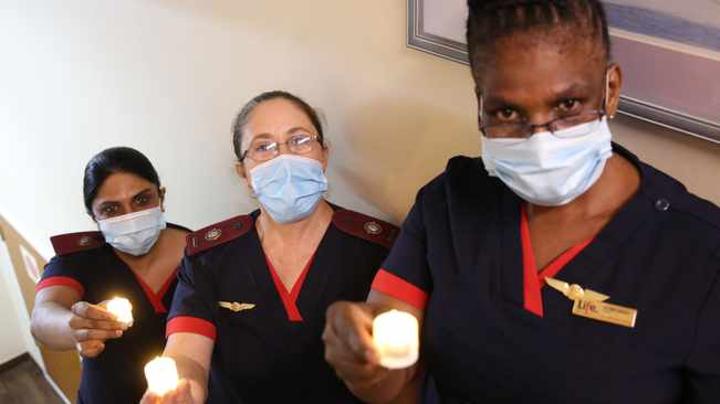
Africa-Press – South-Africa. JOHANNESBURG – Women in South Africa have played a pivotal role in the country’s response to Covid-19, with many of them among the thousands of nurses, doctors, emergency personnel and law enforcement officers at the front lines of the fight against the pandemic, President Cyril Ramaphosa said on Monday.
In his latest weekly newsletter, published on International Women’s Day, Ramaphosa however bemoaned the fact that women still faced numerous challenges, such as being under-represented in boardrooms and corridors of power, more likely to be poor and unemployed than their male counterparts and being vulnerable to gender-based violence and femicide.
International Women’s Day is marked globally every year on March 8 to celebrate the social, economic, cultural and political achievements of women. It also marks a call to action for accelerating gender parity.
“There can be no meaningful progress for women if our society continues to relegate women to ‘traditional’ professions, occupations or roles, while it is mainly men who sit on decision-making structures,” Ramaphosa said on Monday.
“Fittingly, the theme of this year’s International Women’s Day is women’s leadership and achieving an equal future in a Covid-19 world.”
He saluted the resilience and bravery of women front line workers grappling with the pandemic, singling out Petronella Benjamin from the Western Cape province who lost her life to Covid-19 just days before she was due to retire after 25 years as a nurse.
South Africa has recorded by far the highest number of cumulative Covid-19 cases in Africa to date – 1,521,068 – since reporting the first imported case a year ago. Of these, 50,678 people have lost their lives, but 1,440,874 have recovered.
Morocco is a distance second on the continent with 486,223 cases to date, according to official data.
“Our efforts to contain the pandemic have been greatly boosted by the thousands of fieldworkers like Azalet Dube from Doctors without Borders, who went into communities to raise awareness about the disease, who worked in health facilities as contract tracers, and who provided psycho-social support to families and individuals in distress,” Ramaphosa said.
“The dedication of the nation’s educators has ensured that our young people were able to receive an education despite the disruption caused by the pandemic. We owe a debt of gratitude to the many women who have worked as teachers, principals, lecturers and as administrators at institutions of higher learning.”
African News Agency (ANA)