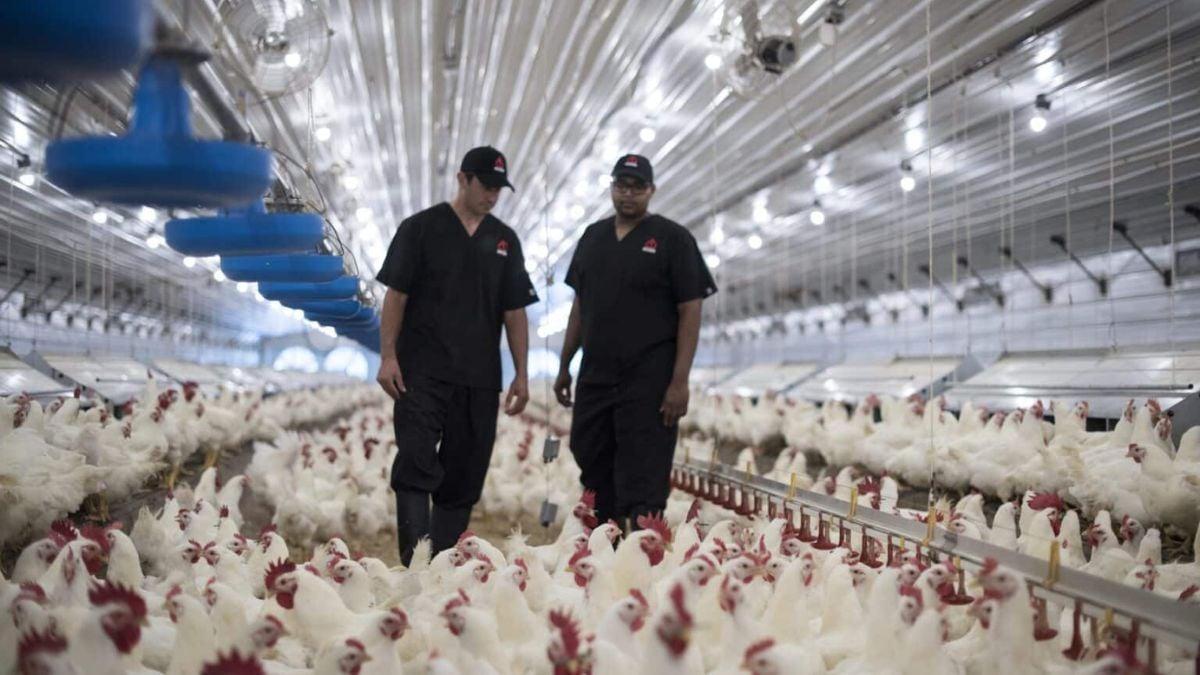
Africa-Press – South-Africa. The local poultry industry is calling on the government to ensure fair, transparent trade terms for the sector amid uncertainty surrounding South Africa’s inclusion in a duty-free trade deal with the United States.
While South Africa has seen immense benefits from its participation in the African Growth and Opportunity Act (AGOA), this has, at times, come at the expense of the country’s poultry producers.
This, in combination with domestic challenges like load-shedding and bird flu outbreaks, has placed significant pressure on the local poultry industry.
Astral Foods chairman Theuns Eloff recently raised these concerns in the company’s 2025 Integrated Report. Astral is South Africa’s largest integrated poultry producer, with about 37 million birds on farm at any given point in time.
Eloff explained that AGOA has long served as a strategic trade instrument for South Africa, granting duty-free access to the US market for a range of exports.
Introduced in 2000, South Africa has participated in this programme since its inception and has been one of its largest beneficiaries.
AGOA has facilitated significant exports of South African goods, including automobiles, agricultural products, and industrial goods like chemicals and steel.
However, Eloff said South Africa’s poultry sector has borne the brunt of concessions made under AGOA, particularly the allowance of up to 72,000 tons of US bone-in chicken imports annually at preferential rates.
“These imports, often priced below market value, have significantly disrupted local production, leading to job losses and undermining investments made under the Poultry Sector Master Plan,” he said.
“While AGOA has supported broader export sectors such as automotive and citrus, the poultry industry continues to be used as a bargaining chip in trade negotiations, raising concerns about sustainability, transformation, and food security.”
With South Africa’s continued inclusion in AGOA now uncertain, it may be time to reconsider those trade terms that undermine the local poultry industry.
Rethinking AGOA
US President Donald Trump announcing wide-reaching tariffs on several countries in 2025.
Rainbow Chicken CEO Marthinus Stander has raised similar concerns, telling Daily Investor earlier this year that, when AGOA first started, the US demanded a quota for chicken exports to South Africa.
At the time, the local industry agreed to this. While it did not benefit local poultry producers, AGOA presented advantages for other sectors to increase their exports to the US.
However, now, Stander said AGOA has effectively fallen away, as the United States imposed 30% tariffs on South African goods imported to the US earlier in 2025.
In addition, growing tensions with the United States have brought into question whether South Africa will continue to be included in AGOA at all.
According to Stander, by the original terms of the AGOA agreement, the United States’ chicken quota to South Africa should no longer exist, as it was tied to AGOA’s benefits.
“I understand the government doesn’t want to anger the Americans, but now they’re also scurrying to find an alternative package that they can offer. And the USA is interested in chicken and more chicken,” he said.
“We’re quite willing to go and sit at the table and see how we can help, but we’ve been giving since 2015. So, unless there’s a benefit to other industries or to ourselves, there’s no point in doing it.”
Eloff made a similar argument, saying that with AGOA’s renewal uncertain beyond 2025, stakeholders are calling for greater transparency and reciprocal trade terms.
He also called for more protective measures to ensure the long-term viability of South Africa’s domestic poultry industry.
As the country’s second-largest agricultural sector, worth around R65 billion, South Africa’s poultry industry plays a vital role in the economy.
It is also the agricultural sector’s largest employer, supporting almost 58,000 jobs across the value chain.
The sector also produces what is often considered South Africa’s favourite protein, with the country consuming an estimated 23 million chickens a week. Of that number, 19 million are locally farmed.
South Africans consume more chicken than any other meat – 49% of animal protein consumed per person is poultry, 26% is beef, 13% is eggs, 7% is pork, and 5% is mutton and goat.
South Africa’s poultry producers are also critical from a trade perspective, as local producers are highly competitive, low-cost players.
South Africa is among the world’s top six lowest-cost chicken producers, cheaper than any European country.
For More News And Analysis About South-Africa Follow Africa-Press