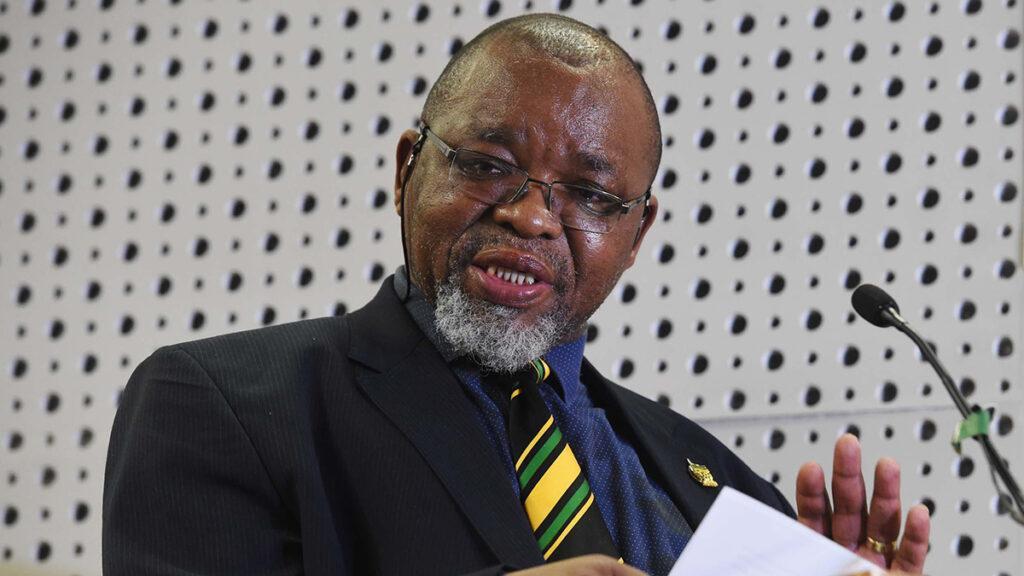
Africa-Press – South-Africa. Mineral and Petroleum Resources Minister Gwede Mantashe said anyone who opens a debate about black economic empowerment (BEE) promotes white supremacy.
The minister shared his views on BEE and transformation during a recent discussion on Newzroom Afrika.
Mantashe’s attack on BEE opponents came as many political parties and companies have highlighted the policy’s failure.
Last year, the Democratic Alliance (DA) proposed a new Bill that could replace BEE with a system that aims to bolster economic growth and employment.
The party argued that BEE has not fulfilled its mandate and has failed to uplift poor black South Africans.
“The ANC’s economic policies have left South Africans unemployed and poor. This is not the inclusive country that we envisioned building in 1994,” the DA said.
Investec CEO Fani Titi previously stated that South Africa requires a reformed empowerment framework that prioritises effectiveness, accountability, and broad-based economic growth.
Titi argued that while it remains essential for economic inclusion, its impact has been weakened by corruption, inefficiency and slow growth.
Solidarity Research Institute Connie Mulder has also said BEE policies have effectively resulted in tax money turning into Maseratis for well-connected individuals.
Mulder said the pressure BEE finds itself under is primarily a result of the immense cost the policy framework places on the economy, with little benefit.
“We did a simple report about what BEE costs the economy, and, on a very conservative level, it is about 3% of GDP per year. That is a massive cost we are paying for this policy,” Mulder said.
There is also growing public opposition to BEE among South Africans, as it has failed to lift poor black citizens out of poverty.
The Institute for Justice and Reconciliation said more than half of South Africans want BEE policies to be scrapped.
The South African Reconciliation Barometer found that 54% of citizens agree that BEE rules should be phased out.
It added that two-thirds of South Africans think that the use of racial categories does more harm than good.
The ANC doubles down on BEE
ANC spokesperson Mahlengi Bhengu-Motsiri
Despite the growing opposition to BEE, the ANC has repeatedly reaffirmed its commitment to these policies.
ANC spokesperson Mahlengi Bhengu said there will not be a situation where BEE is abolished in South Africa.
“The idea of a future South Africa without transformation laws, starting with triple-BEE, is one that must be challenged by all democracy-loving people and patriots,” she said.
Mantashe sang from the same hymnbook, arguing that BEE has opened up the space for innovative black South Africans to be owners in the mining sector.
“Coal mining is 80% owned and managed by black South Africans. More than 50% of manganese mining is owned and managed by black people,” he said.
He added that although platinum group metal mining is majority-owned by others, black South Africans manage this sector.
“Everybody who opens a debate about BEE today is promoting white supremacy,” Mantashe said in the interview.
He added that white dominated parties, like the Freedom Front Plus and the Democratic Alliance, hate black economic empowerment.
“They hate BEE because it is changing what they were built on. They are dependent on white capacity,” he said.
He said that black economic empowerment enabled black people to become owners, executives, and managers at South African companies.
“Those who promote white supremacy and regard blacks as inherently inferior hate black economic empowerment,” he said.
BEE is not pro-black and anti-white – IRR
Free Market Foundation CEO David Ansara
Institute of Race Relations (IRR) Fellow Gabriel Crouse argues that BEE will survive for as long as the idea persists that the policy is pro-black and anti-white.
“If you look at how BEE actually works, you will stop thinking that it’s anti-white and pro-black. BEE will survive for as long as that message does not get out,” he said.
“When BEE is advertised as pro-black and anti-white, it will retain enough political relevance and political popularity to survive,” he said.
It will survive despite having been so terribly damaging to people from all groups, directly and indirectly.
Crouse said black economic empowerment cuts against everyone, not just because of second-order effects but directly.
“It has already been used against people from every single group, so you will confront a clear and present danger to our rainbow republic,” he said.
He said even people who realise the devastating effect of BEE continue to support it because they think they belong to one race group that is a special victim.
He referenced the new employment equity targets, which require businesses to classify their staff based on their race.
“Refusing racial classification at work is a matter of being a South African who sees the system is stupid, counterproductive, and undignified,” he said.
Free Market Foundation CEO David Ansara said that BEE is one of South Africa’s most highly contested policies, affecting all areas of the economy and society.
He said BEE costs the South African economy approximately R290 billion per year. This translates to a total of R5 trillion in lost economic activity since the policy’s inception.
Ansara added that black poverty has worsened during the period when black economic empowerment has been at its strongest.
He highlighted that black economic empowerment only enriches a small group of politically connected elites. “This is a feature, not a bug of the policy,” he said.
For More News And Analysis About South-Africa Follow Africa-Press