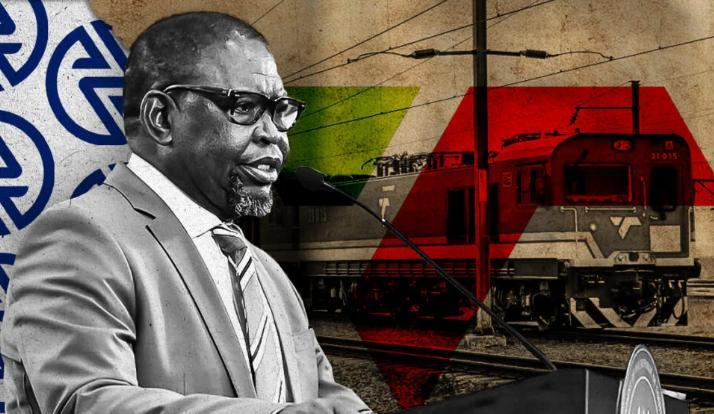
Africa-Press – South-Africa. Two of South Africa’s major state-owned enterprises (SOEs), Eskom and Transnet, are effectively being privatised through the back door as the government’s reform agenda sees private players taking on the roles of public companies.
These monopolies are steadily being broken through the implementation of the government’s reform agenda and the need to secure significant investment in key sectors of the economy.
South Africa’s SOEs are unable to conduct this investment as their balance sheets are extremely weak following a decade of excessive spending and financial mismanagement.
While the performance of both Eskom and Transnet has improved immensely, they are simply unable to invest the money required to ensure two of South Africa’s most important sectors operate efficiently.
Efficient Group chief economist Dawie Roodt explained that this is resulting in the “backdoor privatisation” of these companies.
Roodt’s comments come in response to President Cyril Ramaphosa’s 2026 State of the Nation Address (SONA), where a hard line was drawn on Eskom’s unbundling.
Ramaphosa made it clear that Eskom’s unbundling will proceed as planned, with a fully independent transmission systems operator set to be established.
This will result in a competitive electricity market in South Africa for the first time, with private players generating energy alongside Eskom.
“I am not 100% sure what is going on with the transmission company, because, as far as I understand, Eskom announced it will still be part of the utility, but the President said it would be a completely separate entity,” Roodt said.
“What seems to me is that the President is effectively privatising a lot of state assets, such as electricity generation and parts of the logistics sector.”
Roodt has described the process as the backdoor privatisation of SOEs, in which their monopolies are broken, and private companies outcompete them.
This results in private companies providing services once performed solely by the SOE, with the public company relegated to being a competitor like any other.
Ramaphosa has previously dismissed claims that the government was privatising SOEs. He said the government is initiating reforms to clean up its balance sheets and improve performance.
In the interim, private-sector investment is necessary to mobilise funds for economic infrastructure, given the state’s poor financial health.
The government has no other options
Stanlib chief economist Kevin Lings
South Africa’s government has run out of options in this regard, with public companies and the state no longer having the balance sheet to invest heavily in infrastructure.
This has forced the government’s hand to a degree in implementing its current reform agenda, with it desperately needing the private sector to invest in key sectors of the economy.
This was entirely avoidable, with the current reforms resulting from the financial collapse of SOEs and the state over the past decade.
Stanlib chief economist Kevin Lings explained that this does not mean the state will not play a substantial role in the local economy, with it being crucial to crowd-in private investment.
Lings also said the state cannot be completely replaced by the private sector in many cases. Rather, it simply can no longer be expansionary due to its financial deterioration.
This makes deregulation the only option for South Africa, with it being critically important to open up key sectors to private players.
“I would say that deregulation is your only option now. It is your only choice, and while you may not like it ideologically, it is your only option,” Lings said.
“You are out of options, and those options have been taken away because you took government debt from 26% to 76% of GDP. That increase meant you have taken away your option to use your own balance sheet.”
Lings said it would have been ideal for South Africa for the government to use its own balance sheet for infrastructure investment. However, this option is no longer available.
South Africa’s corporates are sitting on over R1.8 trillion in cash in the bank, which is effectively waiting on the sidelines to be deployed in the economy.
“We would have to up the investment considerably more to result in capacity building or job creation in South Africa,” Lings said.
“The current investment level is mainly maintenance capex and kind of treading water, with companies waiting for a better environment.”
“Instead of deploying capital into growth or hiring, corporates are parking it in money market funds or call accounts.”
For More News And Analysis About South-Africa Follow Africa-Press