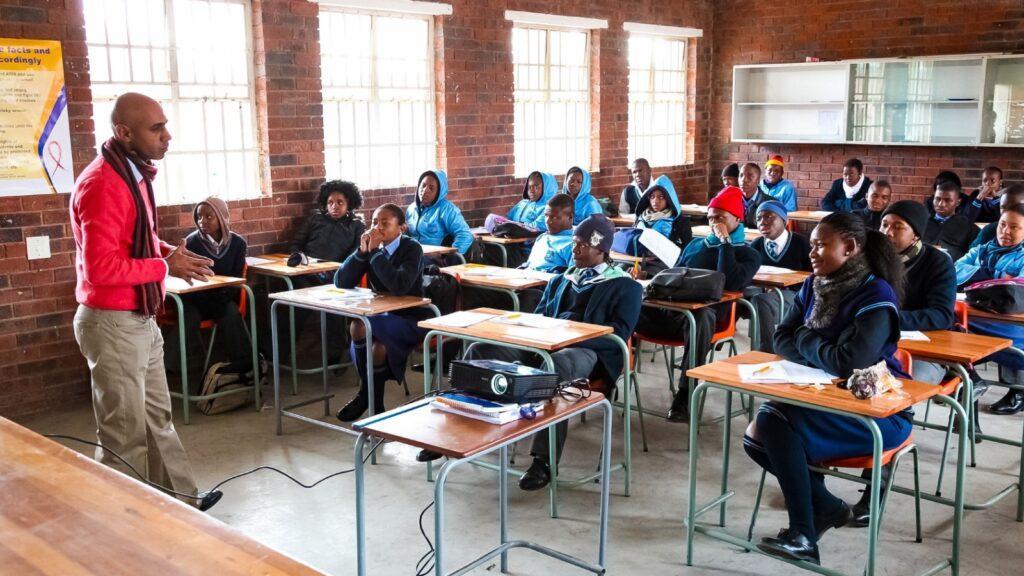
Africa-Press – South-Africa. The government has widely celebrated the fact that the number of pupils enrolling in public schools has risen by 222% over the past 25 years.
However, it often overlooks that over 60% of them reach matric and that less than half are eligible to attend university.
This has a significant negative impact on the South African economy, with workforce productivity stagnating and an increasing number of young people becoming unemployed and unemployable.
The effect is exacerbated by the mismatch between the skills produced by schools and universities and those demanded by the labour market.
This is despite South Africa’s education system absorbing the largest share of the government’s consolidated expenditure.
The Centre for Risk Analysis recently analysed the effectiveness of this spending, finding that increased resources did not lead to improved outcomes.
National Treasury data shows that spending on education will take up 23.2% of consolidated expenditure over the medium term.
This has not been a complete waste of resources, the CRA noted, as it has driven some positive outcomes over the past three decades.
The government has greatly increased access to education in South Africa, with Grade R enrolment rising by 222.4% over the past 25 years.
However, many pupils fail to reach Grade 12 when they are supposed to, with Department of Basic Education data showing that just 63% of Grade 1 pupils in 2014 reached matric in 2025.
“Low levels of retention suggest that the early childhood development stage gives inadequate preparation for pupils to progress to higher grades,” the CRA said.
The situation is even worse when considering how many pupils can access university after finishing matric. Among those who write their Grade 12 exams, just four in ten gain a university entrance pass.
Despite this low pass rate, the CRA said matric exams and, more broadly, high school education are not rigorous enough to prepare pupils for higher education, with many more dropping out in the first year of university.
The graph below shows the steady dropping out of pupils from Grade 1 onwards and the failure of most to attain a university entrance pass mark in Matric.
Source: CRA/Department of Basic Education
A whole generation wasted
Despite the government’s focus on education, particularly the need for South Africans skilled in maths and science, outcomes in these subjects have deteriorated sharply.
The CRA noted that only 1.9% of maths and science students achieved distinctions in either subject in 2025, with less than half achieving a pass mark.
Reasons for this are many, including the quality of teachers, limited access to textbooks and equipment, and a push from schools to boost pass rates.
Former Finance Minister Trevor Manuel pointed to a different reason, explaining that the government’s push to increase access to education came at the expense of quality.
Manuel explained that the government focused intently on getting pupils into school and neglected the quality of the education they were receiving and its usefulness.
“Part of our problem as South Africa is that we have not sufficiently considered what the transformation of education is about,” Manuel said.
This is a function of South Africa’s past, which the ANC government has failed to address, as the two-tier education system remains prevalent.
Manuel explained that there is still a significant drop-off in educational quality from private and former Model C schools to the rest of the public schools in the country.
Instead of improving the quality of the rest of the public schools to match that of the private and Model C schools, the government focused on getting pupils in the classroom.
“It is a huge achievement that 80% of school children in South Africa are at no-fee schools. But no fees frequently also means no maths, no science, and no discipline,” Manuel said.
“And so this notion of transforming the education system is a curious thing that we have not been able to master in South Africa.”
Manuel said the failure to transform South Africa’s education system has left the majority of the country facing the same problems it faced 60 years ago.
“Bantu education was built in the 1950s without mathematics. That was in 1953, and in 2025, the mathematics is still not there,” Manuel said.
“You have taken quantitative skills out of a generation of learners and successive generations of teachers, and so it is still not there.”
For More News And Analysis About South-Africa Follow Africa-Press