
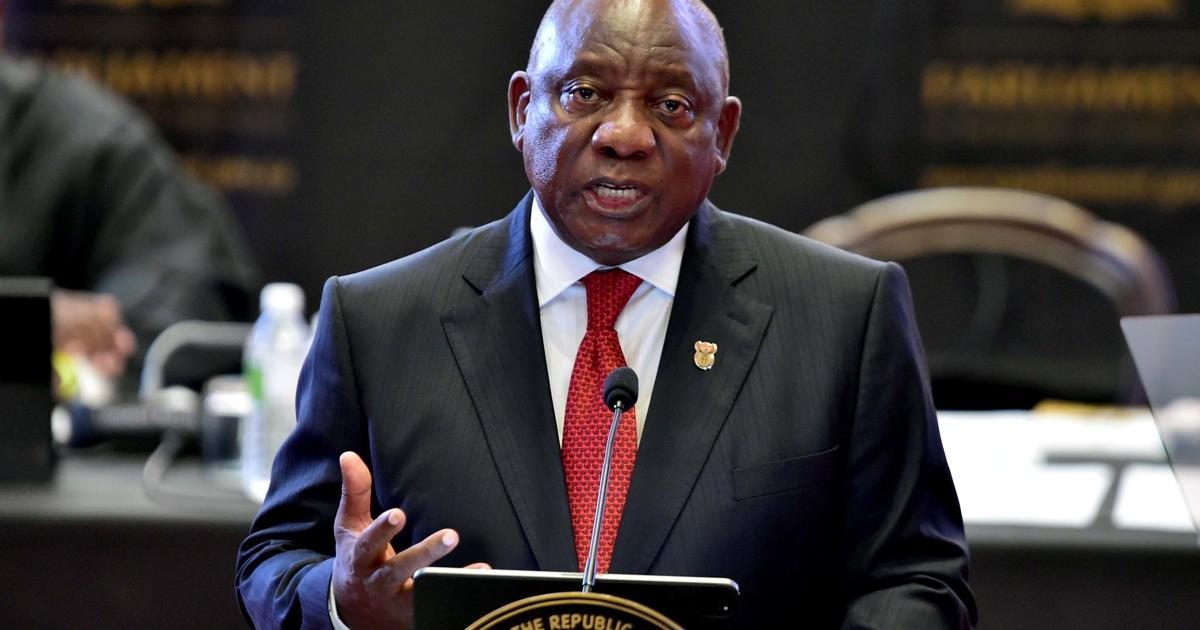
President Cyril Ramaphosa’s decision to take the Section 89 (removal of the President) independent report that was tabled in Parliament in 2022 under judicial review has put him in a dicey situation. This, after the Constitutional Court (ConCourt) recently ruled that Parliament’s failure to adopt the report, which found Ramaphosa could have violated his oath of office and the Prevention and Combating of Corrupt Activities Act was “unconstitutional” and “invalid”. This speaks to the theft of US$580,000 in cash from Ramaphosa’s Phala Phala farm in Limpopo, in February 2020, shortly before the COVID-19 lockdown.
Speaking during televised address to the nation this week, the president said: “I was advised by my legal team that the panel report was capable of being reviewed by a court of law on several grounds, including the misconception of its mandate, grave errors of law and unfounded conclusions of fact,” adding that he would not resign after calls for him to do so grew loud. His announcement came as Parliament plans to form an impeachment committee to investigate the Section 89 report. ConCourt Chief Justice Mandisa Maya delivered the landmark judgment on 8 May 2026. She said: “It is declared that the vote of the National Assembly taken on 13 December 2022, declining to refer the report to the independent panel to an impeachment committee as envisaged in the NA [National Assembly] rules, is inconsistent with the Constitution, invalid and it is set aside…” RAMAPHOSA IS ‘GOING TO HAVE PROBLEMS’ Political analyst Sandile Swane said that “Ramaphosa has got an opportunity to raise the objections about the Section 89 panel report. “So, his rights are protected, but there is no mechanism left for him to delay the actual impeachment process,” he said, adding that Ramaphosa also can’t “dodge” it either. “Once the evidence of the report is clear, it is used to push for a motion of no confidence,” explained Swana.
He further added that Ramaphosa has a “serious legal problem” regarding the US$580,000 in cash stole from his farm in Phala Phala. Swana cited laws pertaining to the South African Revenue Service (SARS), South African Reserve Bank (SARB) and the Financial Intelligence Centre Act (FICA) regarding the handling of foreign currency. “He is going to have problems…This is going to damage the brand of the ANC [African National Congress]. We must state categorically that the ANC has been losing total support in every election since 2009,” Swana said. Ramaphosa has since maintained his innocence regarding the Phala Phala scandal. “Since a criminal complaint was laid against me in June 2022, I have consistently maintained that I have not stolen public money, committed any crime nor violated my oath of office,” the first citizen said. Meanwhile, political analyst Dr Levy Ndou said the ConCourt judgement on the Section 89 report is lucid. “It [the judgement] clearly sets out the processes that should have happened. The ConCourt is assisting Parliament. “In the context of the separation of powers, the ConCourt has taken the matter back to Parliament.
Parliament can still say the committee that was established did not do adequate work.” Ndou added that MPs rushed to vote “So, they [ConCourt] are saying, if indeed you feel that you should not have rights to vote, you should have followed due processes. “Go and follow processes because you decided to vote on the adoption of the report, which you should not have done. So, what you must do, go and follow due processes of Parliament and then make a determination,” he explained. “Remember, nobody has said Ramaphosa is guilty, that’s number one. Number two, Parliament has never made a ruling whether Ramaphosa should be impeached or not.” The Economic Freedom Fighters (EFF) and the African Transformation Movement (ATM) challenged the Phala Phala matter in the Constitutional Court, and after more than a year, the apex court ruled in favour of the parties. RAMAPHOSA CAN RESIGN AT ANY TIME Constitutional expert Pierre de Vos noted that Ramaphosa can take the Section 89 report on review or resign. “The president can resign at any time. He is not bound now because there is an impeachment procedure going…If he does [resign], he stops being the president and the impeachment proceedings obviously stop.”
He added that if Ramaphosa resigns, “Parliament, the National Assembly, has 30 days to elect a new president from among its own members. So, it must be someone who is already an MP [member of Parliament]. It can be anybody, all that is needed is that a majority of the votes cast must be for the candidate.” HOW A PRESIDENT IS REMOVED FROM OFFICE IN SA Section 89 of the Constitution provides for the National Assembly to remove a President of the Republic from office on the following grounds: – serious violation of the Constitution or the law – serious misconduct – inability to perform the functions of office Resignation and death are other ways in which a president loses power. The panel, which the Speaker appoints after consulting political parties represented in the National Assembly, must assess if there is sufficient evidence for Parliament to proceed with a Section 89 inquiry. The panel must function impartially and without fear, favour or prejudice.Get the whole picture