Africa-Press – South-Sudan. A walk through the domestic travel section of Juba International Airport will show you a picture of busy airspace with flights to various parts of South Sudan. The lines that snake from the ticketing agents at the departure section paint a picture of a country that heavily consumes air transport locally. However, it is contingent on circumstances that inform travelers of their limited options.
Fazed by insecurity and poor roads, South Sudanese are only left with air transport to reach some of the remote places scattered in the far corners of the country.
But the woes do not end on the surface of the earth. The country’s aviation sector has been noting frequent crashes—deadly and minor—that, if left unabated, could define the airspace as an “airborne graveyard.”
In 2015, for example, more than 40 people were killed when a plane crashed shortly after taking off from Juba International Airport (JIA). Only two people survived the accident.
The track record has not changed much in the following years. Just like in the years before 2015, planes of different types and sizes continued to crash with little to no action taken to get to the root of the problem.
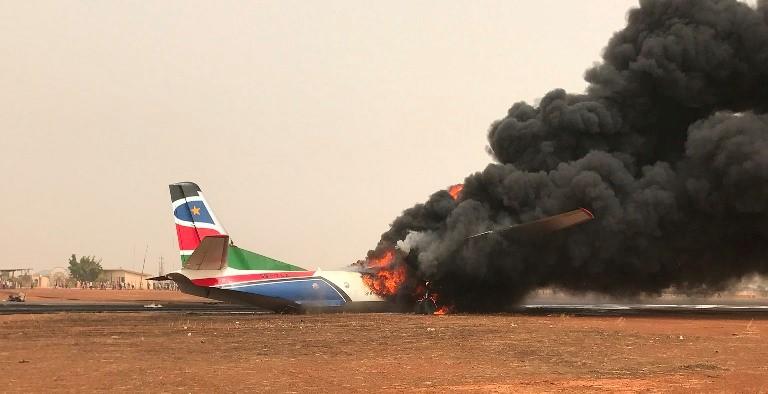
Barely two months into the New Year, there have already been two plane crashes, with at least one life lost in the second accident, which occurred in Ulang County, Upper Nile State, at the beginning of February.
The first crash occurred on January 27, when a light cargo plane suddenly nosedived a few minutes after departing Juba International Airport (JIA). The passengers of this ill-fated craft survived this accident.
“They are not maintaining standards of aviation safety, they tend to undermine standards of aviation, and those compromises are a result of corruption. Airline companies are bribing individuals within the government to violate some safety requirements. “So, the companies feel more powerful than the authorities,” said activist Edmund Yakani.
Yakani says government failure to strictly impose safety requirements has allowed airline companies to do as they please.
He says had there been a proper inquiry into past crashes, authorities would have identified acts of negligence and punished airline operators.
“Secondly, there is no accountability, aviation companies have not been held accountable for past accidents like the one in Pieri, in Jonglei State, that took many lives two to three years ago,” Yakani laments.
“Some of these companies should be suspended, and supervision should be tightened so that all companies comply with safety standards,” the outspoken activist says.
According to a report compiled by 211Check, a fact-checking platform based in Juba, up to 87 people perished while attempting a flight in 36 plane crashes across the country between 2011 and 2021.
The platform quoted data from the Aviation Safety Network, which stated that Juba City in Central Equatoria State and Wau in Western Bahr el Ghazal State had recorded the highest number of incidents in the same period.
The aviation regulator, the South Sudan Civil Aviation Authority (SSCAA), admits there have been difficulties enforcing the safety standards due to interference from unnamed government bodies.
John David Subek, the Chief Executive Officer of the Civil Aviation Authority, says his officers sometimes get intimidated while trying to ensure all standards are met during operations.
“If you can see Boeing planes today, they were manufactured a long time ago, but they continue to be used because they are well maintained, but our people here take things very lightly; they don’t care much,” Subek says, blaming operators and government organs for the negligence.
“Our work is being sabotaged a lot. Let me say that airline companies are extremely intimidating…”You are not allowed to operate with confidence, you are not allowed to apply your knowledge.”
He stresses that the law establishing the institution was now under review and hopes the instrument would empower aviation to carry out its work more independently and efficiently.
“Unless we South Sudanese respect our laws, we will never go ahead and continue losing our people this way,” Subek says.
Following a deadly crash in 2021, the Civil Aviation Authority ordered several Antonov aircraft to leave the country within one week.
“The identified aircraft are ordered to leave South Sudan for their state of the registry within one week from the date of submission of this report,” wrote the institution following a recommendation by the Safety Oversight Committee, a body charged with enforcing safety standards.
President Salva Kiir also suspended South Supreme Airline after one of its planes crashed in Jonglei State, killing all 10 passengers on board.
The government has also grounded all Antonov 26 planes after the type was involved in frequent crashes across the country.
For More News And Analysis About South-Sudan Follow Africa-Press